


}}
}}
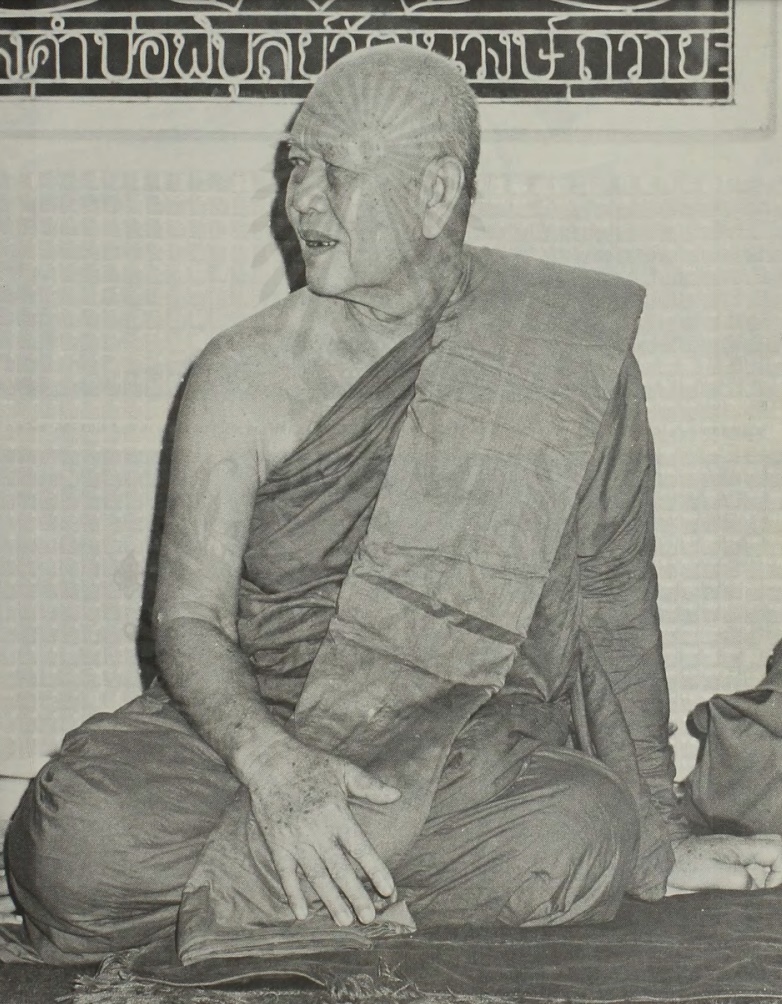
”’Luang Pu Fan Ajaro”’ (Thai: หลวงปู่ฝั้น อาจาโร) was a revered [[thera|elder monk]] in the [[Thai Forest Tradition]].<ref name=”Fun1978″>{{cite book |author=Fun’s Funeral Committee |title=Memorial Book of Phra Ajahn Fan Ajaro |url=https://ia800209.us.archive.org/7/items/unset0000unse_v5e0/unset0000unse_v5e0.pdf |location=Bangkok |publisher=Chuan Printing |year=1978 |pages=690}}</ref>
”’Luang Pu Fan Ajaro”’ (Thai: หลวงปู่ฝั้น อาจาโร) was a revered elder monk in the [[Thai Forest Tradition]].<ref name=”Fun1978″>{{cite book |author=Fun’s Funeral Committee |title=Memorial Book of Phra Ajahn Fan Ajaro |url=https://ia800209.us.archive.org/7/items/unset0000unse_v5e0/unset0000unse_v5e0.pdf |location=Bangkok |publisher=Chuan Printing |year=1978 |pages=690}}</ref>
== Biography ==
== Biography ==
Thai Buddhist Monk (1899-1977)
Luang Pu Fan Ajaro (Thai: หลวงปู่ฝั้น อาจาโร) was a revered elder monk in the Thai Forest Tradition.[1]
Biography
Early life
He was born on Sunday, the 14th waxing moon of the 9th lunar month, Year of the Pig, corresponding to August 20, 1899, in Ban Muang Khai, Phanna Subdistrict, Phanna Nikhom District, Sakon Nakhon Province.[1] He was the fifth child of Chao Chai Kumar (Mao) of the “Suwannarong” family, the former ruler of Phanna Nikhom. His mother’s name was Nui. As a youth, Phra Ajahn Fan was well-behaved, generous, diligent, and resilient, helping his parents with work without complaint.[1]
Education
He attended primary school at Wat Pho Chai in Ban Muang Khai, and later studied under his brother-in-law, who was an assistant district officer in Khon Kaen Province.[1] At first, he intended to pursue government service, but seeing the impermanence of worldly rank and honor, he changed his mind and was ordained as a novice monk at Wat Phon Thong, Ban Ba Thong, a Mahanikaya temple.[1] In 1920, he became a disciple of Ajahn Mun[2] and on May 21, 1925, he reordained into the Dhammayuttika Nikaya at Wat Bodhisomphon, Udon Thani, with Phra Thammachedi (Chum Phanthulo) as preceptor.[1]
Ordination
At age 20, he was fully ordained as a bhikkhu at Wat Sitthibankhom, Rai Subdistrict, Phanna Nikhom District, Sakon Nakhon Province, with Phra Khru Pong as his preceptor and meditation teacher.[1] After his first rains retreat, he returned to Wat Phon Thong under Phra Khru Sakol Samana Kit, who led him on dhutanga wanderings and meditation practice.[1] During his life as a monk, Luang Pu Fan traveled widely, spreading the Dhamma and gaining the deep respect of many laypeople. He came to be regarded as an ariya sangha (noble monk).[1] Among his prominent disciples were Ajaan Suwat Suvaco, and Somdet Phra Ariyavongsagatayana (Amphon Amparo).[1]
Passing
On January 4, 1977, he died at Wat Pa Udom Somphon at the age of 77, after 58 rains retreats.[1] King Bhumibol Adulyadej and Queen Sirikit attended his funeral rites and offered a royal golden coffin.[1] On January 21, 1978, his cremation was held with royal sponsorship. At the cremation site, the 27.9 meter-high Luang Pu Fan Ajaro Memorial Chedi was constructed, lotus-shaped and decorated with tiles depicting various monks. Inside stands a life-sized statue of Luang Pu Fan with a staff, along with his preserved monastic requisites.[1]
Teachings

He taught:
“Everyone must one day enter the great battle with Death. At that moment each must fight alone. Those who fight well will go to good destinations, those who are defeated will go to bad ones. The only weapon is mindfulness (sati), developed through meditation.”[3]
He emphasized that merit (puñña) is cultivated through the perfections of generosity, morality, and meditation:
- “Generosity means letting go. The more one relinquishes, the greater the benefit. Clinging and stinginess are greed; they must be abandoned. Generosity is our provisions for the long journey of saṃsāra.”*[1]
On morality, he said:
- “Morality is not something given by monks. The five precepts are already within us: two arms, two legs, and one head — this is the complete five precepts. To maintain them is to guard body, speech, and mind. Wherever we are, if we abstain from killing, stealing, sexual misconduct, lying, and intoxication, then we have morality.”*[1]
Disciples
- Ajaan Suwat Suvaco – Wat Pa Khao Noi, Buriram province
- Phra Ratchamongkolnayok (Khamdee Panyobhaso) – Wat Pa Sutthawat, Sakon Nakhon province
- Phra Thepsangwornyan (Phuang Sukhindhriyo) – Wat Si Thammararam, Yasothon province
- Somdet Phra Ariyavongsagatayana (Amphon Amparo) – Wat Ratchabophit, Bangkok
- Phra Thepmongkolwatcharacharn (Luang Pu Luang Chandāgamo) – Wat Kradueng Thong, Buriram province
- Phra Khru Udom Thammasunthorn (Plang Suntaro) – Wat Pa Udom Somphon, Sakon Nakhon province
- Luang Pu Suang Siripunyo – Wat Pa Sithan Nai, Yasothon province
- Phra Yan Sittacharn (Thongphun Sirikāmo) – Wat Samakkhi Uppatham, Bueng Kan province
- Phra Khru Suwimonbuniyakorn (Boonpin Katapunyo) – Wat Phathep Nimit, Sakon Nakhon province
- Luang Pu Khiam Sorayo – Wat Pa Tham Kham, Sakon Nakhon province
- Phra Ratchawachirayan Sophon (Uthai Siritharo) – Wat Khao Yai Chaiyantaram, Nakhon Ratchasima province
- Luang Pu Sathian Kunavaro – Wat Tham Phu Wua, Bueng Kan province
- Luang Pu Thongkham Kanchanavano – Wat Tham Bucha, Bueng Kan province
- Phra Khru Wimon Pawanakun (Khun Sumedho) – Wat Pa Phu Thong, Udon Thani province
- Phra Khru Bodhithammaprapas (Chuean Paphassaro) – Wat Pracha Santi, Phang Nga province
- Ajahn Sutthum Sudhammo – Wat Pa Nong Phai, Sakon Nakhon province
- Phra Thep Watcharayanweti (Somboon Kantaseelo) – Wat Pa Sombun Tham, Phitsanulok province
- Phra Khru Watcharathammacharn (Jirawat Attarakko) – Wat Pa Chai Chumphon, Phetchabun province
- Phra Khru Phawana Sutthacharn (Sakorn Thammāvuttho) – Wat Veluwan, Thong Pha Phum District, Kanchanaburi province
- Luang Pu Narong Ajaro – Wat Pa Kok Sathon, Udon Thani province
- Luang Pu Khlat Khrudhammo – Wat Pa Ban Mai, Udon Thani province
- Luang Pu Somkhit Payo Chitto – Wat Pa Phu Wai, Ratchaburi province



