


From Wikipedia, the free encyclopedia
Species of fungus
Macropsalliota americana, commonly known as the American parasol,[2] is the type species of the fungus genus Macropsalliota. It was formerly known as Leucoagaricus americanus. It is widely distributed in North America, mostly east of the Rocky Mountains. It is saprobic and grows on sawdust, wood chips, stumps, and the ground.
The species was first described as Agaricus americanus by the American mycologist Charles Horton Peck in 1872[3] and then reclassified as Lepiota americana in 1887 by the Italian mycologist Pier Andrea Saccardo.[4]
In 1979 it was reclassified as a Leucocoprinus americanus by the Canadian mycologist Scott A. Redhead[5] and then as Leucoagaricus americanus by the mycologist Else Vellinga in 2000.[6]
In 2024 the species was reclassified as Macropsalliota americana by the Chinese mycologists Kun L. Yang, Jia Y. Lin & Zhu L. Yang and became the type species of the newly created Macropsalliota genus.[7]
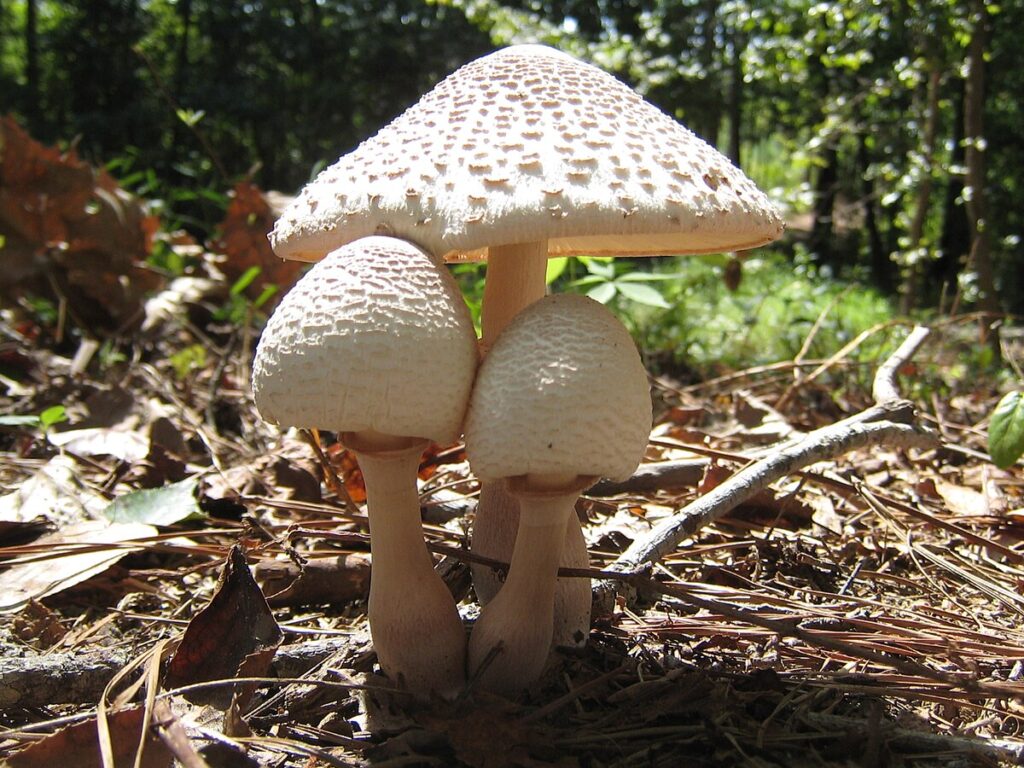
The cap is oval in shape when immature, becoming convex to flat when fully grown, reaching up to 3–15 centimetres (1+1⁄4–6 in) wide.[8] The cap feels dry and smooth at the beginning, but gradually gets reddish to reddish brown scales. It is white in color but reddens with maturity or after being handled.[9] The gills are free from the stipe and lie close together. They appear white when young and are stained pinkish to maroon. The stipe is 7–14 cm long, often enlarged at or below the middle and tapering toward the base. It appears white at first, staining or aging pink or reddish brown. It feels smooth with its silky hairs. The membranous veil leaves a white double edged ring on the upper stipe that may disappear in age.[10]
The spores are white to cream in color and measure 8–10 x 6–7.5 μm.[1] The flesh is white throughout. It bruises yellow to orange when young but dries reddish when mature. The flesh is thick and discolors when cut, bruised or damaged.[10]
It is reported to be edible, but not recommended for consumption because of possible confusion with toxic species like Chlorophyllum molybdites.[10]
Distribution and habitat
[edit]
It is widely distributed in its native North America,[10] though more common east of the Rocky Mountains; it is saprobic, and grows on sawdust, on wood chips, on stumps, and on the ground.[9]
- ^ a b Wood, Michael; Fred Stevens. “California Fungi—Leucoagaricus americanus“. Mykoweb. California Fungi.
- ^ Arora, David (1986) [1979]. Mushrooms Demystified: A Comprehensive Guide to the Fleshy Fungi (2nd ed.). Berkeley, CA: Ten Speed Press. p. 301. ISBN 978-0-89815-170-1.
- ^ Peck, Charles Horton (1870). “Report of the Botanist”. Annual Report of the Regents of the University on the condition of the State Cabinet of Natural History, with catalogues of the same. 23: 71 – via biodiversitylibrary.org.
- ^ Saccardo, P. A. (1887). Sylloge fungorum omnium hucusque cognitorum. Vol. v.5 (1887). Patavii. p. 43.
{{cite book}}: CS1 maint: location missing publisher (link) - ^ Groves, J. Walton; Groves, J. Walton (1979). Edible and poisonous mushrooms of Canada (Rev. ed.). Ottawa: Research Branch, Agriculture Canada. ISBN 978-0-660-10136-1.
- ^ Vellinga, Else C. (December 2000). “Notes on Lepiota and Leucoagaricus”. Mycotaxon. 76: 433 – via biodiversitylibrary.org.
- ^ YANG, KUN L.; LIN, JIA Y.; LI, GUANG-MEI; LI, TAIHUI; YANG, ZHU L. (2024-12-11). “Rediscovering Leucoagaricus sinicus, with the recognition of Leucoagaricus and Leucocoprinus as separate genera, and two new genera in Agaricaceae (Basidiomycota)”. Phytotaxa. 676 (3): 199–255. doi:10.11646/phytotaxa.676.3.1. ISSN 1179-3163.
- ^ Audubon (2023). Mushrooms of North America. Knopf. p. 567. ISBN 978-0-593-31998-7.
- ^ a b Kuo, M. (2005, October). Leucoagaricus americanus. Retrieved from the MushroomExpert.Com Web site: http://www.mushroomexpert.com/leucoagaricus_americanus.html
- ^ a b c d Rogers Mushrooms. “Leucoagaricus americanus”. Archived from the original on 2011-11-09.




