


* [https://drdilipkumarkalitafoundation.com/wp-content/uploads/2023/09/Praagya-Dhara.pdf Praagya Dhara – Collection of Māre-geet]
* [https://drdilipkumarkalitafoundation.com/wp-content/uploads/2023/09/Praagya-Dhara.pdf Praagya Dhara – Collection of Māre-geet]
* [https://www.wisdomlib.org/hinduism/essay/puppetry-in-assam/d/doc1085347.html Wisdomlib: Puppetry in Assam (mentioning Māre-gan)]
* [https://www.wisdomlib.org/hinduism/essay/puppetry-in-assam/d/doc1085347.html Wisdomlib: Puppetry in Assam (mentioning Māre-gan)]
[[Category:Folk dances of Assam]]
[[Category:Culture of Assam]]
| Mare-Gan | |
|---|---|
| Etymology | Songs dedicated to Mare (Manasa) |
| Other names | Mare Geet, Mareguwa Ojapali |
| Typical instruments | Dhol, khol, toka |
| Derivative forms | Ojapali, Deodhani dance |

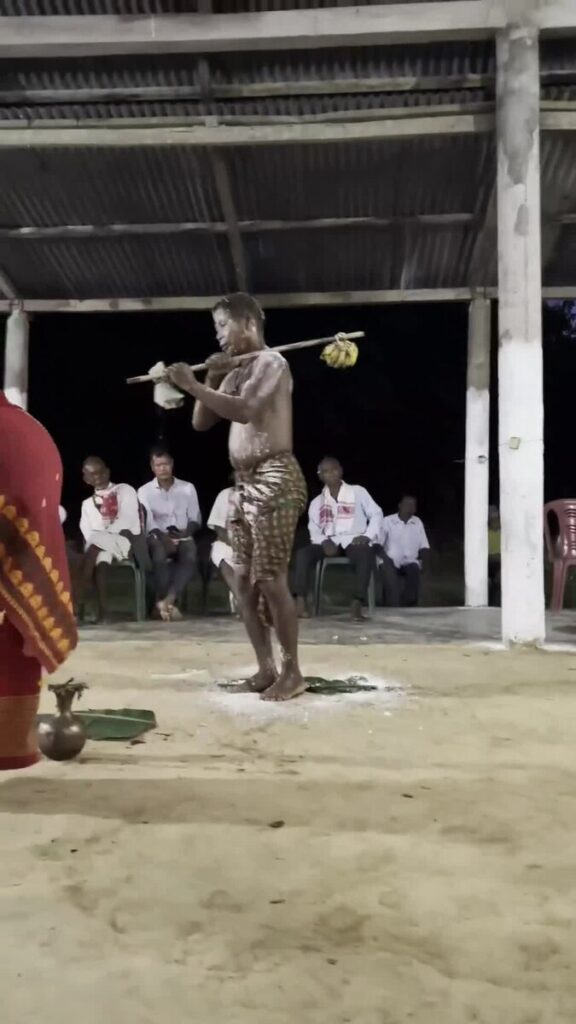
Mare-Gan also known as Mare Geet or Mareguwa Ojapali[1] is a traditional epic singing tradition of the Pati Rabha community of Assam, India. The performance is associated with the worship of the serpent goddess Manasa, also known as Vishahari or Mare Devi, and constitutes an important element of the Rabha community’s magico-religious and cultural practices.[2]
The term Mare refers to the local name of the serpent goddess Manasa (Mare Devi), while Gan means “song”. Thus, Mare-Gan literally signifies “song dedicated to Mare (Manasa)”.[2]
Geographical distribution
[edit]
Mare-Gan is primarily observed among the Pati Rabha community residing in the districts of Goalpara, Kamrup, and Darrang in lower Assam. The tradition forms part of both domestic rituals and community festivals such as Mare Puja or Maroi Puja.[3]
The performance of Mare-Gan constitutes a central component of Mare Puja, a fertility and protective ritual dedicated to the serpent goddess. The ceremony is conducted to seek divine protection from illness, crop failure, and other misfortunes.[3]
During the ritual, a clay effigy known as Maju is crafted and worshipped as the symbolic representation of the goddess.[2]
Mare-Gan is presented as a narrative singing performance led by a principal singer (oja), accompanied by supporting performers. The repertoire includes mythological narratives, accounts of the goddess’s origins, and songs conveying ethical and social teachings. Traditional instruments such as dhol, khols, tals, and bamboo flutes are commonly used. The linguistic register of the performance reflects a blend of the Rabha language and Assamese, indicative of the region’s cultural interactions.[4]
Cultural significance
[edit]
The tradition serves both religious and cultural functions. It preserves the oral literature, folklore, and collective identity of the Pati Rabha community while fostering social cohesion and intergenerational transmission of indigenous knowledge.[2]
Mare-Gan has been recognised by the Sangeet Natak Akademi as an important component of India’s intangible cultural heritage.[2] Various initiatives have been undertaken to document and safeguard the tradition. Projects such as the Blueprint for the Preservation of Mare-Gan (2024) aim to support its continued practice and transmission.[2]



