


{{About|the counter-drone system|other uses|Merops}}
{{About|the counter-drone system|other uses|Merops}}
{{Orphan|date=November 2025}}
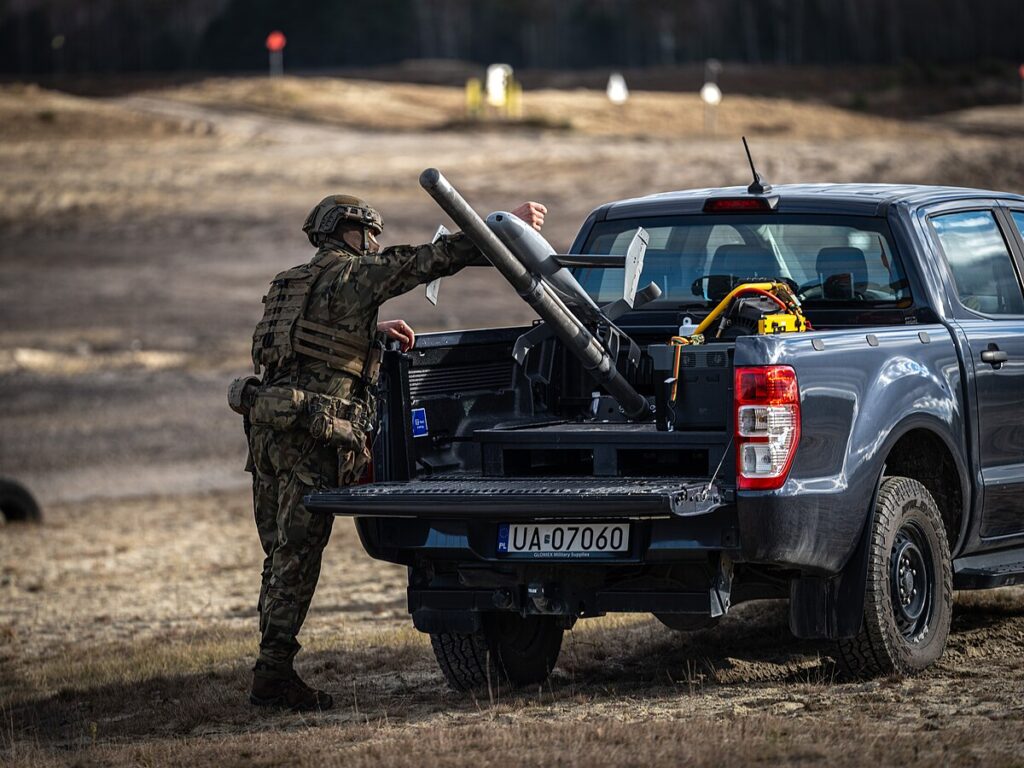
[[File:Polish soldier prepares to launch a Surveyor interceptor from the Merops system.jpg|thumb|A Polish soldier prepares to launch a Surveyor interceptor from the Merops system during a training exercise in Nowa Deba Training Area, Poland, on November 18, 2025.]]
[[File:Polish soldier prepares to launch a Surveyor interceptor from the Merops system.jpg|thumb|A Polish soldier prepares to launch a Surveyor interceptor from the Merops system during a training exercise in Nowa Deba Training Area, Poland, on November 18, 2025.]]
[[File:Polish soldier moves a Surveyor interceptor of the Merops system.jpg|thumb|A Polish soldier moves a Surveyor interceptor drone, part of the U.S. Merops counter-drone system, during a training exercise on November 15, 2025.]]
[[File:Polish soldier moves a Surveyor interceptor of the Merops system.jpg|thumb|A Polish soldier moves a Surveyor interceptor drone, part of the U.S. Merops counter-drone system, during a training exercise on November 15, 2025.]]


Merops is a system for countering enemy unmanned aerial systems, or drones. It is being developed by the California-based Project Eagle, a venture of former Google CEO Eric Schmidt.
The Merops system consists of radar and electro-optical sensors, controller gear, and a drone launcher. The sensors detect and locate incoming drones, then pass targeting data to the interceptor or to other friendly systems.[1]
Small enough to fit in the bed of a pickup truck, Merops launches a three-foot, fixed-wing, propellor-driven interceptor drone called “Surveyor” that flies at speeds up to 175 mph. The $15,000 interceptor can be controlled by a human operator or, when satellite and radio links are jammed or unavailable, autonomously home into its target using artificial intelligence and thermal, radio-frequency, or radar sensors. It can ram its target or carry a small warhead.[1][2] If it misses its target, the interceptor can pop a parachute to return to earth for reuse.[2]
It is operated by a four-person crew: commander, pilot, and two technicians. It is designed for ease of use; training takes just two weeks.[2]
The Merops system is designed for short-range defense[3] against larger drones, like Iranian-designed, Russian-made Shaheds.[2]
The Merops system was first deployed by Ukrainian forces. As of November 2025, it had reportedly been used to destroy more than 1,900 incoming Russian drones during Russia’s invasion of Ukraine. It accounted for some 40% of downed Shaheds, U.S. Army Brigadier General Curtis King, the commanding general of the 10th Army Air and Missile Defense Command, told reporters.[2]
As of November 2025, Merops is deployed by the Polish and Romanian militaries along their borders with Russia. Denmark has also declared its intent to acquire Merops.[1]
In November 2025, Brig. Gen. Thomas Lowin, deputy chief of staff operations at NATO Allied Land Command, described NATO members’ deployment of Merops as the “first phase” of a two- to five-year effort to build defenses to deter a Russian invasion.
The development of Merops is intended to give the U.S. military and its allies a more cost-effective means of destroying enemy drones than existing interceptor missiles.[1]
The effort was funded in part by Eric Schmidt, the decabillionaire former CEO of Google[1], as part of the Project Eagle (né White Stork) initiative.[2][4] Schmidt launched White Stork in 2023 to develop AI-enabled drones. Initial hires included at least a dozen employees from Apple, SpaceX, Google, federal government agencies, and Schmidt Futures. Others included former Pentagon innovation chief Will Roper. In February, the company was renamed Project Eagle. By 2024, initial products were being tested at Hillspire, the headquarters of Schmidt’s family ventures in Menlo Park, California; and in Ukraine.[5]



