
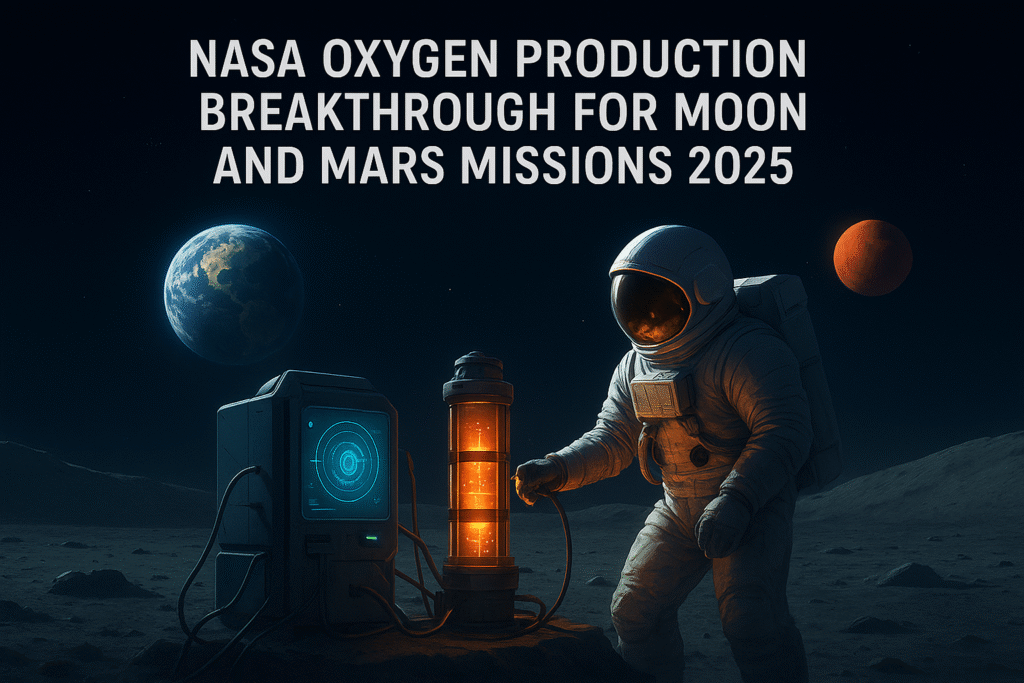
NASA Oxygen Production
Humanity’s dream of living beyond Earth has always faced one major challenge—sustaining life in space. Oxygen, the most essential element for human survival, is incredibly difficult and expensive to transport from Earth to the Moon or Mars. In 2025, NASA scientists announced a revolutionary breakthrough: a lightweight, energy-efficient method to produce oxygen directly in space. This innovation could change the future of lunar and Martian exploration forever.
This article explores NASA’s new technology, how it works, why it matters, and what it means for future space missions.
Why NASA Oxygen Production Is Critical for Space Missions
1. The High Cost of Oxygen Transport
Every kilogram of oxygen sent to space costs thousands of dollars. Transporting large volumes of oxygen for astronauts, rockets, and future colonies is not sustainable.
2. Human Survival
Astronauts need oxygen not only for breathing but also for fuel, water recycling, and creating a safe habitat. Without local oxygen production, permanent Moon or Mars bases would be nearly impossible.
3. The Goal of Long-Term Colonization
NASA’s Artemis program (Moon) and future Mars missions aim to establish human presence. Sustainable oxygen production is a key step toward making this possible.
The Breakthrough: Magnetic Separation Technology
Traditionally, space researchers used centrifuges to separate elements in space. However, centrifuges are heavy, energy-consuming, and unsuitable for long-term missions.
NASA’s new method uses magnetic separation—a simple yet powerful technique. This method exploits the different magnetic properties of oxygen and other elements in lunar or Martian soil. By applying magnetic fields, scientists can separate oxygen-rich particles without bulky equipment.
Advantages of this method include:
- Light and portable equipment
- Minimal energy consumption
- Works in microgravity conditions
- Adaptable to Moon and Mars environments
This discovery has been described as a game-changer for space exploration.
How NASA Oxygen Production Works on the Moon and Mars
- Lunar Soil (Regolith): The Moon’s surface contains metal oxides rich in oxygen. By extracting these oxides and applying magnetic separation, oxygen can be released.
- Martian Atmosphere: Mars has a thin atmosphere of carbon dioxide. Technologies like MOXIE (Mars Oxygen In-Situ Resource Utilization Experiment) already demonstrated that oxygen can be extracted from CO₂. NASA’s new breakthrough could make this process more efficient.
- Closed-Loop Systems: Future bases could recycle and reuse oxygen, reducing waste and reliance on Earth supplies.
Impact on Space Exploration
1. Lower Mission Costs
If astronauts can generate oxygen on the Moon or Mars, NASA will save billions in launch and transportation costs.
2. Longer Human Presence
This innovation allows astronauts to stay longer, build bases, and conduct deeper scientific research.
3. Fuel Production
Oxygen is a critical component of rocket fuel. Producing it locally means future rockets could refuel on the Moon or Mars, making interplanetary travel more efficient.
4. Opening the Path to Colonization
This breakthrough moves humanity one step closer to colonizing Mars and making the dream of a multi-planetary civilization a reality.
Challenges Ahead
Despite the breakthrough, several challenges remain:
- Scaling up oxygen production to support full crews
- Testing the technology in real lunar and Martian conditions
- Ensuring safety and reliability for long-term missions
NASA plans to run pilot tests in upcoming Artemis missions before applying it to Mars exploration.
The Bigger Picture: Space Technology in 2025
NASA’s oxygen breakthrough is part of a larger wave of innovations in space technology. From quantum computing for space data, AI-driven exploration, to nuclear-powered spacecraft, 2025 is shaping up as a defining year for human spaceflight.
This discovery also aligns with global space ambitions:
- China and India are expanding their Moon missions.
- SpaceX and Blue Origin aim to develop commercial space colonies.
- The European Space Agency (ESA) is researching lunar bases.
All of these efforts depend on solving the oxygen challenge—and NASA may have just found the answer.
FAQs About NASA’s Oxygen Breakthrough
1. How does NASA’s new oxygen production method work?
It uses magnetic separation technology to extract oxygen from lunar soil and Martian resources, replacing heavy centrifuges with lightweight, efficient tools.
2. Why is NASA oxygen production in space important?
Oxygen is needed for breathing, fuel, and habitat life support. Without producing oxygen locally, colonization of the Moon or Mars would not be possible.
3. Has NASA tested this technology in space yet?
So far, it has been tested in laboratories on Earth. The first in-space tests are expected in upcoming Artemis missions.
4. Could this help future Mars colonies?
Yes. Mars has CO₂-rich air, and with this technology, oxygen can be extracted efficiently for long-term colonization.
5. Is this only for NASA, or will private companies benefit too?
Private companies like SpaceX, Blue Origin, and international agencies could also use this breakthrough for sustainable missions.
Conclusion
NASA’s oxygen production breakthrough in 2025 marks a historic step toward permanent human settlements on the Moon and Mars. By using magnetic separation instead of heavy centrifuges, this innovation reduces costs, increases efficiency, and makes the dream of interplanetary living closer to reality.
From supporting astronauts’ survival to enabling rocket refueling on extraterrestrial surfaces, oxygen production is the foundation of space colonization. With this discovery, the vision of a multi-planetary civilization is no longer science fiction—it’s becoming science fact.
Related : Writozy

