


Characteristics
| ← Previous revision | Revision as of 05:29, 22 October 2025 | ||
| Line 33: | Line 33: | ||
|
== Characteristics ==
|
== Characteristics ==
|
||
|
Popl
|
|||
|
NGC 5907 has an anomalously low [[metallicity]] and few detectable [[giant stars]], being apparently composed almost entirely of [[dwarf star]]s.<ref>{{cite journal| bibcode=1998AAS…193.0807L| title= Weighing the Stellar Content of NGC 5907’s Dark Matter Halo| last=Liu| first= M. C.|author2=Marleau, F. R. |author3=Graham, J. R. |author4=Charlot, S. |author5=Sackett, P. |author6= Zepf, S. E. | journal=Bulletin of the American Astronomical Society| volume= 30| pages=1258|date=December 1998}}</ref> It is a member of the [[NGC 5866 Group]].
|
|||
|
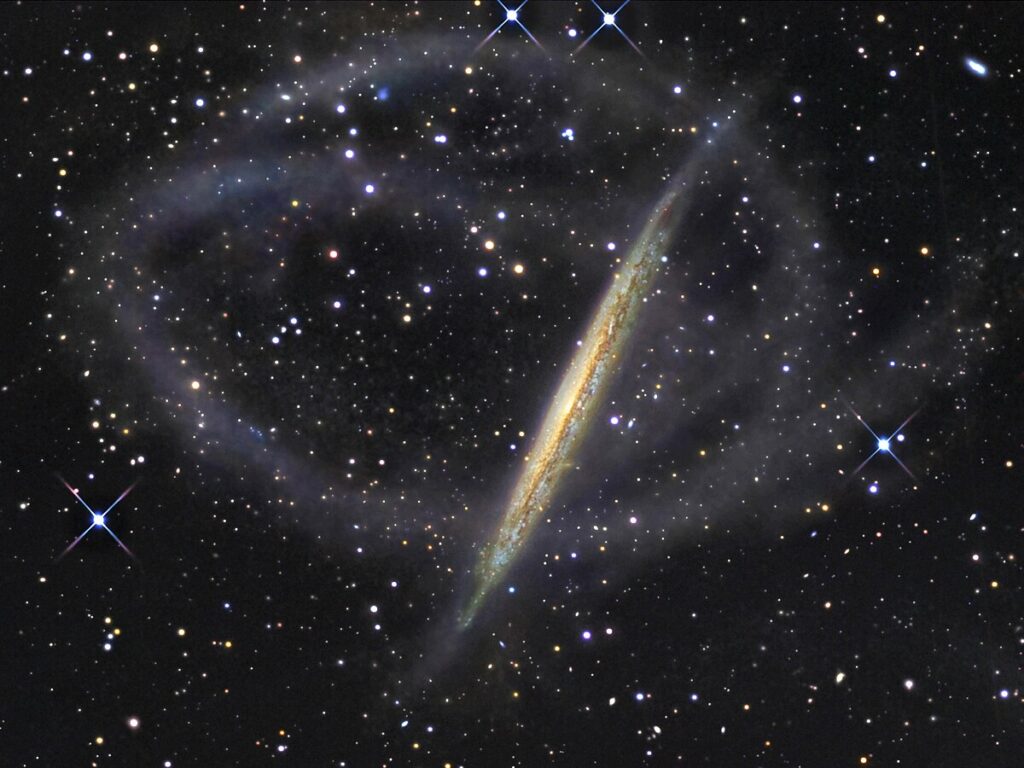
NGC 5907 has long been considered a prototypical example of a warped spiral in relative isolation. In 1998, a faint ring structure, likely caused by a disrupted [[dwarf spheroidal galaxy]], was first observed around the galaxy.<ref>{{Cite journal |last1=Shang |first1=Zhaohui |last2=Zheng |first2=Zhongyuan |last3=Brinks |first3=Elias |last4=Chen |first4=Jiansheng |last5=Burstein |first5=David |last6=Su |first6=Hongjun |last7=Byun |first7=Yong-ik |last8=Deng |first8=Licai |last9=Deng |first9=Zugan |last10=Fan |first10=Xiaohui |last11=Jiang |first11=Zhaoji |last12=Li |first12=Yong |last13=Lin |first13=Weipeng |last14=Ma |first14=Feng |last15=Sun |first15=Wei-hsin |date=1998-07-27 |title=Ring Structure and Warp of NGC 5907: Interaction with Dwarf Galaxies* |url=https://iopscience.iop.org/article/10.1086/311563 |journal=The Astrophysical Journal |language=en |volume=504 |issue=1 |pages=L23 |doi=10.1086/311563 |arxiv=astro-ph/9806395 |bibcode=1998ApJ…504L..23S |issn=0004-637X}}</ref> This challenged the assumption of isolation and suggests the gravitational perturbations induced by the stream progenitor may be the cause for the warp. Then, in 2008, an international team of astronomers announced the presence of an extended double loop tidal stream coiling around the galaxy.<ref>{{Cite journal |last1=Martínez-Delgado |first1=David |last2=Peñarrubia |first2=Jorge |last3=Gabany |first3=R. Jay |last4=Trujillo |first4=Ignacio |last5=Majewski |first5=Steven R. |last6=Pohlen |first6=M. |date=December 2008 |title=The Ghost of a Dwarf Galaxy: Fossils of the Hierarchical Formation of the Nearby Spiral Galaxy NGC 5907 |url=https://ui.adsabs.harvard.edu/abs/2008ApJ…689..184M/abstract |journal=The Astrophysical Journal |language=en |volume=689 |issue=1 |pages=184–193 |doi=10.1086/592555 |arxiv=0805.1137 |bibcode=2008ApJ…689..184M |issn=0004-637X}}</ref> The existence of part of these tidal streams has been recently challenged by some deeper surveys, which show only a single knee-shaped stream as opposed to the full double loop structure.<ref>{{Cite journal |last1=Müller |first1=Oliver |last2=Vudragović |first2=Ana |last3=Bílek |first3=Michal |date=2019-12-01 |title=Hunting ghosts: the iconic stellar stream(s) around NGC 5907 under scrutiny |url=https://www.aanda.org/articles/aa/full_html/2019/12/aa37077-19/aa37077-19.html |journal=Astronomy & Astrophysics |language=en |volume=632 |pages=L13 |doi=10.1051/0004-6361/201937077 |arxiv=1911.12577 |bibcode=2019A&A…632L..13M |issn=0004-6361}}</ref> This shorter stream has a length of 45′ in the sky (or a physical size of 220 kpc) and has a surface brightness ranging from 27.6 mag/arcsec<sup>2</sup> at its brightest to 28.8 at its faintest.<ref>{{Cite journal |last1=van Dokkum |first1=Pieter |last2=Gilhuly |first2=Colleen |last3=Bonaca |first3=Ana |last4=Merritt |first4=Allison |last5=Danieli |first5=Shany |last6=Lokhorst |first6=Deborah |last7=Abraham |first7=Roberto |last8=Conroy |first8=Charlie |last9=Greco |first9=Johnny P. |date=September 2019 |title=Dragonfly Imaging of the Galaxy NGC 5907: A Different View of the Iconic Stellar Stream |journal=The Astrophysical Journal Letters |language=en |volume=883 |issue=2 |pages=L32 |arxiv=1906.11260 |bibcode=2019ApJ…883L..32V |doi=10.3847/2041-8213/ab40c9 |issn=2041-8205 |doi-access=free}}</ref>
|
|||
|
An [[ultraluminous X-ray source]], [[NGC 5907 ULX-1]], is located in the galaxy.<ref name=”:0″>{{cite journal| doi=10.1126/science.aai8635 | title= An accreting pulsar with extreme properties drives an ultraluminous x-ray source in NGC 5907| first1=Gian Luca|last1=Israel|first2=Andrea|last2=Belfiore|first3=Luigi|last3=Stella|first4=Paolo|last4=Esposito|first5=Piergiorgio|last5=Casella|first6=Andrea|last6=De Luca|first7=Martino|last7=Marelli|first8=Alessandro|last8=Papitto|first9=Matteo|last9=Perri|first10=Simonetta|last10=Puccetti|first11=Guillermo A.|last11=Rodríguez Castillo|first12=David|last12=Salvetti|first13=Andrea|last13=Tiengo|first14=Luca|last14=Zampieri|first15=Daniele|last15=D’Agostino|first16=Jochen|last16=Greiner|first17=Frank|last17=Haberl|first18=Giovanni|last18=Novara|first19=Ruben|last19=Salvaterra|first20=Roberto|last20=Turolla|first21=Mike|last21=Watson|first22=Joern|last22=Wilms|first23=Anna|last23=Wolter|arxiv=1609.07375|journal=Science|volume=355|issue=6327|pages=817–819|date=24 Feb 2017| pmid= 28219970| bibcode= 2017Sci…355..817I| s2cid= 206653306}}</ref> This source is also called an ultraluminous X-ray pulsar (ULXP) because it exhibits a rapid pulsation effect. This pulsation has a period of 5.7 days and is caused by a rotating [[neutron star]] orbiting a [[X-ray binary|high mass companion]].<ref>{{Cite journal |last1=Belfiore |first1=Andrea |last2=Salvaterra |first2=Ruben |last3=Sidoli |first3=Lara |last4=Israel |first4=Gian Luca |last5=Stella |first5=Luigi |last6=De Luca |first6=Andrea |last7=Mereghetti |first7=Sandro |last8=Esposito |first8=Paolo |last9=Pintore |first9=Fabio |last10=D’Aì |first10=Antonino |last11=Rodrìguez Castillo |first11=Guillermo |last12=Walton |first12=Dominic J. |last13=Fürst |first13=Felix |last14=Magistrali |first14=Danilo |last15=Wolter |first15=Anna |date=2024-04-10 |title=The Orbit of NGC 5907 ULX-1 |journal=The Astrophysical Journal |language=en |volume=965 |issue=1 |pages=78 |doi=10.3847/1538-4357/ad320a |doi-access=free |arxiv=2405.04574 |bibcode=2024ApJ…965…78B |issn=0004-637X}}</ref> The neutron star itself has a spin period of 1.13 seconds and seems to be accelerating; its period ten years prior was 1.43 seconds.<ref name=”:0″ /> It is one of the brightest such source yet discovered with a luminosity over 10<sup>41</sup> erg/s (7 orders of magnitude more luminous than the Sun).<ref>{{Cite journal |last1=Miura |first1=Daiki |last2=Kobayashi |first2=Shogo B. |last3=Yamaguchi |first3=Hiroya |date=2024-06-20 |title=Phase-dependent Spectral Shape Changes in the Ultraluminous X-Ray Pulsar NGC 5907 ULX1 |journal=The Astrophysical Journal |language=en |volume=968 |issue=2 |pages=95 |doi=10.3847/1538-4357/ad4451 |doi-access=free |arxiv=2404.19300 |bibcode=2024ApJ…968…95M |issn=0004-637X}}</ref> Notably, its peak luminosity is over 1000 times greater than the [[Eddington luminosity]] for a neutron star.<ref name=”:0″ />
|
|||
|
NGC 5907 and the galaxy ”'[[KUG 1513+566]]”’ are listed together as ”'[[Holm 704]]”’ in [[Erik Holmberg (astronomer)|Erik Holmberg’s]] ”A Study of Double and Multiple Galaxies Together with Inquiries into some General Metagalactic Problems”, published in 1937.<ref>{{cite journal | bibcode=1937AnLun…6….1H | title=A Study of Double and Multiple Galaxies Together with Inquiries into some General Metagalactic Problems | last1=Holmberg | first1=Erik | journal=Annals of the Observatory of Lund | date=1937 | volume=6 | page=1 }}</ref>
|
|||
|
==NGC 5907 group==
|
==NGC 5907 group==
|
||



