


move thumbs
| ← Previous revision | Revision as of 20:35, 15 October 2025 | ||
| Line 2: | Line 2: | ||
|
{{Infobox open cluster|
|
{{Infobox open cluster|
|
||
|
| name = NGC 6281
|
| name = NGC 6281
|
||
|
| image = NGC 6281
|
| image = NGC 6281 .
|
||
|
| caption = NGC 6281
|
| caption = NGC 6281
|
||
|
| epoch = [[J2000]]
|
| epoch = [[J2000]]
|
||
|
| class = II2p
|
| class = II2p
|
||
|
| constellation = [[Scorpius]]
|
| constellation = [[Scorpius]]
|
||
|
| ra = {{RA|17|04.7}}<ref name=aaa438_3_1163/>
|
| ra = {{RA|17|04.7}}<ref name=aaa438_3_1163/>
|
||
| Line 19: | Line 19: | ||
|
| notes =
|
| notes =
|
||
|
| names = C 1701-378<ref name=simbad/>
|
| names = C 1701-378<ref name=simbad/>
|
||
|
}}
|
|||
|
|image_size=250|credit=DECaPS}}
|
|||
|
[[File:NGC 6281
|
[[File:NGC 6281 .||]]
|
||
|
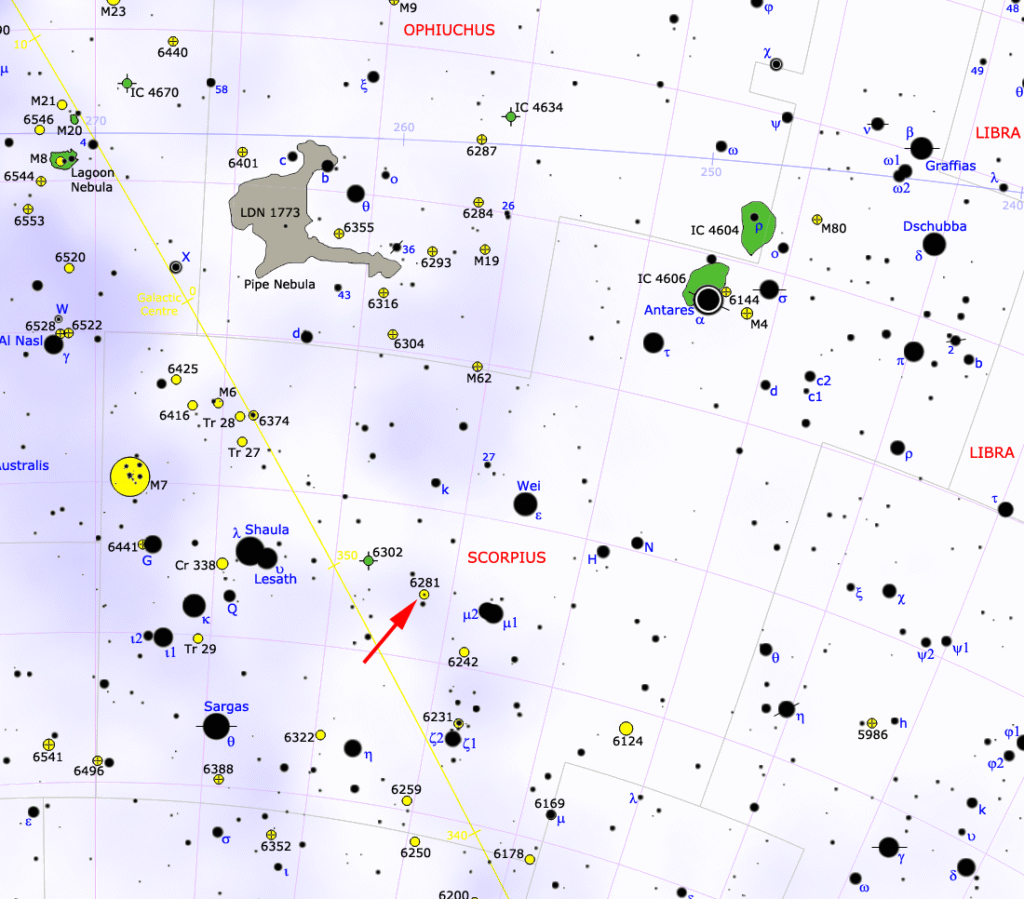
”’NGC 6281”’ (also informally known as the ”’Moth Wing Cluster”'<ref>{{cite web | title=NGC 6281 the Moth Wing Cluster | website=AstroBin | date=2023-09-19 | url=https://www.astrobin.com/405971/ | access-date=2024-07-15}}</ref>) is an [[open cluster]] of stars in the constellation [[Scorpius]]. It was not included in the [[Messier object|Messier]] or [[Caldwell catalogue|Caldwell]] catalogues of nebulous objects, but it is the brightest such cluster in the constellation to be left out of both. It is readily observed with the naked eye; it is located about {{formatnum:2}}° to the east of [[Mu Scorpii]]. [[James Dunlop]] described the cluster as a “curiously curved line of pretty bright stars, with many stars mixt”. [[John Herschel]] then described the cluster as both “pretty bright” and “pretty rich”.<ref name=crossen_rhemman2004/><ref name=omeara2007/>
|
”’NGC 6281”’ (also informally known as the ”’Moth Wing Cluster”'<ref>{{cite web | title=NGC 6281 the Moth Wing Cluster | website=AstroBin | date=2023-09-19 | url=https://www.astrobin.com/405971/ | access-date=2024-07-15}}</ref>) is an [[open cluster]] of stars in the constellation [[Scorpius]]. It was not included in the [[Messier object|Messier]] or [[Caldwell catalogue|Caldwell]] catalogues of nebulous objects, but it is the brightest such cluster in the constellation to be left out of both. It is readily observed with the naked eye; it is located about {{formatnum:2}}° to the east of [[Mu Scorpii]]. [[James Dunlop]] described the cluster as a “curiously curved line of pretty bright stars, with many stars mixt”. [[John Herschel]] then described the cluster as both “pretty bright” and “pretty rich”.<ref name=crossen_rhemman2004/><ref name=omeara2007/>
|
||
|
This cluster has a tidal radius of {{Convert|26|ly|pc|abbr=on}} and a mass of about 214 [[solar mass]]es.<ref name=aaa477_1_165/> It is classified as a type II2p cluster and has 55 members with a [[visual magnitude]] of 13.5 or greater within 20 [[arcminute]]s of the center.<ref name=aass61_45/> The brightest member is 9th magnitude. Overall, the cluster has an [[integrated visual magnitude]] of 5.4.<ref name=omeara2007/>
|
This cluster has a tidal radius of {{Convert|26|ly|pc|abbr=on}} and a mass of about 214 [[solar mass]]es.<ref name=aaa477_1_165/> It is classified as a type II2p cluster and has 55 members with a [[visual magnitude]] of 13.5 or greater within 20 [[arcminute]]s of the center.<ref name=aass61_45/> The brightest member is 9th magnitude. Overall, the cluster has an [[integrated visual magnitude]] of 5.4.<ref name=omeara2007/>
|
||
|
{{clear left}}
|
|||
|
==References==
|
==References==
|
||
|
{{reflist|refs=
|
{{reflist|refs=
|
||



