
Pakistan, where 45pc of people live under poverty line, is among countries most vulnerable to climate change, with limited resources for adaptation.
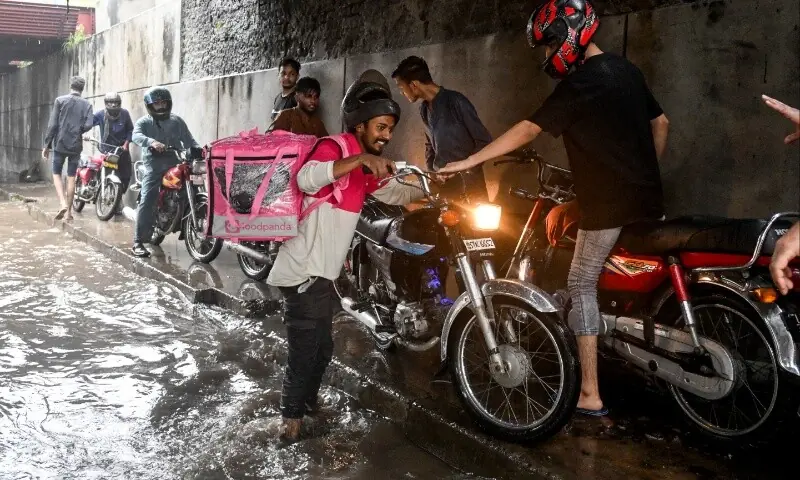
Abdullah Abbas waded through Lahore’s flooded streets, struggling to push his motorcycle and deliver a food order on time.
The water had risen to his torso, his jeans soaked and rolled up over sandals, leaving him vulnerable to electrocution and infectious diseases.
Even as monsoon rains deluge Pakistan’s cities, food and grocery orders on the Singapore-based delivery platform Foodpanda pour in.
“If I don’t deliver the orders, my Foodpanda account will get blocked, which would leave me without money,” Abbas told AFP in the old quarter of Lahore, known for its narrow, congested streets.
“I need this money to pay my high school fees,” added the 19-year-old, who is completing his last year of secondary school.
Since June, monsoon rains in Pakistan have killed more than 1,000 people, swelling major rivers and devastating rural communities along their banks.
Urban centres such as Lahore, a city of more than 14 million people, and Karachi, the country’s largest city with more than 25 million people, have also suffered urban flooding in part because of poorly planned development.
Abbas earns around $7 a day, above the average salary, but only when the sun is shining.
To meet the average monthly pay of around $140, he was to work seven days a week for over 10 hours, fitted around his studies.
“Customers behave rudely and you have to handle all the stress,” added Muhammad Khan, a 23-year-old Foodpanda rider, as he carefully navigated his motorbike through Karachi’s muddy, pothole-ridden roads.
Pakistan, where 45 per cent of people live below the poverty line, is among the countries most vulnerable to climate change, with limited resources dedicated to adaptation.
‘Stressful’
By the middle of August, Pakistan had already received 50pc more monsoon rainfall than last year, according to disaster authorities, while in neighbouring India, the annual rains kill hundreds every year.
While South Asia’s seasonal monsoon brings rainfall that farmers depend on, climate change is making the phenomenon more erratic.
A report by the Human Rights Commission of Pakistan said brown water inundating city streets is not only the result of climate change but “clogged drains, inadequate solid waste disposal, poor infrastructure, encroachments, elitist housing societies.”
Doctors warn that working repeatedly in damp conditions can cause fungal infections and flu, while exposure to dirty water can spread eye and skin infections.
Gig economy workers attached to delivery apps such as Foodpanda and ride-hailing apps Bykea and InDrive, made up nearly two per cent of Pakistan’s labour force or half a million people in 2023, according to Fairwork, a project by the University of Oxford.
Fairwork rated six digital labour platforms in the country, and all of them have the “minimum standards of fair work conditions”.
The International Labour Organisation, meanwhile, says gig workers lack government protection and face systemic violations of international labour standards.
Motorbike rider Muneer Ahmed, 38, said he quit being a chef and joined Bykea to become “his own boss”.
“When it rains, customers try to take rickshaws or buses, which leaves me with no work,” said Ahmed, waiting anyway on the side of the flooded street.
“Rain is a curse for the poor,” he said, watching the screen of his phone for a new customer.
Daily wage labourers, often working in construction, also see their work dry up.
It has been nearly four days since labourer Zahid Masih, 44, was hired, he told AFP while taking refuge under a bridge with other masons in Karachi.
“Jobs do come up, but only after the rain stops. There is no work as long as it is raining,” says the father of three.
“Sitting idle at home is not an option, as our stoves won’t be lit.”

