


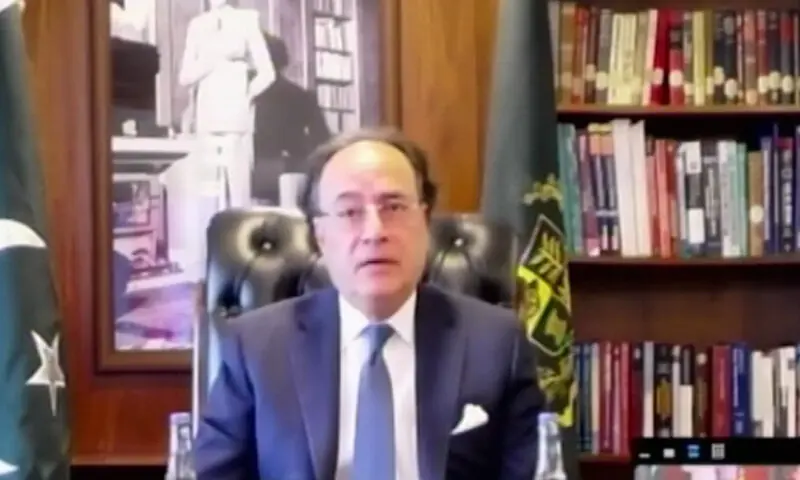
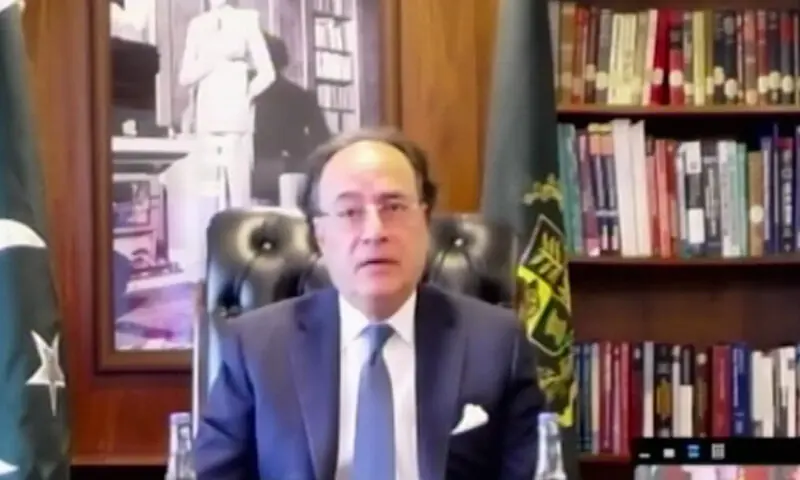
Finance Minister Muhammad Aurangzeb on Friday said that Pakistan’s recent engagement with the International Monetary Fund (IMF) was “constructive”, adding that there appeared to be no “showstoppers” so far.
An IMF mission led by Iva Petrova met with Pakistan’s economic team in Karachi and Islamabad from September 24 to October 8 to review the implementation of the $7 billion Extended Fund Facility (EFF) and $1.1bn Resilience and Sustainability Facility (RSF). The programme’s performance as of the end of June this year — the period under review — has been mixed.
A day earlier, the Fund said that “significant progress” had been made towards finalising a staff-level agreement on the second review under the 37-month EFF and the first review of the 28-month RSF.
“Programme implementation remains strong, and broadly aligned with the authorities’ commitments,” the IMF had said.
Today, the minister virtually addressed a high-level business delegation from Saudi Arabia, which arrived in Pakistan on October 7, and said, “We have had very constructive engagement with the [IMF] mission here.
“We have a few outstanding issues — from my perspective, no showstoppers,” he said.
“We will continue these discussions virtually tonight, into the weekend, and hopefully early [next] week when the [State Bank of Pakistan] governor, finance secretary and myself are in Washington. We hope to get moving with the staff-level agreement,” he said.
Meanwhile, Aurangzeb also lauded the Saudi delegation’s visit, terming it “timely”. He also called it an opportunity for Pakistan to “step up in terms of inviting [investors], and equally making sure that our existing investors work in a good environment“.
The finance minister also went on to detail Prime Minister Shehbaz Sharif’s vision for the economy, outlining two areas the premier aimed to prioritise.
“One is taxation reform,” he said, acknowledging the “additional burden business leaders face in the formal sector because the other sections of society are not setting up the way they need to”.
“The second is our digital journey and moving towards a cashless economy,” he said, noting that the two were interconnected. He stated that 40 to 50 per cent of Pakistan’s economy was undocumented.
Stressing the need for digitisation, Aurangzeb said, “The more we move toward a cashless economy and our digital journey, the more we sort of help the documentation and moving stuff into the formal economy.”



