
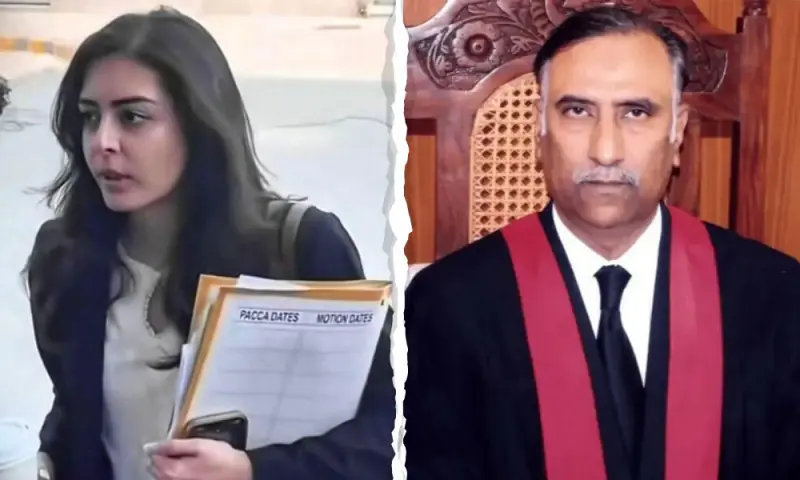
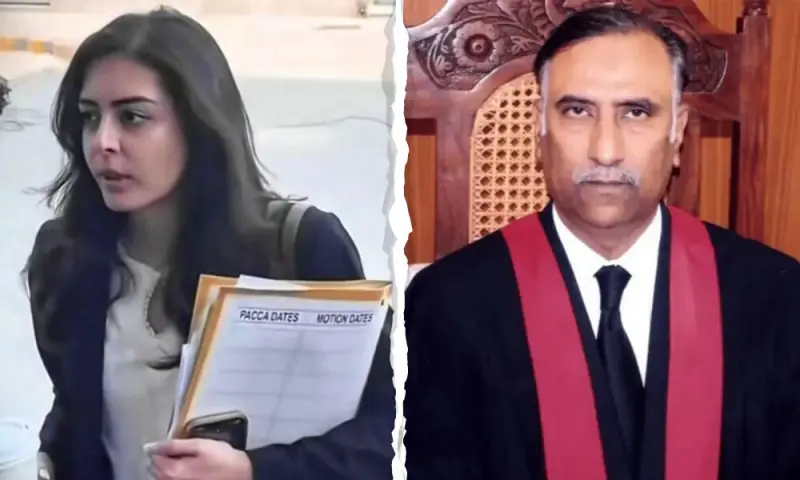
When a Chief Justice tells a woman to shut her mouth, it is not just an insult to her — it is a verdict on every woman who has ever dared to stand tall in a country that insists she stay small.
Pakistani women have often been told to stay quiet. To make themselves small. To cause little havoc when offering opinions outside the narrow fields deemed acceptable — education, medicine, caretaking.
But the world has taught us something the hard way: silence does not bring peace either.
There is an African proverb: “If your mother doesn’t teach you something, the world will.”
And the world is teaching us women, again and again, that the system is not built to listen to us, especially not when we speak with force, confidence, and independence.
A clash in the courtroom
Consider Imaan Mazari, a human rights lawyer in Pakistan, unapologetically outspoken in a courtroom that too often doubles as a boys’ club. Last week, she faced Islamabad High Court Chief Justice Sarfraz Dogar, a man entrusted with upholding dignity through the rule of law, who instead subjected her to humiliation.
In open court, Justice Dogar told Mazari to shut her mouth (moun band rakho). He threatened physical violence (jiss din maine pakar lia). He told her husband to rein her in, as if she were a farm animal, the ward of some guardian rather than a full constitutional citizen.
This is not an offhand slight. Neither is it a one-off offence. Justice Dogar has a pattern of dismissing her with comments like, “Why are you so stubborn?” — targeting her person instead of her arguments. But this recent outburst crosses into much darker terrain.
When the moral custodian of a legal system speaks to a woman this way, the insult ricochets beyond one courtroom. It lands on every woman who has ever been told to sit down, lower her voice, stay in her place. Or else.
Often, the men threatening women are vagabonds of some sort. We are all reeling because this comes from a man that the vagabonds should fear.
We have all been told that courtrooms are no place for a woman. But we should not have to hear that from the very people tasked with our protection.
No, we don’t want to leave.
When confronted by women’s groups, Justice Dogar insisted his words to Iman were gracious, merely meant to scold a child. But even by that framing, it reflects a troubling paternalism — one that women have long been forced to resist.
We want to stand up to our uncles, our fathers, our make-shift fathers; the whole lot.
To deny a woman’s intelligence is a form of violence. To neglect her educational expertise is a form of violence.
A legacy of resistance
Imaan Mazari is not small. She stands in a lineage of women like Asma Jahangir — the iconic Pakistani lawyer and activist who fought for those buried under patriarchy and state violence. The world finds it easier to dignify Jahangir now that she is gone. Mazari, alive and forceful, is harder to dismiss. Young, sharp, blisteringly defiant; she is a blinding force field in a landscape still upheld by men who prefer obedience. She prefers equality.
They have tried to punish her before — locking her in jail without the medication she needs to keep her kidneys functioning, counting on her dignity to fracture. She walked out of prison with her head still high. That, too, is why they fear her.
The broader context
What Mazari faced fits within a much larger story. In Pakistan, women’s rights are not merely curtailed — they are structurally undermined. Marital rape is effectively legal. Honour killings persist. Child marriage is jealously defended by powerful religious institutions. Rape survivors are disbelieved and humiliated. Women’s testimony still counts for half a man’s in court.
Mukhtaran Mai. Noor Mukadam. Dr Mahrang Baloch, Imaan’s client, whom she was representing in court the day she was asked to shut up.
Imagine living under laws that over-legislate your existence, simultaneously fearing you, and pitying you, reducing you to a reproductive vessel. If a woman were a car, to use one analogy, she would be denied headlights and an engine — deliberately mutilated.
In that context, every insult hurled at a lawyer like Mazari carries disproportionate weight. Because if the lawyers are silenced, what chance do their clients, the poor, the vulnerable, the disappeared, ever have?
So no. The kind of compliance needed from women in our country is not the nation-building kind of woman our founding mothers were. Imaan is a mouth on legs, and if you ask me, that is far more judge-like than the people she calls “my lord”.
The moral choice
This is not just Pakistan’s story. It is a universal story about how patriarchies function, how power defaults to diminishing women, how “everyday sexism” provides cover for systems of slavery, casteism, ownership, and silencing.
Iman Mazari knew Justice Dogar’s words were not just outbursts; they were claims to authority. She knew they must be resisted. By calling him out publicly on her social media, she broke the cycle of complicity that silence demands. That act alone is worth celebrating.
Because sexism is not just another side of the story. And respect — in law, as in life — must be earned.
What comes next
Pakistan can choose differently. It has shown remarkable willpower when it comes to reshaping skylines with housing societies and concrete developments, often for profit. Yet the more urgent task lies in rebuilding the moral and social foundations of the state.
Justice Dogar, too, has choices. He can approach his office as a servant of law, as a reconciler of fractured social trust between genders. He can help build a country where women are treated as equals under justice: citizens, never subjects.
Or he can continue playing the old patriarch, reinforcing the entrenched patterns of authority that rely on diminishing women’s place in public life.
Pakistan’s women already know this much: they have been the invisible half of its economy, its politics, its homes. They have fought, endured, marched, and still received nothing — no capital, no inheritance, no protection. Just marching orders.
That is why, after centuries of silence, they are no longer whispering.
They will not keep their mouths shut.

