


| Pacification of Ukrainians in Eastern Galicia | |
|---|---|
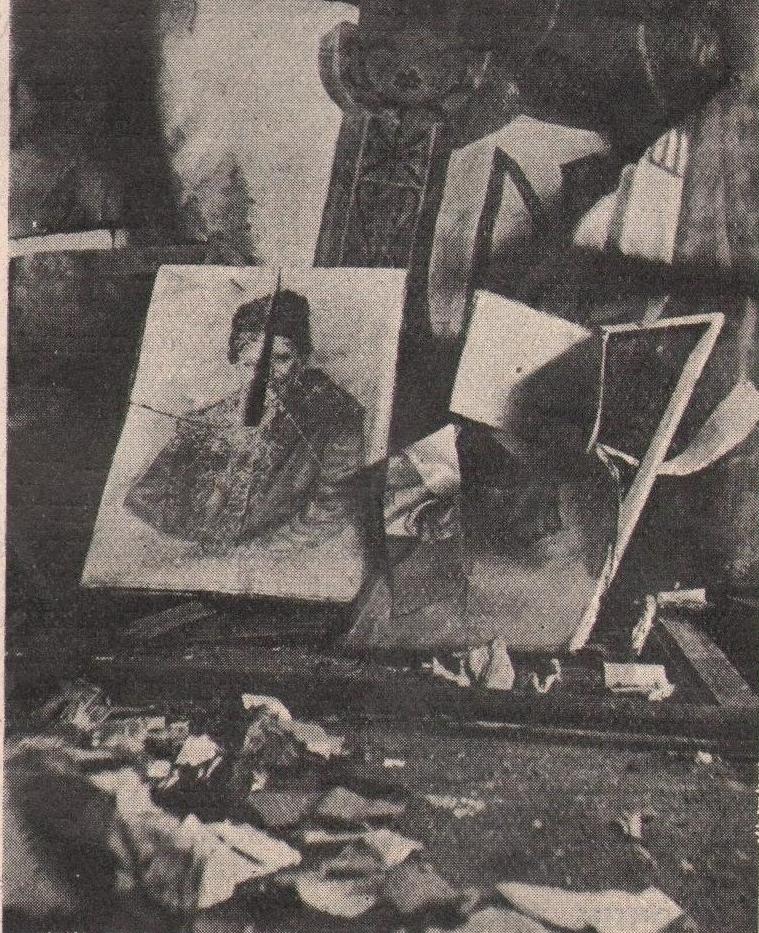
 Prosvita society reading room demolished during Pacification in September–October of 1930. Knyahynychi, today Rohatyn Raion
|
|
| Location | Eastern Galicia |
| Date | 16 September − 30 November 1930 |
|
Attack type |
Mass searches, arrests, destruction of property, food |
| Perpetrators | Polish Sanation regime |
| Motive | Crackdown on Ukrainian nationalists |

The Pacification of Ukrainians in Eastern Galicia was a punitive action against the Ukrainians in Galicia, carried out by police and military of the Second Polish Republic from September until November 1930 in reaction to a wave of sabotage and acts of terror perpetrated by Ukrainian nationalists.[nb 1][1][2][3][4]
It took place in 16 Polish counties of three southeastern voivodeships. During the Interbellum this area was part of the so-called Eastern Lesser Poland province. Therefore, in Ukrainian and Polish literature this event is called “Pacification of/in Eastern Galicia” (Ukrainian: Пацифікація у Східній Галичині) (Polish: Pacyfikacja Galicji Wschodniej) and “Pacification of Eastern Lesser Poland” (Polish: Pacyfikacja Małopolski Wschodniej).
Eastern Galicia, with the ethnic composition of about two thirds Ukrainians and one third Poles (in 1931 in Lwów Voivodeship Poles made up 57,7% of population, Ukrainians and Ruthenians 34,1%, 7,5% Jews who identified mostly as Polish Jews or just Jewish, in Tarnopol Voivodeship 49,3% was Polish, 45,5% Ukrainian and Ruthenian, 4,9% Jewish, Stanisławów Voivodeship was 68,8% Ukrainian and Ruthenian, 22,4% Polish, 7,4% Jewish) east of the Curzon line, was incorporated into the Second Polish Republic after Austria-Hungary‘s collapse and the defeat of the short-lived West Ukrainian People’s Republic.[1] Ukrainians during the war were held in internment camps by the Polish government, the total number of Ukrainian internees, prisoners of war, and hostages who passed through Polish prisoner-of-war camps, internment camps, collection stations, and prisons during the Polish-Ukrainian war of 1918–1919 was at most 30–35 thousand people. Of this number, about 1.5–2 thousand people successfully escaped, and a further 1.5 thousand prisoners, internees, and hostages died due to epidemic diseases, starvation, or natural causes.[5] After the war, in 1920–1921, approximately 100,000 Ukrainians (mostly from UNR, but also from ZUNR) were held in internment camps by the Polish government, where they were often denied food and medicine; some of them died from starvation, disease or suicide. The victims included not only soldiers and officers but also priests, lawyers and doctors who had supported the Ukrainian cause. The death toll at these camps from diseases was estimated at 20,000 people,[6] during the war the West Ukrainian government had also interned Poles in camps, which was described by Jan Zamorski in his Sejm Speech as such:
“Seeing conspiracies everywhere, Poles were immediately deported. The main internment camps we have so far visited were in Żółkiew, Lwów, Złoczów, Tarnopol, Mikulińce, Strusów, Jazłowiec, Kołomyja at Kosacz, and others. The internees were driven in winter into unheated barracks. At first they were given nothing to eat for several days, and afterwards in the morning some kind of coffee; sometimes once a week or once every two weeks a piece of black bread; sometimes a piece of horsemeat; sometimes instead of dinner, boiled pumpkins. I have here a photograph of such internees who froze their feet in the camps after which their feet were amputated. They froze, and then they fell ill. The main disease that spread there was typhus. In Mikulińce alone, more than 600 deaths from typhus were recorded. Similar deaths occurred likewise in Jazłowiec, Strusów, Kołomyja, Tarnopol. The sick were always housed together with the healthy. For example, in Mikulińce, Dr. Shpor would come, declare from a distance that everything was in order, even though he was told that there was typhus present, even though the Polish nurses, that is, the ladies from the committee, said that it was typhus, he insisted it was only influenza. And under such conditions, thousands of people perished. The arrangement of these internment camps was of such a kind that one must conclude that there was deliberate intent to exterminate as many Poles as possible. The sick were always kept together with the healthy, so that disease spread artificially. Such cases are recorded in Tarnopol in two prisons, in Półkowińkówka, in three schools, in the prison in Strusów, Mikulińce, Kołomyja and so on.
Interment was carried out in such a way that people were usually seized at night, not allowed to take anything with them, and naturally looting began. In this way the internees sat naked, often in rags, half-military clothing, in filth and hunger.
In Tarnopol, a committee of Polish ladies was formed, made up of several dozen women. They divided themselves into groups of fifteen. The first fifteen went to care for the sick and brought them food begged from the villages, which Polish peasants carried in, until one by one all the women themselves succumbed to typhus. Then the second fifteen went, then the third. Yet very many of these women died. A priest also died; all the other priests went about giving the sacraments to the sick and the dying.
Internees were driven to forced labor. For example, in Tarnopol, more than 200 people were driven out barefoot in the frost (or with feet wrapped in straw) to work supposedly on the railway, and every day several died from the cold while others fell ill.”[7]
This, as well as other crimes committed on Poles in the West Ukrainian People’s Republic, contributed to tense relations between Poles and Ukrainians in the Second Polish Republic, for example numerous testimonies describe how Polish countryside communities were destroyed when Ukrainian forces withdrew from Lwów. Entire villages were deliberately set on fire. This happened in Sokolniki, in Biłka Szlachecka, in Dawidów, and essentially in every settlement considered Polish. Soldiers stormed into these places and torched the houses. It was not difficult, since the walls were often covered in straw, forming so-called “zachaty”, which ignited easily. These were usually the first to be set ablaze. At the same time, soldiers opened fire on anyone attempting to flee. Whoever stepped outside was immediately at risk of being shot. Altogether, more than five hundred farms — roughly between fifteen hundred and two thousand buildings — went up in flames. People still tried to leave their cottages to free their cattle, but most who did so were shot down. Some testimonies were especially harrowing. One came from a girl from Biłka, Agnieszka Kubów, not yet fourteen years old. She explained that her father had been shot dead in the snow while she tried to drag his body toward the barn. Her mother was struck by an explosive dum-dum bullet, lingered in agony for weeks, and eventually died. Her aunt was hit in the leg in a similar way and had to be hospitalized in Lwów. With her home destroyed by fire, the young girl became the sole surviving head of her household. There were many reports of equally brutal acts: if a householder was killed, or even still alive but dying, straw was placed beneath him and set alight so that he burned together with his home. Such incidents were widespread, this was the fate of many Polish villages.[8]
During forced labor, young girls were singled out and often handed over to soldiers for sexual exploitation. The Ukrainian ataman Klee, of German origin, reportedly established a military brothel in Żółkiew using Polish girls.
One young girl, under twenty and well educated, was compelled by her doctor to testify before a commission. She described how Klee, together with another Ukrainian officer, had attempted to rape her and her sister. When she resisted, she was handed over to soldiers, dragged into a barn, and gang raped so badly she fainted. She continued to undergo treatment with doctors after Polish-Ukrainian War. Similar atrocities were reported in three women’s convents. Once soldiers had satisfied their lust, they often killed their victims. In Chodaczków Wielki near Tarnopol, a fully Polish village, four girls were killed in a garden in May. Before their deaths, their breasts were cut off, and Ukrainian soldiers tossed them around for sport. Abuse of civilians was widespread. Women were mutilated in various ways: breasts cut off, and grenades were placed in private areas and ignited so the nuns or the female volunteers were blown apart, such incidents reportedly occurred repeatedly.
In Szkło, a Polish prisoner was found tied by the neck to a tree with his hands bound and then shot by Ukrainian soldiers. In December 1918, Mykhailo Helova, a Greek Catholic from Jaworów, was ordered by the Ukrainian gendarmerie to transport seventeen wounded Polish soldiers by sleigh to Żółkiew, along with two others from Jaworów. The wounded were escorted by six Ukrainian soldiers, instead of heading to Żółkiew, the escorts directed the sleighs toward Janów. Upon reaching the Grabnik forest in Szkło, the soldiers executed all seventeen wounded men. Later, sixteen of the bodies were exhumed, as one had escaped. The corpses were stripped of clothing and bore numerous gunshot wounds, indicating they had been repeatedly shot. Similar massacres occurred in Janów with twenty-six Polish prisoners.
Other atrocities were documented as well. Father Ryś from Wiśniew was buried alive, upside down, while another unknown priest was murdered and thrown into a grave he had been forced to dig. Burials alive were frequent and are recorded in court protocols.
All suburban communes around Lwów — Brzuchowice, Biłka, Winniki, Dawidów, Sokolniki, Dublany, Basiówka — experienced similar tragedies. Shootings were often so indiscriminate that a single observer could count twelve unarmed victims at once. In Basiówka, Ukrainian soldiers reportedly took the crying eighteen-month-old daughter of Marcin Piwka from her cradle, threw her to the ground, and killed her.[9]
A medical-judicial commission exhumed a single grave containing the bodies of five murdered individuals. The victims had been tossed into the grave in disorder, partially naked, and lying in various positions. One body was found on its knees and elbows, suggesting that the person may have been buried alive and struggled for life even after being covered with soil. Signs of extreme cruelty inflicted upon the deceased were clearly visible. At Hercog’s, the skull bones, including the base of the skull, were shattered into tiny fragments, so that the cranial contents, along with the liquefied brain, had spilled out lifelessly. In the case of Jerzy Podgórski, the nose and face were flattened, and the frontal bone as well as both petrous portions of the temporal bones were entirely missing. The victims had first been tortured, then beaten with rifle butts, and in addition, they suffered other inhumane treatment: tongues were torn out, fingers ripped off, and further acts of brutal abuse inflicted upon them. Judicial investigations confirmed such atrocities in multiple locations: seventeen cases in Jaworzno, twenty-eight in Złoczów, and one or several cases in various other localities. These findings were sufficient to demonstrate to the High Chamber that the treatment of the Polish population—whether landowners, intellectuals, or peasants—was in complete violation of any recognized standards of wartime conduct.[10]
Among the many tragic incidents, is the so-called discovery of a conspiracy in Złoczów. The town had a large number of impoverished residents, as well as prisoners held in the former Sobieski castle. Aid totaling 5,000 koronas was sent from Tarnopol to these people, including railway workers who had lost their jobs and income for refusing to swear allegiance to the Ukrainian state. The money was delivered by Dr. Nieć. Even though the funds were officially distributed with the approval of the Ukrainian authorities in Tarnopol, they were nevertheless treated as if they had come from a foreign Polish organization intending to organize a conspiracy. On the night of March 26–27, several individuals were immediately arrested and imprisoned. According to available testimonies, the accused were interrogated in a brutal manner, being beaten unconscious while being forced to confess to a conspiracy against the Ukrainians. The testimony of the oldest accused, a local notary approximately seventy-six years old, Mr. Sawicki, who was also charged with conspiracy, confirms these events. Remarkably, the trial began at 7 a.m. and the verdict was issued by 9 a.m., while by 4 p.m., two wagons were already waiting in the courtyard to remove the executed bodies, indicating that the outcome had been predetermined, from the previous night two large pits had been dug in the cemetery to receive the corpses. After the executions, the personal belongings of the victims—including snuffboxes, cigarette cases, and chains—were taken by the court officers.[11]
Immediately after taking control of towns in Eastern Galicia, Ukrainian authorities ordered the removal of Polish inscriptions in places were Poles lived, and their replacement with Ukrainian ones, while also closing Polish schools. All of this was carried out with the goal of getting rid of Poles, or forced Ukrainization of the local Polish population. Polish officials were required to swear allegiance to the Western Ukrainian Republic; those who refused were stripped of their positions. As a result, in nearly every town, Polish civil servants lost both their offices and their income. Cities and counties were placed under the administration of Ukrainian commissioners, and the Polish population was denied access to municipal provisioning. This forced the local Polish communities to provide food for urban residents themselves.
In Tarnopol, attempts by rural Poles to supply food to the city were prohibited, putting villages such as Ptotycz, Bajkowice, and Czenielów at risk of persecution. Despite this, peasants secretly carried food to the towns at night, risking arrest and beatings. For instance, the farmer Markowicz from Bajkowice, a friend of Jan Zamorski, had all the food he was transporting to Poles in Tarnopol confiscated by Ukrainian soldiers, who also knocked out his teeth with a rifle butt.
Ukrainian soldiers claimed to be uncovering conspiracies, which provided a pretext for searches that were often accompanied by widespread looting. Once one group of soldiers completed its plundering, another would arrive to continue. When nothing remained, walls were torn down, floors removed, and further revenge was taken on the local population for having no goods left to hand over. During these searches for weapons, soldiers not only looted but also murdered civilians, many defenseless Poles were murdered during this period.
Churches and manor houses were also systematically looted and desecrated. Notable examples include the Bernardine churches in Zbaraż, Fraga, Sambor, Niemirów, and others. In Fraga, all church vessels were removed, the building was turned into a latrine, and a non-commissioned officer reportedly played dances on the organ while drunken soldiers danced inside. Other acts of sacrilege included dragging statues of the Virgin Mary or Jesus to wells as a mock “drinking ritual” or making insulting remarks about avoiding wetting a mustache, such humiliations of Catholic Polish population were frequent.
In addition to looting and desecration, money was confiscated. Poles often had no cash remaining, soldiers seized funds from the population under the guise of exchanging Austrian currency for Ukrainian currency—first karbovanets during the Petliura period, and later hryvnias. Fines were issued in large denominations, often starting at 500 hryvnias, leaving small change scarce and forcing people to convert goods into smaller Austrian coins. During fairs, townspeople were surrounded by troops, subjected to searches, and had their Austrian money confiscated, being left only with largely worthless Ukrainian currency.[12] Collectively, these atrocities shaped an unfavorable view of Ukrainians among Poles in the Second Polish Republic.
Many Ukrainian organizations continued close contact with the Weimar Republic, later Nazi Germany, while others kept in contact with the new Soviet government to the east. The Ukrainian language was banned in government agencies in 1924 and support was steadily withdrawn from Ukrainian schools. Polish-Ukrainian relations deteriorated during the Great Depression, leading to much economic disruption, hitting hard, particularly the rural areas. In this atmosphere, radical Ukrainian nationalists propagating active resistance to Polish domination found a ready response from Ukrainian youth.[13]
In July 1930, activists of the extremist Organization of Ukrainian Nationalists (OUN) began sabotage actions, during which warehouses and cereal fields owned by Poles were burned, Polish homes were destroyed, bridges were blown up, state institutions, rail lines and telephone connections were damaged.[1][14] The organizer of the action was Yevhen Konovalets.[15] Financing was provided and weaponry was illegally smuggled with Weimar German support.[citation needed]
The main reason behind the sabotage campaign was the mainstream Ukrainian parties’ decision to participate in the Polish elections, coupled with Józef Piłsudski‘s policy of tolerance, which threatened the OUN’s position in Ukrainian society.[1][16] The organization reacted by adopting a tactic designed to radicalize Ukrainian public opinion and block any form of compromise with Polish authorities.[1][14][15] The OUN used terrorism and sabotage in order to force the Polish government into reprisals so fierce that they would cause the more moderate Ukrainian groups ready to negotiate with the Polish state to lose support.[17] OUN directed its violence not only against the Poles but also against all Ukrainians wishing for a peaceful settlement of the Polish-Ukrainian conflict.[18]
Over time, local Ukrainians, many of whom saw the Poles as occupiers of their land, joined the action. Offices of the Polish paramilitary Riflemen’s Association were burned, as were the stands of the popular trade fairs in Lwów (Lviv). Government offices and mail trucks were attacked. This situation lasted until September, with some sporadic incidents happening as late as November. Between July and November 1930, there were 197 cases of terrorist and sabotage activities. The vast majority, 172 incidents, were directed against private civilian property, mostly belonging to Polish and Jewish civilians, only 25 cases involved state-owned property, this shows that the violent acts were mostly aimed at terrorizing civilian population, while attacks on state infrastructure accounted for only a small portion of the total.[19] The terror action was limited to Galicia, and did not take place in Volhynia.[1]
In response, Polish authorities decided to pacify the turbulent province. The decision to carry out the action was made by Marshal Józef Piłsudski in his capacity as Prime Minister of the Second Polish Republic. Recognizing that terrorist actions carried out by the OUN did not amount to an insurrection, Piłsudski ordered a police action, rather than a military one, and deputized the Minister of Interior, Felicjan Sławoj Składkowski with its organization. Sławoj Składkowski in turn ordered regional police commanders to prepare for it in the Lwów Voivodeship, Stanisławów Voivodeship and Tarnopol Voivodeship. The commander of the planned action was Lwów Voivodeship’s chief of police, Czesław Grabowski.[citation needed]
Before the action commenced, around 130 Ukrainian activists, including a few dozen former Sejm (Polish parliament) deputies were arrested.[20] The action itself began on 14 September 1930, in several villages of Lwów Voivodeship, where the 14th Jazlowiec Uhlan Regiment was directed, even though the detailed plan for the action was not established until 18 September.[citation needed]
From 20 to 29 September, 17 companies of police (60 policemen each) were used. Of these, 9 came from the police academy in Mosty Wielkie (Velyki Mosty), 3 from Lwów Voivodeship, 2.5 from Stanisławów Voivodeship, 2.5 from Tarnopol Voivodeship (a total of 1,041 policemen and officers). The main operations with the participation of military units took place in the first half of October.
Overall, the action affected:
- Lwów Voivodeship: police action – 206 places in 9 different counties, military action – 78 places in 8 different counties.
- Stanisławów Voivodeship: police action – 56 places in 2 counties, military action – 33 places in one county
- Tarnopol Voivodeship – police action – 63 places in 4 counties, military action – 57 places in 5 counties.
Or in total 494 villages. Timothy Snyder and other sources give the figure of 1000 policemen used in the operation, affecting 450 villages.[1]
Nature of the action
[edit]
The operation was carried out in three stages. First, a basic edict was issued authorizing a particular action. Second, police units were brought in. Third units of the regular army carried out “operational maneuvers”.[citation needed]
The pacification involved the search of private homes as well as buildings in which Ukrainian organizations (including the Ukrainian Greek Catholic Church) were based. During the search, the buildings, belongings, and property of Ukrainians were destroyed and the inhabitants were often beaten and arrested. Several Ukrainian schools (in Rohat, Drohobycz, Lwów, Tarnopol and Stanisławów) were closed and the Ukrainian Youth Scout organization Plast was outlawed. On 10 September, five deputies of Ukrainian National Democratic Alliance were arrested.[citation needed]
The pacification was carried out by first surrounding a village with police units, then calling out the village elder or an administrator of the village. He in turn was informed about the purpose of the operation and was ordered to give up any weapons or explosives hidden in the village. All villagers were to remain in their houses. Subsequently, the houses of those suspected of cooperation with Organization of Ukrainian Nationalists were searched, which included the tearing up of floors and ceilings. During the course of the search, the furniture and property inside the houses were often destroyed.[21] Policemen found about 100 kilograms of explosives and weapons (1287 rifles, 566 revolvers, 31 grenades).[1] Also, during the searches, physical force was used and many people were beaten.[21] According to Polish historian Władysław Pobóg-Malinowski, there were no fatalities,[22] while, according to Ukrainian historian and an OUN member, Petro Mirchuk, 35 Ukrainian civilians died during the pacification. Stephan Horak estimates the number of victims at 7.[23] Additional punishments included levying special “contributions” on the villages and stationing regiments of cavalry in the village, which had to be fed and quartered by the villages.[citation needed]
Ukrainian nationalists lodged an official complaint regarding the “pacification” action to a committee of the League of Nations, which in its response disapproved the methods used by the Polish authorities, but also put blame on the Ukrainian extremist elements for consciously provoking this reaction from the Polish government. The committee concluded that the pacification did not constitute the governmental policy of persecution of the Ukrainian minority.[13][24]
Effects of the action
[edit]
The operation resulted in a reduction of Ukrainian terrorist actions carried out by the OUN for a short while,[25] but also, just as the OUN had planned,[26] in an antagonism between the Ukrainians and the Poles.[27] On the other hand, however, some Ukrainian activists criticized the methods used by the OUN (e.g., Petliurites, some members of the UNDO).
The OUN also gained increased funding from the Weimar Republic and the Nazi Germany. Tensions in Polish–Ukrainian relations were escalated by Ukrainian nationalist periodicals.
The Ukrainian nationalist newspaper “Rozbudova Natsii” appealed to the Ukrainian nation in the following words:
“A new war is coming, and we must prepare for it. When that day arrives, we will be merciless; we will see the rising of Zalizniaks and Gontas, and no one will find mercy, and the poet will be able to sing ‘a father murdered his own son.’ We will not investigate who is without guilt—like the Bolsheviks, we will first shoot, and only afterwards try and carry out investigations.”[28]
The OUN continued its terroristic activities and engaged in numerous assassinations. Some of those murdered by the OUN after the Pacification included Tadeusz Hołówko, a Polish politician who promoted support for the Ukrainian minority’s culture and education, advocating legal protections and policies to preserve their identity and foster peaceful coexistence, Emilian Czechowski, Lwów‘s Polish police commissioner, Alexei Mailov, a Soviet consular official killed in retaliation for the Holodomor, and most notably Bronisław Pieracki, the Polish interior minister. The OUN also killed moderate Ukrainian figures such as the respected teacher (and former officer of the Ukrainian Galician Army of the West Ukrainian People’s Republic) Ivan Babij.[29]
According to Ukrainian-Canadian historian, Orest Subtelny, “collective punishment” meted out on thousands of “mostly innocent peasants” resulted in the exacerbation of animosity between the Polish state and the Ukrainian minority.[13]
- ^ Snyder writes: “In July 1930, Ukrainian nationalists began sabotage actions in Galicia, destroying Polish properties and homes throughout the region in hundreds of terrorist actions. In September, Piłsudski ordered the pacification of Galicia, sending a thousand policemen to search 450 villages for nationalist agitators… “In 1930, as the OUN terrorized the Galician countryside…Volhynia remained comparatively peaceful…”[1]
- ^ a b c d e f g h i Snyder, Timothy (2007). Sketches from a Secret War: A Polish Artist’s Mission to Liberate Soviet Ukraine. Yale University Press. pp. 75–76, 157. ISBN 978-0300125993.
- ^ Lucyna, Kulińska (2009). Działalność terrorystyczna i sabotażowa nacjonalistycznych organizacji ukraińskich w Polsce w latach 1922-1939 [Activities of terrorism and sabotage by Ukrainian nationalist organizations in Poland in the years 1922-1939] (in Polish) (1st ed.). Kraków: Księgarnia Akademicka. p. 212. ISBN 9788371881473. OCLC 613214866.
- ^ Pisuliński, Jan (2003). “Pacyfikacja w Małopolsce Wschodniej na forum Ligi Narodów”. Zeszyty Historyczne (in Polish) (144). Instytut Literacki: 110. ISSN 0406-0393.
- ^ Ostanek, Adrian Adam (2017). “Stosunki polsko‑ukraińskie a bezpieczeństwo II Rzeczypospolitej w kontekście wydarzeń 1930 roku w Małopolsce Wschodniej”. Studia Historica Gedanensia (in Polish). VIII: 164.
- ^ Kania, Leszek. “Administracja polskich obozów dla jeńców i internowanych wojennych w polsko-ukraińskiej wojnie o Galicję Wschodnią (1918-1919)” (PDF). Biblioteka Cyfrowa Uniwersytetu Wrocławskiego. Państwowa Wyższa Szkoła Zawodowa w Sulechowie – Instytut Prawa i Administracji.
- ^ Jochen Böhler. (2019). Civil War in Central Europe, 1918-1921: The Reconstruction of Poland. Oxford University Press, pg. 81 “100,000 Ukrainians were subsequently interred in the camps of the ultimately victorious Polish Army. One fifth of them fell to infectious diseases.”
- ^ Zamorski, Jan (1919). “Mowy Sejmowe. Nr 7. O okrucieństwach hajdamackich” (PDF). Magazyn 253, 4. Kujawsko-Pomorska Biblioteka Cyfrowa.
- ^ Zamorski, Jan (1919). “Mowy Sejmowe. Nr 7. O okrucieństwach hajdamackich” (PDF). Magazyn 253, 4. Kujawsko-Pomorska Biblioteka Cyfrowa.
- ^ Zamorski, Jan (1919). “Mowy Sejmowe. Nr 7. O okrucieństwach hajdamackich” (PDF). Magazyn 253, 4. Kujawsko-Pomorska Biblioteka Cyfrowa.
- ^ Zamorski, Jan (1919). “Mowy Sejmowe. Nr 7. O okrucieństwach hajdamackich” (PDF). Magazyn 253, 4. Kujawsko-Pomorska Biblioteka Cyfrowa.
- ^ Zamorski, Jan (1919). “Mowy Sejmowe. Nr 7. O okrucieństwach hajdamackich” (PDF). Magazyn 253, 4. Kujawsko-Pomorska Biblioteka Cyfrowa.
- ^ Zamorski, Jan (1919). “Mowy Sejmowe. Nr 7. O okrucieństwach hajdamackich” (PDF). Magazyn 253, 4. Kujawsko-Pomorska Biblioteka Cyfrowa.
- ^ a b c Subtelny, Orest (1994). Ukraine. A history. University of Toronto Press. pp. 429–431. ISBN 978-0802071910.
- ^ a b Lagzi, Gábor (2004). “The Ukrainian Radical National Movement in Inter-War Poland. The Case of Organization of Ukrainian Nationalists (OUN)”. Regio – Minorities, Politics, Society – English Edition. VII (1): 201.
Burning and damaging property owned by Poles, according to the logic of the perpetrators, maintained the Ukrainians’ “revolutionary attitude” and strengthened the OUN’s position in Ukrainian society
- ^ a b Mazur, Grzegorz (2001). “Problem Pacyfikacji Małopolski Wschodniej w 1930 r.”. Zeszyty Historyczne (in Polish) (135). Instytut Literacki: 4–5. ISSN 0406-0393.
- ^ Bulutgil, H. Zeynep (2016). The Roots of Ethnic Cleansing in Europe. Cambridge University Press. p. 103. ISBN 978-1107135864.
- ^ Crampton, R. J. (1994). Eastern Europe in the Twentieth Century – And After. Routledge. p. 50. ISBN 978-0415053464.
- ^ Hann, C. M.; Magocsi, Paul R., eds. (2005). Galicia: A Multicultured Land (1st ed.). University of Toronto Press. p. 148. ISBN 978-0802037817.
- ^ Adam Adrian Ostanek. “Wydarzenia 1930 roku w Małopolsce Wschodniej a bezpieczeństwo II Rzeczypospolitej, Warszawa 2017, s. 90”.
- ^ Paczkowski, Andrzej; Cane, Jave (2003). The Spring Will Be Ours: Poland and the Poles from Occupation to Freedom. Penn State University Press. p. 48. ISBN 978-0271023083.
- ^ a b Teich, Mikuláš; Porter, Roy, eds. (1993). The National Question in Europe in Historical Context. Cambridge University Press. p. 309. ISBN 978-0521367134.
- ^ Motyka, Grzegorz (2006). Ukraińska partyzantka, 1942-1960: działalność Organizacji Ukraińskich Nacjonalistów i Ukraińskiej Powstańczej Armii (in Polish). PAN. p. 57. ISBN 83-7399-163-8.
- ^ Brandon, Ray; Lower, Wendy, eds. (2008). The Shoah in Ukraine: History, Testimony, Memorialization. Indiana University Press. p. 148. ISBN 978-025335084-8.
- ^ Piotrowski, Tadeusz (2000). Genocide and Rescue in Wolyn. McFarland. p. 226. ISBN 0-7864-0773-5.
- ^ Grzegorz Mazur, Problem pacyfikacji Małopolski Wschodniej, „Zeszyty Historyczne”, nr 135, s. 35, 39.
- ^ „Trudne sąsiedztwo” s. 423-425.
- ^ Cordell, Karl, ed. (2000). Poland and the European Union. Routledge. p. 187. ISBN 978-0415238854.
- ^ Florentyna Rzemieniuk, Unici Polscy 1596–1946, Siedlce, 1998, pp. 202, 204, 210.
- ^ Alexander Motyl. (1985). Ukrainian Nationalist Political Violence in Inter-War Poland, 1921-1939. East European Quarterly, 19:1 (1985:Spring) p.45



