
Cheaper batteries from China are driving an energy shift in a country beset by power cuts, but some worry about waste and the people left behind.
In the hot summer sun of southern Punjab, the roof of Lucky Cement’s factory glints with solar panels soaking up rays. Below, inside a quiet control room, sit rows of lithium-ion batteries made by Chinese company CATL.
While the plant usually draws from the national grid when possible, these batteries can power it during the blackouts that have become an almost daily problem.
Across Pakistan’s busy industrial zones – from Faisalabad’s textile mills to food processing units in Sindh – an increasing number of businesses are turning to solar panels paired with batteries.
They, along with wealthier households, are trying to cope with soaring electricity prices and frequent load shedding, where power is shut off to parts of the grid to ease the strain on power stations. Helping drive this change is an unexpected factor: China producing more batteries than it can use.
But rather than continuing to rely on Chinese battery and solar products, Pakistan needs policies that promote their manufacture domestically, that make this tech accessible to poorer communities, and encourage safe recycling.
China has, Pakistan needs
China has, over the last few years, massively expanded its battery-production capacity to meet the needs of its electric vehicle (EV) industry and government green-energy goals. Over three-quarters of the world’s batteries are produced in China, according to the International Energy Agency (IEA). However, EV sales in Europe and other markets have recently slowed, leaving Chinese companies with a surplus.
Pakistan, meanwhile, has been facing a growing energy crisis marked by regular power outages and unaffordable electricity. The main causes are underinvestment in infrastructure and reliance on expensive fossil-fuel imports. Pakistan is therefore an ideal market for Chinese battery manufacturers, who are now exporting their products at lower prices.
Though the precise proportion is not publicly available, Pakistan currently imports the majority of its lithium batteries from China, according to the Institute for Energy Economics and Financial Analysis (IEEFA).
The price of lithium-based battery packs fell by 20% in 2024, partly driven by competition among Chinese companies, according to the IEA. Data from IEEFA indicated a significant uptick in Pakistan’s lithium battery imports in the first two months of this year. If that trend continues, imports could nearly double in 2025 compared to 2024.
Solar + Battery = win?
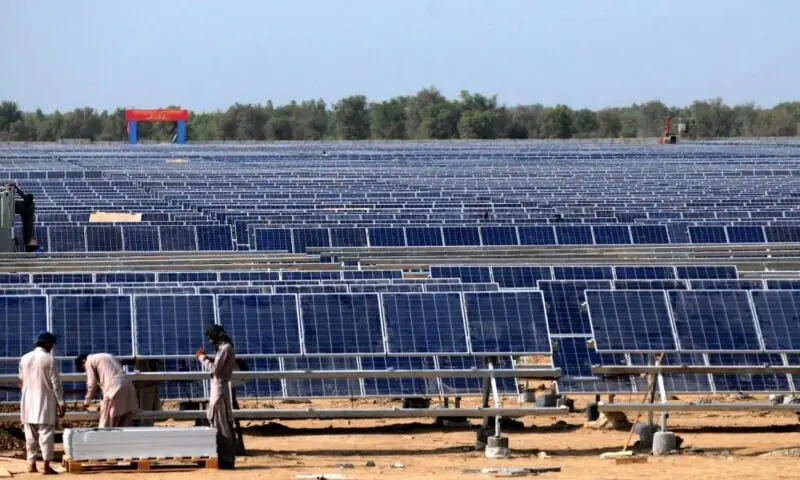
Pakistanis have been using solar panels for years, especially in rural areas. However, without proper storage, the benefits can only be felt during the day. Now, the combination of solar panels with battery-storage systems is transforming how power is managed. In the nine months between July 2024 and March 2025, Pakistan imported 12.7 gigawatts (GW) of solar PV – astonishing given its total installed power generation capacity from all sources of 46.6 GW.
If they already have solar panels, people are connecting them to Chinese lithium batteries to store the power they generate. Meanwhile, commercial consumers and people in newly electrifying areas are purchasing combined solar-battery systems.
These new solar-battery systems make power available at night or during outages. For factories, shops and offices that need a constant power supply, and usually rely on diesel generators, this is a major improvement.
In Faisalabad, a textile mill owner told me that he cut his diesel consumption by 70% after installing a 1.5 megawatt-hour battery system. “It cost us a lot upfront,” he said, “but we expect to recover the investment in three years. More importantly, we are no longer at the mercy of the utility company”.
In wealthy urban neighbourhoods of Lahore, developers are now offering houses with built-in solar-and-battery systems as standard features. In Sindh, some wealthier farmers are using solar-powered tube wells with battery backup to pump water even at night.
This silent revolution is happening across the country. From cold storage units in Balochistan to small IT firms in Islamabad, solar-battery combos are helping people stay productive during hours-long power cuts.
The powerless
But while businesses and wealthier families are benefiting, many poorer communities are being left behind. Solar-battery systems are still expensive, and government support for clean energy is minimal. Microfinance loans for solar installations are hard to come by, especially in rural area and informal urban settlements. Underprivileged people often lack land papers or collateral, making banks and microfinance groups hesitant to issue loans.
Asad Mehmood, a development specialist in Islamabad, warns this trend could worsen inequality. “When clean energy becomes a luxury for the few, you risk deepening social divisions. Energy access is a right, not a privilege,” he says.
In many katchi abadis (informal settlements), people still rely on illegal electricity connections. Poorly ventilated diesel generators are also common, exposing people to high energy costs and health risks.
Meanwhile, small shopkeepers and farmers, already struggling with inflation, find it difficult to invest in solar setups even though it would save them money long term. Without policy support, clean energy may remain out of reach for the people who need it most.
Dumping ground or development partner?
There is also growing concern among energy experts that Pakistan might become over-reliant on Chinese manufacturers.
On condition of anonymity, an energy researcher at the Lahore University of Management Sciences says: “Yes, we are getting affordable technology, but we are also becoming extremely dependent on one source. What if China changes its export policies or battery prices go up again?”
There is also the growing need to properly recycle or dispose of batteries. Currently, Pakistan has a 0% e-waste collection rate, according to the Global E-waste Statistics Partnership. Most lithium-ion batteries end up in landfills or are dismantled by informal workers without any safety measures. This can lead to chemical pollution, fire hazards and severe health risks.
In 2020, Pakistan pledged to generate 60% of its electricity from renewable sources by 2030. By 2023, the proportion was 40% if nuclear is included and 26% if not, according to Ember. Solar-battery systems could help achieve the 60% target faster than large-scale dams or wind farms, which often face delays and political hurdles.
But right now, this green shift is happening without proper rules or planning. There are no dedicated national standards for battery installation, storage or safety. There is no clear integration of small solar-battery systems into the main power grid. Most of the transition is being driven by private individuals and businesses acting out of necessity.
A chance to rethink energy
Pakistan’s move to solar-battery systems offers a real chance to address the country’s energy problems while helping the planet. But we must be careful. The current shift is happening more because of market pressure than proper planning.
If Pakistan wants this energy shift to truly benefit everyone, several important steps need to be taken.
The government must create proper battery-recycling laws to safely manage electronic waste and prevent environmental damage.
Clear standards must also be set for the quality of products and installation practices to avoid accidents and substandard equipment being imported.
Subsidies and accessible loan options should be introduced, to make solar-battery systems more accessible, especially for small-scale farmers, shopkeepers and low-income families.
Lastly, Pakistan should invest in developing local industries to produce key components domestically, reducing reliance on foreign imports and strengthening energy independence.
We need national policies that make clean energy fair, safe and lasting. We must build a system that supports both businesses and poor households. And we must ensure the technology we import today doesn’t become waste that we can’t handle tomorrow.
As the sun continues to shine on the rooftops of Pakistan, solar panels and batteries are quietly powering homes, shops and factories. But they are also raising an important question. Are we shaping our energy future, or are we just reacting to what the world gives us?
This article was originally published by Dialogue Earth and has been republished with permission.
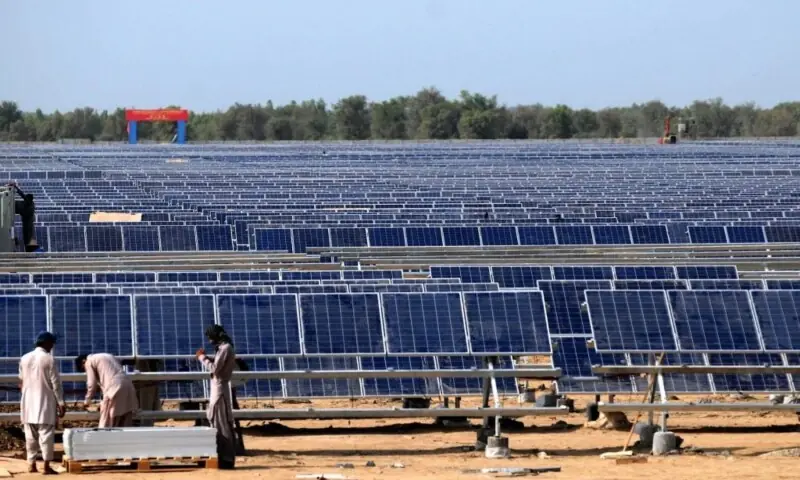
Header Image: Workers install photovoltaic panels at the 900-megawatt Zonergy Bahawalpur Solar Park in Punjab, eastern Pakistan (Image: Ahmad Kamal / IMAGO / Alamy)

