
From Wikipedia, the free encyclopedia
Content deleted Content added
| Line 24: | Line 24: | ||
|
==Chemistry== |
==Chemistry== |
||
|
Palmitoyl pentapeptide-4 (Pal-Lys-Thr-Thr-Lys-Ser = Pal-KTTKS) contains 5 [[amino acid]]s linked to a 16-carbon [[aliphatic]] chain for improving the penetration of the molecule through the lipid structures of the skin. It is a matrikine.<ref>{{Cite web |title=Matrixyl™ {{!}} Palmitoyl pentapeptide-4; former Palmitoyl pentapeptide-3 {{!}} Ingredient {{!}} INCI Guide |url=https://inci.guide/peptides/matrixyltm |access-date=2023-07-03 |website=inci.guide}}</ref> A number of similar molecules are known.<ref> |
Palmitoyl pentapeptide-4 (Pal-Lys-Thr-Thr-Lys-Ser = Pal-KTTKS) contains 5 [[amino acid]]s linked to a 16-carbon [[aliphatic]] chain for improving the penetration of the molecule through the lipid structures of the skin. It is a matrikine.<ref>{{Cite web |title=Matrixyl™ {{!}} Palmitoyl pentapeptide-4; former Palmitoyl pentapeptide-3 {{!}} Ingredient {{!}} INCI Guide |url=https://inci.guide/peptides/matrixyltm |access-date=2023-07-03 |website=inci.guide}}</ref> A number of similar molecules are known.<ref>{{doi|10.4062/biomolther.2014.053}}</ref><ref>{{doi|10.1007/s13770-016-0017-y}}</ref><ref>{{pmid|31829923}}</ref><ref>{{doi|10.3390/molecules30163415}}</ref> |
||
|
Matrikines are messenger [[peptides]] capable of regulating cell activities by interacting with their specific receptors. They activate certain genes involved in the process of extracellular matrix renewal and cell proliferation.<ref>{{Cite journal | doi = 10.1051/jbio/1999193040423 | title = Régulation de l’activité cellulaire par la matrice extracelulaire : Le concept de matrikines | journal = Journal de la Société de Biologie | volume = 193 | issue = 4–5 | pages = 423–428 | year = 1999 | last1 = Maquart | first1 = François-Xavier | last2 = Siméon | first2 = Alain | last3 = Pasco | first3 = Sylvie | last4 = Monboisse | first4 = Jean-Claude }}</ref> By activating the neosynthesis of extracellular matrix macromolecules, palmitoyl pentapeptide-4 provides an anti-wrinkle effect.{{medcn|date=January 2015}} Studies (”[[in vitro]]” and ”[[in vivo]]”) demonstrating the anti-wrinkle efficacy of this [[peptide]] have been conducted and published by Sederma and by independent organisations.<ref>{{Cite journal | doi = 10.1021/mp300549d | pmid = 23320752 | title = Collagen Stimulating Effect of Peptide Amphiphile C16–KTTKS on Human Fibroblasts | journal = Molecular Pharmaceutics | volume = 10 | issue = 3 | pages = 1063–1069 | year = 2013 | last1 = Jones | first1 = Roanne R. | last2 = Castelletto | first2 = Valeria | last3 = Connon | first3 = Che J. | last4 = Hamley | first4 = Ian W. }}</ref><ref>{{Cite journal | doi = 10.1046/j.1467-2494.2000.00010.x| pmid = 18503476| title = Biologically active peptides: From a laboratory bench curiosity to a functional skin care product| journal = International Journal of Cosmetic Science| volume = 22| issue = 3| pages = 207–218| year = 2000| last1 = Lintner| last2 = Peschard}}</ref><ref>{{Cite journal | doi = 10.1111/j.1467-2494.2005.00261.x| pmid = 18492182| title = Topical palmitoyl pentapeptide provides improvement in photoaged human facial skin1| journal = International Journal of Cosmetic Science| volume = 27| issue = 3| pages = 155–160| year = 2005| last1 = Robinson| first1 = L. R.| last2 = Fitzgerald| first2 = N. C.| last3 = Doughty| first3 = D. G.| last4 = Dawes| first4 = N. C.| last5 = Berge| first5 = C. A.| last6 = Bissett| first6 = D. L.}}</ref> |
Matrikines are messenger [[peptides]] capable of regulating cell activities by interacting with their specific receptors. They activate certain genes involved in the process of extracellular matrix renewal and cell proliferation.<ref>{{Cite journal | doi = 10.1051/jbio/1999193040423 | title = Régulation de l’activité cellulaire par la matrice extracelulaire : Le concept de matrikines | journal = Journal de la Société de Biologie | volume = 193 | issue = 4–5 | pages = 423–428 | year = 1999 | last1 = Maquart | first1 = François-Xavier | last2 = Siméon | first2 = Alain | last3 = Pasco | first3 = Sylvie | last4 = Monboisse | first4 = Jean-Claude }}</ref> By activating the neosynthesis of extracellular matrix macromolecules, palmitoyl pentapeptide-4 provides an anti-wrinkle effect.{{medcn|date=January 2015}} Studies (”[[in vitro]]” and ”[[in vivo]]”) demonstrating the anti-wrinkle efficacy of this [[peptide]] have been conducted and published by Sederma and by independent organisations.<ref>{{Cite journal | doi = 10.1021/mp300549d | pmid = 23320752 | title = Collagen Stimulating Effect of Peptide Amphiphile C16–KTTKS on Human Fibroblasts | journal = Molecular Pharmaceutics | volume = 10 | issue = 3 | pages = 1063–1069 | year = 2013 | last1 = Jones | first1 = Roanne R. | last2 = Castelletto | first2 = Valeria | last3 = Connon | first3 = Che J. | last4 = Hamley | first4 = Ian W. }}</ref><ref>{{Cite journal | doi = 10.1046/j.1467-2494.2000.00010.x| pmid = 18503476| title = Biologically active peptides: From a laboratory bench curiosity to a functional skin care product| journal = International Journal of Cosmetic Science| volume = 22| issue = 3| pages = 207–218| year = 2000| last1 = Lintner| last2 = Peschard}}</ref><ref>{{Cite journal | doi = 10.1111/j.1467-2494.2005.00261.x| pmid = 18492182| title = Topical palmitoyl pentapeptide provides improvement in photoaged human facial skin1| journal = International Journal of Cosmetic Science| volume = 27| issue = 3| pages = 155–160| year = 2005| last1 = Robinson| first1 = L. R.| last2 = Fitzgerald| first2 = N. C.| last3 = Doughty| first3 = D. G.| last4 = Dawes| first4 = N. C.| last5 = Berge| first5 = C. A.| last6 = Bissett| first6 = D. L.}}</ref> |
||
Revision as of 03:11, 10 November 2025
 |
|
| Identifiers | |
|---|---|
| ChEMBL | |
| ChemSpider | |
| ECHA InfoCard | 100.126.177 |
| EC Number | |
| UNII | |
|
|
|
|
| Properties | |
| C39H75N7O10 | |
| Molar mass | 802.068 g·mol−1 |
|
Except where otherwise noted, data are given for materials in their standard state (at 25 °C [77 °F], 100 kPa).
|
|

Chemical compound
Palmitoyl pentapeptide-4 (palmitoyl pentapeptide-3 before 2006) is a matrikine used in anti-wrinkle cosmetics. It was launched in 2000 as an active ingredient for the personal care industry under the trade name Matrixyl by the Spanish cosmetic active ingredient manufacturer Sederma SAS.
Chemistry
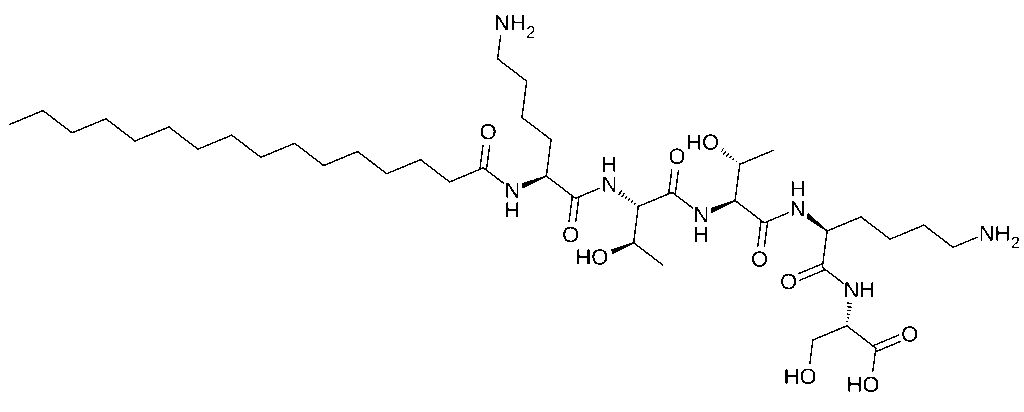
Palmitoyl pentapeptide-4 (Pal-Lys-Thr-Thr-Lys-Ser = Pal-KTTKS) contains 5 amino acids linked to a 16-carbon aliphatic chain for improving the penetration of the molecule through the lipid structures of the skin. It is a matrikine.[1] A number of similar molecules are known.[2][3][4][5]
Matrikines are messenger peptides capable of regulating cell activities by interacting with their specific receptors. They activate certain genes involved in the process of extracellular matrix renewal and cell proliferation.[6] By activating the neosynthesis of extracellular matrix macromolecules, palmitoyl pentapeptide-4 provides an anti-wrinkle effect.[medical citation needed] Studies (in vitro and in vivo) demonstrating the anti-wrinkle efficacy of this peptide have been conducted and published by Sederma and by independent organisations.[7][8][9]
References
- ^ “Matrixyl™ | Palmitoyl pentapeptide-4; former Palmitoyl pentapeptide-3 | Ingredient | INCI Guide”. inci.guide. Retrieved 2023-07-03.
- ^ doi:10.4062/biomolther.2014.053
- ^ doi:10.1007/s13770-016-0017-y
- ^ PMID 31829923
- ^ doi:10.3390/molecules30163415
{{doi}}: unflagged free DOI (link) - ^ Maquart, François-Xavier; Siméon, Alain; Pasco, Sylvie; Monboisse, Jean-Claude (1999). “Régulation de l’activité cellulaire par la matrice extracelulaire : Le concept de matrikines”. Journal de la Société de Biologie. 193 (4–5): 423–428. doi:10.1051/jbio/1999193040423.
- ^ Jones, Roanne R.; Castelletto, Valeria; Connon, Che J.; Hamley, Ian W. (2013). “Collagen Stimulating Effect of Peptide Amphiphile C16–KTTKS on Human Fibroblasts”. Molecular Pharmaceutics. 10 (3): 1063–1069. doi:10.1021/mp300549d. PMID 23320752.
- ^ Lintner; Peschard (2000). “Biologically active peptides: From a laboratory bench curiosity to a functional skin care product”. International Journal of Cosmetic Science. 22 (3): 207–218. doi:10.1046/j.1467-2494.2000.00010.x. PMID 18503476.
- ^ Robinson, L. R.; Fitzgerald, N. C.; Doughty, D. G.; Dawes, N. C.; Berge, C. A.; Bissett, D. L. (2005). “Topical palmitoyl pentapeptide provides improvement in photoaged human facial skin1”. International Journal of Cosmetic Science. 27 (3): 155–160. doi:10.1111/j.1467-2494.2005.00261.x. PMID 18492182.

