


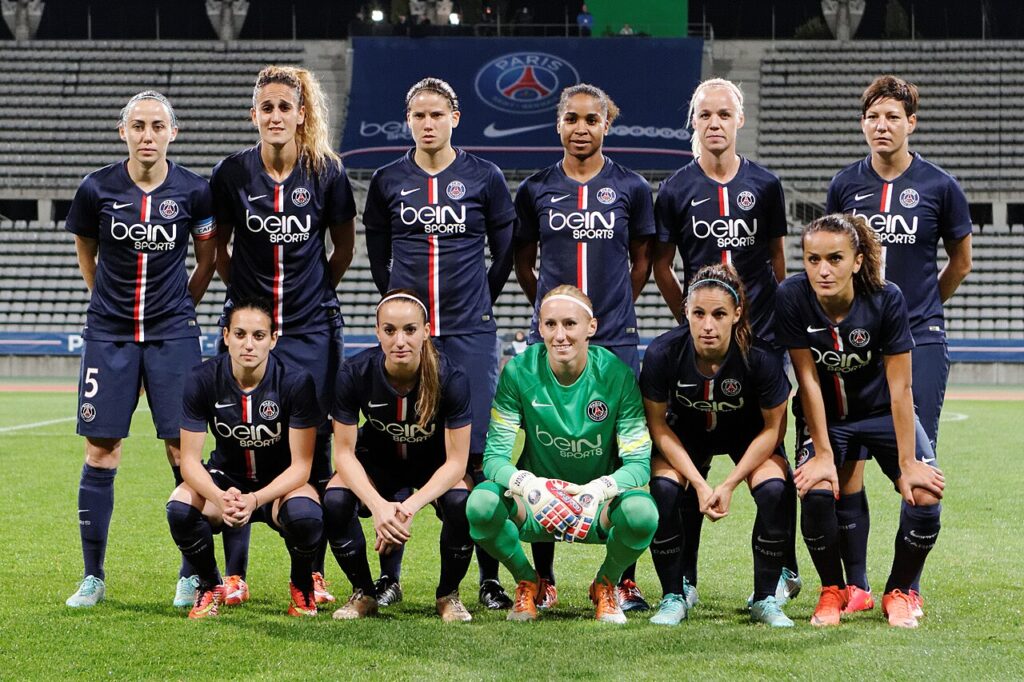
Football rivalry in France
The Paris derby (French: Derby de Paris) is a French football rivalry contested between Paris Saint-Germain FC (women) (PSG) and Paris FC (women) (PFC), the two largest professional women’s clubs based in Paris, France. Both Étoile Sportive de Juvisy-sur-Orge and Paris Saint-Germain were founded in 1971, making them among the oldest clubs in French women’s football.
During the 1990s and 2000s, Juvisy established itself as the dominant Parisian side, regularly competing for national championships alongside OL Lyonnes and benefiting from consistent support from the Essonne departmental council. PSG, in contrast, remained a mid-table club for much of this period, undergoing a squad overhaul in 2005 to promote young talent and restructure the team. Juvisy’s sustained strength was highlighted by decisive victories over PSG, illustrating the club’s superior resources and squad depth.
PSG gradually closed the gap after 2009, strengthened by key signings and the 2012 takeover by Qatar Sports Investments (QSI), which bolstered the squad and allowed the club to challenge Lyon and assert dominance in the Paris derby. Juvisy’s absorption into Paris FC in 2017 created a new dynamic, with PFC seeking to compete with the top teams despite initial difficulties. Throughout the 2010s, PSG largely dominated the derby, while Paris FC emerged as a third force in French women’s football during the 2020s.
The Paris derby also extends to men’s football, where Paris Saint-Germain FC and Paris FC compete at the highest level. PSG was founded in 1970 and quickly became the leading professional club in the capital, while Paris FC, which split from PSG in 1972, spent decades outside the top flight. Following Paris FC’s promotion to Ligue 1 in 2025, the men’s derby returned to the French top division for the first time in decades, further intensifying the historical rivalry between the two clubs.
History
Juvisy supremacy

Étoile Sportive de Juvisy-sur-Orge and Paris Saint-Germain FC (women) were both founded in 1971, making them among the oldest clubs in French women’s football. During the 1990s and 2000s, Juvisy shared championship honours with OL Lyonnes and emerged as the dominant force in the capital. In an era when the women’s game was largely amateur, Juvisy benefited from sustained support from the Essonne departmental council, which allowed the club to develop superior organization and resources. PSG, by contrast, regularly competed in the top division during the 1980s and again from 2001, but generally remained a mid-table side, typically finishing between fifth and tenth place.[1]
A first restructuring of PSG occurred in 2005 after a 10th-place league finish. With the club’s backing, head coach Cyril Combettes overhauled the squad: around ten players, including veterans Ingrid Boyeldieu, Stéphanie Hoffele and Florence Freyermuth, were asked to find new clubs. They were replaced by emerging talents, notably CNFE Clairefontaine graduates Laure Boulleau and Sabrina Delannoy. The third-division team was dismantled, with some players promoted to the first team, others reassigned, and the rest released, leaving PSG with roughly twenty players for the season.[1]
By contrast, Juvisy required no major overhaul. Runners-up to Montpellier the previous season, the club compensated for the retirement of Stéphanie Mugneret-Béghé and the maternity leave of Aline Riera by signing internationals Anne-Laure Casseleux and Amélie Coquet, who joined eight other French internationals already at the club. Juvisy went on to record 21 wins, a single defeat, and 85 goals. PSG, meanwhile, entered the season with a reduced squad and no reserve team. Led by captain Sandrine Soubeyrand, Juvisy defeated PSG 4–0 in the league, with goals from Marinette Pichon, Élise Bussaglia, Virginie Mendes, and Laëtitia Tonazzi.[1]
The return match, played on 18 December 2005, was even more one-sided. Juvisy defeated PSG 5–0 at the Stade Georges-Maquin, with Marinette Pichon scoring a hat-trick and additional goals from Peggy Provost and Sandrine Soubeyrand. PSG were unable to name 11 players on the match sheet, having been reduced for nearly a month to a squad of just 13 players, including two goalkeepers. Several players were unavailable, including Émilie Gassin, Gwenaël Gérard, Stéphanie Legrand and Stéphanie Morel. As a result, PSG took the field with only nine outfield players, with captain Bérangère Sapowicz in goal and reserve goalkeeper Cécilie Quatredeniers at left-back.[1]
Rise of PSG
Although PSG had defeated Juvisy twice during their first two seasons in the Première Ligue, Juvisy subsequently asserted its dominance, recording 11 wins and 2 draws between 2003 and 2010. In cup competitions, their first meeting in 2005 ended in a comprehensive 7–0 victory for Juvisy, while the second, in 2008, was won by PSG thanks to a brace from Marie-Laure Delie, allowing the club to reach the final at the Stade de France.[1]
PSG did not begin to challenge consistently at the top of the table until 2009, a season marked by the signings of Élise Bussaglia, Jessica Houara, and Julie Soyer, as well as short-term stints by Americans Camille Abily and Sonia Bompastor.[1] On 18 October 2009, PSG played their first match at the Parc des Princes, winning through a goal by Abily, a result that coincided with a gradual rebalancing of the rivalry during the following decade.[1][2][3]
PSG was further strengthened following the takeover by Qatar Sports Investments (QSI) in 2012, developing a fierce rivalry with Lyon, winning several national titles, and reaching two UEFA Women’s Champions League finals.[3][4][5] During the 2010s, PSG largely dominated the Paris derby, reflecting the financial disparity created by QSI investment. The last victory for Juvisy in the derby came on 6 December 2013, when captain Sandrine Soubeyrand led the team to a 1–0 win over PSG.[2][6]
PFC and renewed rivalry
In June 2017, Paris FC (women) absorbed Juvisy with the aim of challenging Lyon and PSG for the top positions. Despite substantial investment, PFC initially struggled to reach the podium.[2][4] PSG claimed their first championship in 2021, the first for a Parisian club since Juvisy in 2006.[2][6][7] In the 2020s, Paris FC gradually established itself as the third force in the Première Ligue, notably defeating PSG in the 2025 Coupe de France Féminine final on penalties.[4][8] PSG later took revenge with a 3–0 victory in the championship semi-final, with goals from Romée Leuchter, Sakina Karchaoui and Korbin Shrader. For the first time in four meetings between the clubs that season, PSG prevailed over Paris FC, denying captain Gaëtane Thiney a place in the final and marking the last match of her career.[9]
Statistics
- As of 7 February 2026.[10]

Paris Saint-Germain Paris FC Draw
Honours
Head-to-head
Finals
Men’s derby
The men’s Paris derby is contested between Paris Saint-Germain FC (PSG) and Paris FC (PFC). PSG, founded in 1970 through the merger of Paris FC and Stade Saint-Germain, has grown into the dominant club in both the capital and French football, regularly competing in Ligue 1 and European competitions. Paris FC, which split from PSG in 1972, spent decades in the lower divisions before returning to the top flight in 2025, reigniting a local derby that had been dormant at the highest level for more than three decades.[8][13][14]
The rivalry traces its roots to the early history of football in the French capital, where historic clubs like Racing Club de France Football and Red Star FC once competed. PSG emerged from efforts by the French Football Federation (FFF) to create a major inner‑city club in the late 1960s, while Paris FC originally remained in Ligue 1 following the 1972 split. PSG quickly established itself as the capital’s leading club, taking over the Parc des Princes and embarking on a period of sustained success that left Paris FC largely absent from the top tier. Consequently, first‑team meetings between the two were rare for decades.[8][13][14]
Following Paris FC’s promotion to Ligue 1 in 2025, the Paris derby returned as a significant fixture in French football. The two clubs’ home stadiums—PSG’s Parc des Princes and PFC’s Stade Jean-Bouin—are separated by only a short distance, creating one of the closest geographic derbies in world football. The first top‑flight meeting since 1990 took place on 4 January 2026 at the Parc des Princes, with PSG winning 2–1 in a closely contested match. A subsequent Coupe de France encounter saw Paris FC secure a 1–0 victory, marking PSG’s first home defeat in the competition in several years.[14][15][16][17]



