


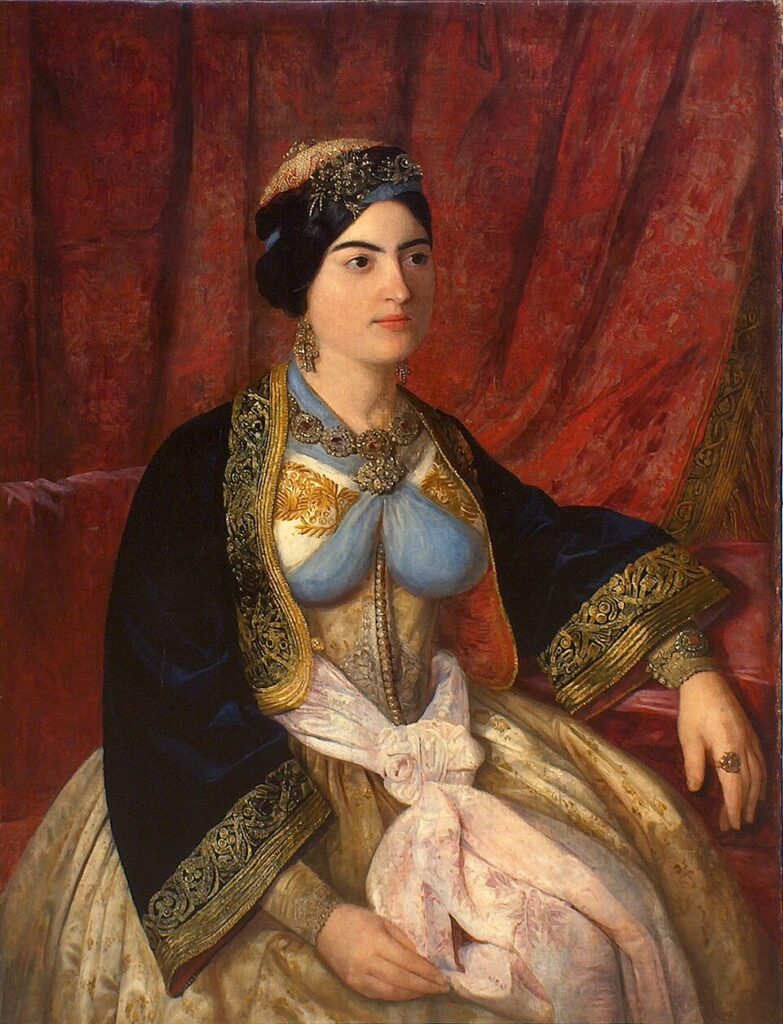
Princess consort of Serbia
Persida Karađorđević née Nenadović (Serbian Cyrillic: Персида Ненадовић; 15 February 1813 – 29 March 1873) was the Princess of Serbia as the wife of Alexander Karađorđević, who ruled the Principality of Serbia from his election on 14 September 1842 until his abdication on 24 October 1858. She was the mother of ten children, including future king Peter I of Serbia, who succeeded to the throne after the assassination of King Alexander I, the last ruler of the Obrenović dynasty (the traditional rivals of the Karađorđevićs).[1]
Biography


Early life and ancestry
Persida was born on 15 February 1813 in Brankovina, Ottoman Empire (now Serbia), into Nenadović family, at that time the most powerful political family in Principality of Serbia, hich had earned its name and reputation long before the Karađorđević and Obrenović dynasties. They were representatives of the people, princes under Ottoman authority, and freikorps soldiers in the imperial Austrian army. All later dynasties earned their name and reputation through various uprisings, while the Nenadović family had already been shaping Serbian history as early as the 18th century. In times of war, they produced four vojvodas (military commanders). Persida was the daughter of Voivode Jevrem Nenadović (1793–1867) and his wife, Jovanka “Joka” Milovanović (1792–1880), who was remembered as a very beautiful woman, of medium height, strong build, and with unusually black hair which, it is said, never turned gray until her death at the age of 88.[3]
Her paternal grandfather was Jakov Nenadović, the first Serbian Interior Minister of Revolutionary Serbia, while her maternal grandfather Mladen Milovanović was the first Serbian Minister of Defence.[4] Through her younger sister Anka (1820-1843), she was the aunt of Petar Topalović, Serbian Minister of Construction.
On 1 June 1830 in Khotyn, Bessarabia, at the age of 17, young Persida married Alexander Karađorđević (1806-1885), the youngest son of Karađorđe Petrović and his wife, Jelena Jovanović (1771-1842). Her family, too, lived in exile, and with this marriage the two most influential families in Serbia at the time became united.
Prince Alexander was a withdrawn and highly sensitive young man, deeply attached to his mother. He had been a cadet at the Page Corps military academy in Chișinău, though he never completed his studies. It was only in 1831 that Prince Miloš finally permitted the Karađorđević family to return to Serbia. At that time, Karadjordje’s widow, Jelena Jovanović—Alexander’s mother and Persida’s mother-in-law—held a Russian passport.
However, Miloš soon changed his mind: he refused to allow any of the Karađorđevićs, except Karađorđe’s daughter Stamenka (1799-1875), who was married into the influential Čarapić family, to reenter Serbia. As compensation, he sent them a small sum of money and arranged modest lodging for them in Wallachia, in the town of Craiova. Four years later, he arranged for them to receive a national pension of 500 thalers per year, though in reality it was never paid. As a result, the family lived in severe poverty, struggling to make ends meet. Only in 1839 were they at last allowed to return to Serbia—precisely after Miloš himself was forced into exile in Wallachia.
Return to Serbia
The family finally crossed the Danube and entered Serbia on 1 September 1839, despite opposition from several members of the State Council and the Regency at the time. Their return was made possible largely through the decisive assistance of the Russian consul, Gerasim Vasilevich Vaschenko (1790–1868). They initially settled in Negotin. Many historians believe that the primary aim of their return was not the head of the family’s pursuit of the throne; rather, their eventual ascent resulted from a series of circumstances shaped by the turbulent political climate in Belgrade, which altered the balance between the competing dynasties.[5]
Upon their return, Alexander Karadjordjević joined the headquarters of the Serbian Princely Army and received the rank of second lieutenant. Later, at the end of April 1840, Prince Mihailo promoted him to serve as his personal adjutant.[6] Alexander’s mother Jelena passed away on 17 February 1842, and her close friend, Princess Ljubica of Serbia, accompanied the funeral procession all the way to Topola, hinting at the possibility of reconciliation between the two rival families.[7]
The Princess of Serbia

.jpg)

On 14 September 1842, as a result of the uprising led by Toma Vučić Perišić and the Defenders of the Constitution, Alexander was elected as Prince of Serbia, succeeding the deposed Prince Mihailo Obrenović III, and himself becoming the first Karađorđević ruler. After their accession to the throne, they moved into the house of Stojan Simić, located on the site of today’s Old Palace. It was granted to them for use, but not as their property.
In the newly established court, the leading figure was the princess, Persida, and under her guidance, life at the palace was far more lively and interesting than the general social life of Belgrade. She held complete initiative, overseeing everything from interior decoration and arrangements to matters of policy. Her influence became particularly evident when, after some time, she began organizing the famous court gatherings. These were the principal cultural events of the period, featuring a variety of programs: music and dance, singing, and readings of new dramatic works.
These gatherings, which combined elements of old Serbian tradition, Oriental influences, and the fresh currents of contemporary European culture, were attended by the entire elite of Belgrade. Persida possessed a keen sense of diplomacy, and even the most staunch supporters of the Obrenović dynasty were invited to her events. The attendees included members of the court, foreign diplomats, families of several ministers, officers, retired Serbian diplomats, and a small number of Belgraders who had, “by chance,” become Europeanized. This was considered the elite of the time, especially since Serbia forbade the granting of noble titles and the existence of an aristocracy, due to fears of extreme social stratification.[8]
The main aides of Princess Persida and the architects of her refined courtly environment were Marija Milutinović, widow of Sima Milutinović Sarajlija, and the esteemed writer and academic Matija Ban, who formally acted as tutor to the prince’s daughters and to Prince Peter. Deeply committed to her children’s education, she even brought from Prague Dr. Vilém Gabler to oversee the instruction of Peter and his younger brother Andrej. Persida herself was fluent in Russian, French, and German, and devoted considerable attention to her daughters’ physical training. Beyond regular exercises, they became renowned as some of the finest horsewomen in Belgrade, especially during their excursions to Topčider.
Until the final days of her husband’s rule, she sought to be his chief political adviser. In doing so, however, she often hindered Alexander more than she helped him and, despite her best intentions, contributed in part to his downfall rather than his endurance on the throne. This influence was particularly evident during the final days of his rule, when the prince began making serious errors regarding the punishment of those involved in Tenka’s conspiracy and in handling the events surrounding the Saint Andrew’s Day Assembly. More ambitious than her husband, the loss of the throne weighed far more heavily on her. Yet she never really abandoned hope that, one day, the family would return to power.
After the end of the Crimean War, the international situation shifted in Russia’s favor, something that did not suit Prince Alexander, known for his strong Austrophile leanings. During this period, even politicians who had once supported him—most notably Toma Vučić Perišić and Stefan Stefanović Tenka—turned their backs on him, and there were suspicions that Prince Miloš, from exile, was funding the rebels.
When a delegation from the National Assembly arrived at court to demand Alexander’s abdication, he replied that he needed time to think until the next day. This infuriated Persida so much that she stepped out in front of the delegation, sharply reproached her husband for his weakness in negotiations, and declared publicly that she “would sooner let herself be cut to pieces than give up the throne.”
After a long conversation with Ilija Garašanin—who conveyed the position of the great powers, especially Russia, France, and the Ottoman Empire—Alexander decided to go for a “meeting” with Omer Pasha in the Belgrade Fortress, which effectively meant abdication. His wife cried after him: “What fortress, what Pasha? Are you not the son of Karađorđe? Go to the military barracks—that is where you belong!” But it was all in vain: the very next day, Prince Alexander was deposed.
The conspirators’ intention had not been to restore the Obrenović dynasty, but to place Alexander’s nephew, Đorđe Karađorđević (1827-1884)—son-in-law of Miša Anastasijević, President of the National Assembly of Serbia and one of the wealthiest men in the region, known as the Danubian Rothschild—on the throne. His plan was to use his son-in-law to place his daughter, Sara Sarka Anastasijević (1836-1931), on the throne as the Princess Consort of Serbia. However, Prince Miloš was already returning from Wallachia to take the throne for himself and ordered the removal of everyone involved in this plan, starting with Ilija Garašanin. From the date of her husband’s accession until his abdication, she held the style of Princess of Serbia; during her exile, she was styled Princess Karađorđević.[9]
During her husband’s reign, Princess Persida played a significant and pioneering role in many of the new cultural and social initiatives emerging in Serbia. For her charitable endeavors and contributions to cultural life , Princess Persida was awarded the Order of the Imperial Portrait by Sultan Abdulmejid I of the Ottoman Empire. She also participated in establishing the first Serbian theater in 1847 and, the following year, donated money to transform one of the building’s halls into a permanent theatre hall in Kosančićev Venac. The theatre was named “Theatre at Deer’s”.[10] At her initiative, the Church of St. Ilija in Sokobanja was erected and a precious cross was donated to the Church of the Ascension in Mionica.[11]
Life in exile

.jpg)
Following Alexander’s abdication, she and her family retired to Timișoara. During her years in exile, she was the one who largely oversaw all matters and made the final decisions, including those concerning the education and marriages of her children. Mihailo Obrenović, Prince of Serbia, dissatisfied with his marriage, attempted to secure a divorce, and during the process he began seeking another wife for himself. Encouraged by the advice of his friends and reflecting on his experience with his wife Julia Hunyady, he decided that a foreign bride was no longer an option; instead, he sought a Serbian woman from a prominent family. The choice fell on Princess Jelena Karadjordjević (1846-1867), the youngest daughter of the deposed Serbian prince and granddaughter of Karađorđe.
The proposal itself, and its outcome, were decided entirely by Persida rather than the former prince. This is attested by a letter she wrote to her youngest son, Prince Arsen on 10 March 1864, in which she stated:
“They say Mihailo wants to marry, but he cannot find a suitable bride; he wants a Serbian woman. His people came to ask if we would give the hand of our Jelena, and we told them we would not.”
Prince Mihailo repeated his request in 1866, but Persida once again categorically refused, unwilling to reconcile the Karađorđević and Obrenović dynasties through the marriage of her daughter.[12]
Persida invested heavily in the education of both her sons and daughters. She was far more politically ambitious than her husband, practically managing the state’s affairs on her own, which contributed significantly to his removal from the throne, although her intentions were genuinely honorable. Even in exile, she never lost hope that the Karađorđevićs would return to the throne.[13]
When they departed, their estates in Serbia were not confiscated, and he continued to enjoy a respectable income. After leaving Serbia in the middle of 1859, he purchased a large three-story house in Pest, where the family spent much of their time. That same year, he also bought properties in Bocsig (Arad County) and Herăști (Muntenia), as well as a very fine house in Timișoara—then part of the Austro-Hungarian Empire—slightly smaller than the one in Pest.
But this prosperity did not last. When Prince Mihailo was assassinated during his excursion to Košutnjak in 1868, the government accused the Karađorđević family of orchestrating the attack—first and foremost Alexander Karađorđević and the Nenadović brothers and cousins of Princess Persida. In Serbian political circles, even Persida herself was suspected, with many believing she controlled the entire network and all the threads of the conspiracy in an effort to secure the throne for her son, Peter.
Legal proceedings over their alleged involvement, which proved enormously costly, began both in Pest and in Belgrade. The Belgrade municipal court summoned Alexander to appoint a defense lawyer and appear before the court. When he refused, the court issued a decision confiscating all of his Serbian estates, which were far from insignificant. Their value was estimated between 180,000 and 250,000 ducats, and included houses, manors, farmland, the “Kruna” Hotel in Belgrade, shops, stables, steam-powered mills, vineyards, bonds, and cash held by various individuals.
Over the years, these Serbian estates were sold off for a pittance—merely 57,990 ducats. Matters were more complex regarding the properties in Romania. Belgrade demanded that everything be seized and sold, while the Romanian court ultimately ruled in favor of the Karađorđević family, judging the prince’s alleged offense to be political in nature and therefore invalid on Romanian territory.
At Belgrade’s request, the Hungarian authorities later arrested Alexander Karađorđević and threw him into prison, where he spent a year. In January 1871, he was sentenced to eight years of imprisonment. Immediately after Alexander’s arrest, Princess Persida moved to Vienna, where she lived until her death on April 10, 1873. After his release from prison, her husband also spent some time in Vienna before relocating to Timișoara, where he fell ill in February 1885 and died on May 3 of the same year.[14]
Death
Princess Persida passed away on 29 March 1873 in Vienna at the age of 60, while her husband, the former Prince Alexander, died in Timișoara on 3 May 1885 at the age of 78, outliving his wife by more than twelve years. In 1912, their son King Peter ordered the remains of Princess Persida and Prince Alexander to be moved to the Church of St. George in Oplenac.[15]
The actress Catherine Oxenberg and an actor Sebastian Arcelus are among of Princess Persida’s many living descendants.[16]
Issue
During her marriage, Persida gave birth to a total of 10 children, six of whom lived to adulthood:
- Princess Poleksija (1 February 1833 – 5 December 1914), married firstly in 1849 Konstantin Nikolajević (1821 – suicide 13 October 1877),[17] Minister of the Interior of Serbia, by whom she had issue; secondly Dr Alexander Preshern (1830 – 2 December 1914).
- Princess Kleopatra (26 November 1835 – 13 July 1855), her hand was previously sought by Danilo I of Montenegro.[18][19] However, when nothing resulted from that, she went on to marry in 1855 Milan Avram Petronijević, the Serbian Ambassador to Russia.
- Prince Aleksij (23 March 1836 – 21 April 1841)
- Prince Svetozar (1841 – 17 March 1847)
- Prince Peter (29 June 1844 – 16 August 1921), ruled Serbia from 1903 until 1918, and subsequently as King of the Kingdom of Serbs, Croats, and Slovenes until his death; married Princess Zorka of Montenegro, by whom he had issue.
- Princess Jelena (18 October 1846 – 26 July 1867), married in 1867 to Đorđe Simić (28 February 1843 – 11 October 1921), Prime Minister of Serbia.
- Prince Andrej (15 September 1848 – 12 July 1864)
- Princess Jelisaveta (born and died 1850)
- Prince Đorđe (11 October 1856 – 5 January 1889), based on Glas Crnogorca from 1884, he was reportedly engaged to Princess Olga of Montenegro.[20]
- Prince Arsenije (16 April 1859 – 1938), married in 1892, Princess Aurora of San Donato. They were the parents of Prince Paul, Regent of Yugoslavia.
See also
References
- ^ C. L Sulzberger. (1977). The Fall of Eagles, New York: Crown Publishers, Inc., pp. 198, 202, 221
- ^ https://www.galerijamaticesrpske.rs/kolekcija/ivanovic-katarina-anka-topalovic-rodj-nenadovic/
- ^ Siniša Ljepojević (2018). Knez Arsenije Karadjordjević (page=20)
- ^ “Prva odlikovana Srpkinja, presto branila žustrije od muža: Ko je bila kneginja Persida Karađorđević? – Život – Dnevni list Danas” (in Serbian). 2023-11-19. Retrieved 2025-02-28.
- ^ Siniša Ljepojević (2018). Knez Arsenije Karadjordjević (page=15)
- ^ Milanovic, Stefan. “HSH Prince Alexander of Serbia”. The Royal Family of Serbia. Retrieved 2025-02-25.
- ^ Siniša Ljepojević (2018). Knez Arsenije Karadjordjević (page=16)
- ^ Milanovic, Stefan. “Princess Persida Karadjordjevic”. The Royal Family of Serbia. Retrieved 2025-02-27.
- ^ Siniša Ljepojević (2018). Knez Arsenije Karadjordjević (pages=16-24)
- ^ Mirjana Nikić (28 June 2019). Изглед првих театара у Београду [Appearance of the first theatres in Belgrade]. Politika-Moja kuća (in Serbian). p. 1.
- ^ https://royalfamily.org/dinasty/princess-persida-karadjordjevic/
- ^ Dragoslav Stranjaković, Mihailo i Julija Obrenović (Belgrade: Narodno Delo, 2023), p. 64. [1] (in Serbian)
- ^ Siniša Ljepojević (2018). Knez Arsenije Karadjordjević (pages=63/64)
- ^ Siniša Ljepojević (2018). Knez Arsenije Karadjordjević (pages=21/27)
- ^ Siniša Ljepojević (2018). Knez Arsenije Karadjordjević (page=27)
- ^ https://www.washingtonpost.com/lifestyle/what-to-watch-tv-chat-with-hank-stuever/2018/08/02/e6c4aa5e-9508-11e8-818b-e9b7348cd87d_livediscussion.html
- ^ “Константин Николајевић [Српска енциклопедија]”. srpskaenciklopedija.org. 27 September 2017. Retrieved 2025-05-17.
- ^ “Kolektiv ME”. Archived from the original on 2019-01-23.
- ^ Dvor kralja Nikole, Milan Jovićević, Anđe Kapičić i Tatjana Jović, Narodni muzej Crne Gore i Presmedij, Novi Sad, 1999.
- ^ Др Димо Вујовић (1968). Књегиња Даринка – политичка активност: прилог историjи Црне Горе 1855 – 1867 (page=155)



