
The Peshawar High Court reserved on Monday its decision on the PTI’s application seeking the nomination of Khyber Pakhtunkhwa Assembly Speaker Babar Saleem Swati or any other person “considered appropriate” in place of the province’s governor to administer the oath to Chief Minister-elect Sohail Afridi.
Earlier, PTI’s Salman Akram Raja and the provincial AAG appeared before the court today with regard to the PTI application.
On Monday, in a pre-emptive move, the PTI had approached the PHC to request that KP Assembly Speaker Babar Saleem Swati be nominated to administer Afridi’s oath, rather than the KP governor.
Plea filed in PHC against chief minister’s election
JUI-F leader Maulana Lutfur Rehman also filed a petition in the PHC today, requesting that the election of Sohail Afridi as the Khyber Pakhtunkhwa chief minister be “set aside” and declared null and void.
The election was held amid uncertainty about the status of Ali Amin Gandapur’s resignation from the provincial chief executive’s position.
Rehman was one of the four people in the race fot the KP CM office, along with Sardar Shah Jehan Yousaf of the PML-N, and Arbab Zarak Khan of the PPP and PTI’s Sohail Afridi — who won the election after the opposition staged a boycott.
In a petition filed today, a copy of which is available with Dawn.com, Rehman named six respondents, including the KP government, KP Governor Faisal Karim Kundi, the KP Assembly through its Speaker Babar Saleem Swati, the secretary of the provincial assembly, outgoing KP Chief Minister Ali Amin Gandapur, and CM-elect Sohail Afridi.
In his petition, he requested the court to set aside the election and declare it “ab initio void” as the it was “wholly unlawful, arbitrary, capricious, mala fide, without jurisdiction, coram non judice.”
Rehman questioned how an election could be held if Gandapur’s resignation had not yet been accepted. Citing Article 130(8) of the Constitution, he stressed that elections for the post can not be held unless it was vacant.
Article 130(8) states that “the Chief Minister may, by writing under his hand
addressed to the governor, resign his office”, and is the same clause that the PTI has been citing to contend that the CM’s resignation does not require the governor’s acceptance or approval.
Rehman’s petition further asked the court to declare decisions taken by the assembly and the speaker with regard to the CM appointment as “without lawful authority, void, and of no legal effect.”
The petition further urged the court to “declare all consequential notifications and actions, including the impugned notification, as illegal, arbitrary, capricious, without jurisdiction and having no legal effect.”
Rehman requested the court to halt any further proceedings in the matter until the governor had “lawfully received and verified” the resignation of Gandapur.
The petition called for a fresh election “in accordance with the Constitution and the assembly rules, after lawful confirmation of vacancy.”
It concluded by requesting the PHC to suspend the election result in order to “prevent chaos and ensure preservation of the rule of law.”
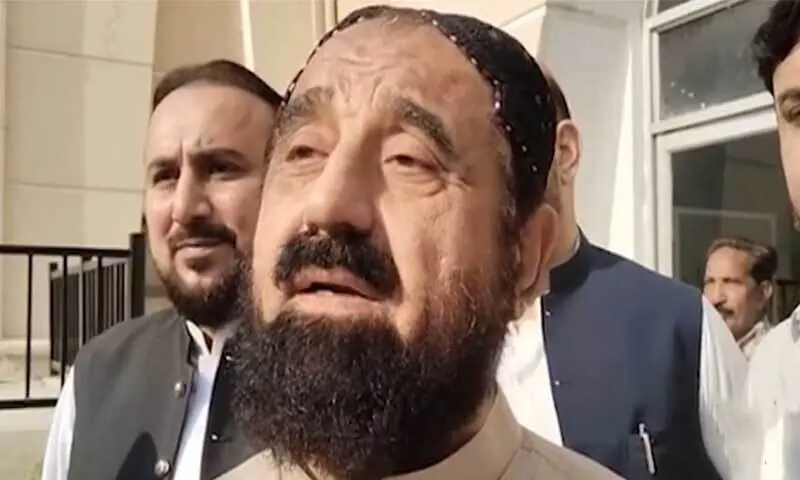
Speaking to the media outside the court, Rehman reiterated the opposition’s stance over the validity of the elections.
“We said this yesterday as well that the former chief minister’s resignation has not been accepted yet, and he has been summoned by the governor on Oct 15.
“Until the seat becomes vacant, the election can not be held,” he said.
Responding to a question that why the opposition chose to field candidates for the CM election if it believed the election was not in line with the law, he said, “At first, we were under the impression that the resignation had been finalised, but then the governor’s letter came to light, detailing that the resignation had not yet been finalised.”
From resignation to election
The barely two-year-old KP Assembly presently seems to be facing a constitutional crisis, which originates from incarcerated PTI founder Imran Khan’s decision on October 8 to change the command at the helm in the province.
In line with his directive, Gandapur resigned from his role the same day as the provincial chief executive while the party’s general secretary, Salman Akram Raja, confirmed that the party had picked Sohail Afridi.
The resignation letter, shared by Gandapur on X, was typed on his official letterhead and signed at the bottom. However, this initial resignation letter had apparently gotten lost in red tape, with the Governor’s House initially denying ever receiving it.
But, a copy of the letter seen by Dawn showed that it was received by the governor’s staff.
Subsequently, Gandapur sent another handwritten resignation to the governor, which was acknowledged by Kundi on Oct 11. He said in a post on X that the Governor House had received a handwritten resignation letter from Gandapur. “After thorough scrutiny and legal formalities as per the constitution [and] relevant laws, subject resignation will be processed in due course of time,” he added.
The controversy around the resignation took another turn late night the next day when Governor Kundi returned two separate letters submitted by the former over “disparate signatures” and summoned him on October 15 (tomorrow) to settle the matter.
In a post on social media platform X, Kundi said that the chief minister’s resignation had been “returned with observation”.
He also shared a letter addressed to Gandapur, wherein he stated that two resignation letters had been received by the Governor House on October 8 and October 11, both of which had “disparate and unalike signatures”.
For his part, Gandapur responded to Kundi’s post on X, stating: “Finally, the resignation submitted on October 8, previously denied by the Governor Office, also acknowledged.”
He further said that both resignations submitted by him bore his “authentic signatures”.
By that time, KP Assembly Speaker Babar Saleem Swati had already convened an assembly session to elect a new leader of the house. And the PTI maintained that under Article 130(8) of the Constitution, a chief minister’s resignation did not require the governor’s acceptance or approval.
The opposition, however, disagreed and walked out of the session held for the CM election yesterday. Following its boycott, candidates fielded by the JUI-F, the PPP and the PML-N recieved zero votes while Afridi won the race with 90.

