
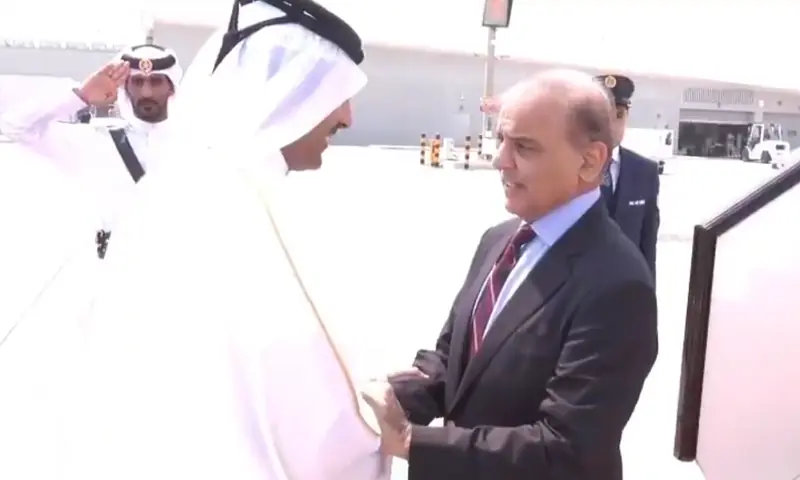
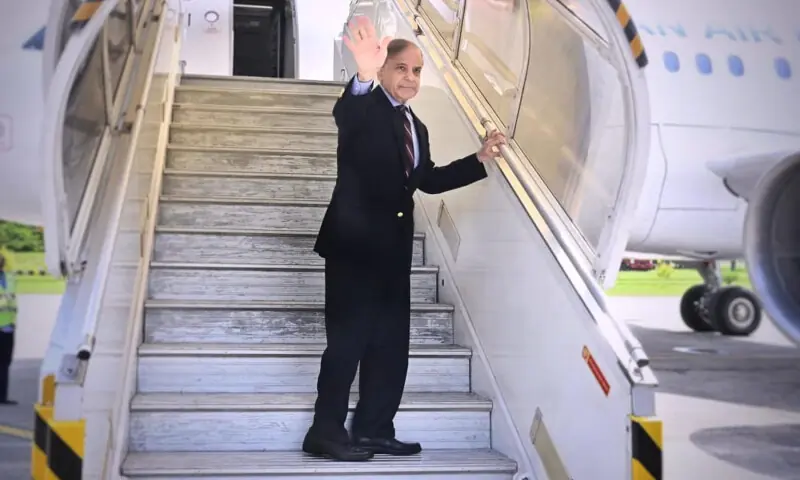
Prime Minister Shehbaz Sharif reached Doha on Monday to to attend the Arab-Islamic summit in Doha today to consider a draft resolution on a recent Israeli attack on Qatar, state-run PTV News reported.
Leaders from around 50 states are expected to attend the high-level moot. which is being held under the umbrella of the 57-member Organisation of Islamic Cooperation (OIC).
PM Shehbaz is accompanied by a high-level delegation, including Defence Minister Khawaja Asif, Information Minister Attaullah Tarar and Special Assistant to PM Tariq Fatemi, according to PTV News.
He was received by Qatar’s minister for culture, Sheikh Abdulrahman bin Hamad Al Thani .
Deputy Prime Minister Ishaq Dar is already in Doha and actively participated in a meeting of foreign ministers on Sunday to craft the draft resolution that will be discussed during today’s summit, which has been co-sponsored by Pakistan.
PM Shehbaz has also undertook a one-day visit to Doha on September 11, when he met with Qatari Emir Sheikh Hamad bin Khalifa al-Thani to denounce the Israeli attack and show solidarity with the Gulf state.
Today’s summit has been convened to rally support for Qatar following the Israeli attack targeting Hamas leaders in the Gulf state on September 9. Five Hamas members and a Qatari security officer were killed in the attack. The attack — widely condemned by major world powers — was carried out while negotiations were underway for a ceasefire in Gaza, in which Qatar has been playing an instrumental role.
The summit will also discuss the “escalating developments in Palestine — following Israeli attempts to occupy Gaza, expand settlement activities in the occupied West Bank and forcibly displace the Palestinians“, according to an earlier Foreign Office (FO) statement.
Analysts say the high-level moot is meant to send Israel a clear signal. Tel Aviv’s attack has prompted US-allied Gulf Arab states to close ranks, adding to strains in ties between the UAE and Israel, which normalised relations in 2020.
According to a Dawn report, diplomats said leaders at the summit may also weigh in on pushing Palestinian statehood at the upcoming UN General Assembly session in New York.
Moreover, the United Nations Human Rights Council said today that it would host an urgent debate on Tuesday on Israel’s airstrike in Qatar.
The council said the debate would “discuss the recent military aggression carried out by the State of Israel against the State of Qatar on 9 September 2025’”.
Apart from PM Shehbaz, Iranian President Masoud Pezeshkian and Iraqi PM Mohammed Shia al-Sudani will also attend today’s moot in Qatar. Turkish President Recep Tayyip Erdogan is also expected to participate, Turkish media reported.
Palestinian president Mahmud Abbas also arrived in Doha on Sunday, on the eve of the summit.
Pezeshkian today urged Muslim countries to cut ties with Israel. “It is possible that Islamic countries cut their ties with this fake regime and maintain unity and cohesion as much as possible,” Pezeshkian said before departing for Doha, adding that he hoped the summit would “reach a conclusion” on measures against Israel.
However, it remained to be seen whether Saudi Crown Prince Mohammed bin Salman, Saudi Arabia’s de facto ruler, would attend, though he visited Qatar earlier this week in a show of neighbourly solidarity.
US President Donald Trump, who had dinner with Qatari Prime Minister Sheikh Mohammed bin Abdulrahman al-Thani in New York on Friday, made careful remarks before today’s Arab gathering as Washington’s two powerful Middle Eastern allies face a worsening rift.
“Qatar has been a very great ally. Israel and everyone else, we have to be careful. When we attack people, we have to be careful,” Trump told reporters.
The US president initially rebuked Israel over the attack, saying he was “very unhappy” about it. However, yesterday, Secretary of State Marco Rubio said it was “not going to change the nature of our relationship with the Israelis”.
Rubio is set to meet with Israel’s Prime Minister Benjamin Netanyahu today to examine the aftermath of Tel Aviv’s military action against Qatar and its effects on efforts for a Gaza truce.
Dar seeks steps against Israel to safeguard global order
Foreign Minister Dar met with his Turkish counterpart Hakan Fidan today. The two leaders “strongly condemned Israel’s unprovoked and unjustified strikes on Qatar and other nations in the region”, the FO said on X.
“They reaffirmed unwavering support for the Palestinian cause, underlined the importance of the OIC and the Arab League in mobilising collective action of the Muslim Ummah, and welcomed the convening of the Arab-Islamic Summit.”
Dar yesterday also met with OIC Secretary General Hissein Brahim Taha, Egypt’s FM Dr Badr Abdelatty, Iran’s FM Abbas Araghchi, Malaysia’s FM Dato’ Seri Mohamad Hasan, Bangladesh’s Foreign Affairs Adviser Md Touhid Hossain and Uzbekistan’s FM Bakhtiyor Saidov.
Attending the ministerial meeting, the foreign minister called for urgent steps against Israel to “safeguard the global order”.
During his speech, Dar highlighted that the frequency of meetings to discuss Israel’s activities in the region underlines “how Israel has become a persistent irritant and a danger to world peace and security”, according to a FO statement.
“Pakistan condemns, in the strongest possible terms, the illegal and unprovoked Israeli aggression against the brotherly State of Qatar,” Dar was quoted as saying.
The foreign minister listed the following “urgent steps” that need to be taken:
-
Israel must be held accountable for war crimes and crimes against humanity. It should not be allowed to get away with attacking Islamic countries and killing people with impunity.
-
Creation of an Arab-Islamic task force to monitor the Israeli designs in the region and adopt effective deterrent and offensive measures in a synchronised manner to ward off Israeli expansionist designs.
-
Pursue the suspension of Israel’s membership in the United Nations. Following up on this step would be a clear message on seriousness by the ummah.
-
Member states should actively consider implementing additional punitive measures against Israel, as a means to reinforce accountability and deter further violations of international law.
-
The UN Security Council must urgently demand [from] Israel, under Chapter VII of the UN Charter … an immediate, unconditional, and permanent ceasefire, release of hostages and exchange of Palestinian prisoners.
-
Unfettered, sustained and secure humanitarian access to all civilians in need, and the protection of aid workers, medical teams and UN personnel in the [Occupied Palestinian Territories].
-
The revival of a genuine and time-bound political process to achieve a just, comprehensive and lasting two-state solution in accordance with international law and relevant UN and OIC resolutions.
More to follow
Additional input from AFP

