
From Wikipedia, the free encyclopedia
Content deleted Content added
| Line 19: | Line 19: | ||
|
== Distribution == |
== Distribution == |
||
|
This species of urchins is native to the central and eastern Pacific Ocean. It can be found across the islands within the Papahānaumokuākea Marine National Monument, as well as on Kauaʻi and Oʻahu.<ref name=”:1″>{{Cite web |date=1 Oct 2015 |title=Hawaiʻi Department of Land and Natural Resources, Division of Forestry and Wildlife |url=https://dlnr.hawaii.gov/wildlife/files/2019/03/SWAP-2015-Echinoderms-Final.pdf |access-date=15 Nov 2025 |website=Hawaiʻi’s State Wildlife Action Plan: Echinoderms}}</ref> It is typically found around {{cvt|150|ft}} deep but can be found in shallower areas as well.<ref name=”: |
This species of urchins is native to the central and eastern Pacific Ocean. It can be found across the islands within the Papahānaumokuākea Marine National Monument, as well as on Kauaʻi and Oʻahu.<ref name=”:1″>{{Cite web |date=1 Oct 2015 |title=Hawaiʻi Department of Land and Natural Resources, Division of Forestry and Wildlife |url=https://dlnr.hawaii.gov/wildlife/files/2019/03/SWAP-2015-Echinoderms-Final.pdf |access-date=15 Nov 2025 |website=Hawaiʻi’s State Wildlife Action Plan: Echinoderms}}</ref> It is typically found around {{cvt|150|ft}} deep but can be found in shallower areas as well.<ref name=”:” /> |
||
|
== Geographic range and habitat == |
== Geographic range and habitat == |
||
Revision as of 15:36, 24 November 2025
Species of echinoderm
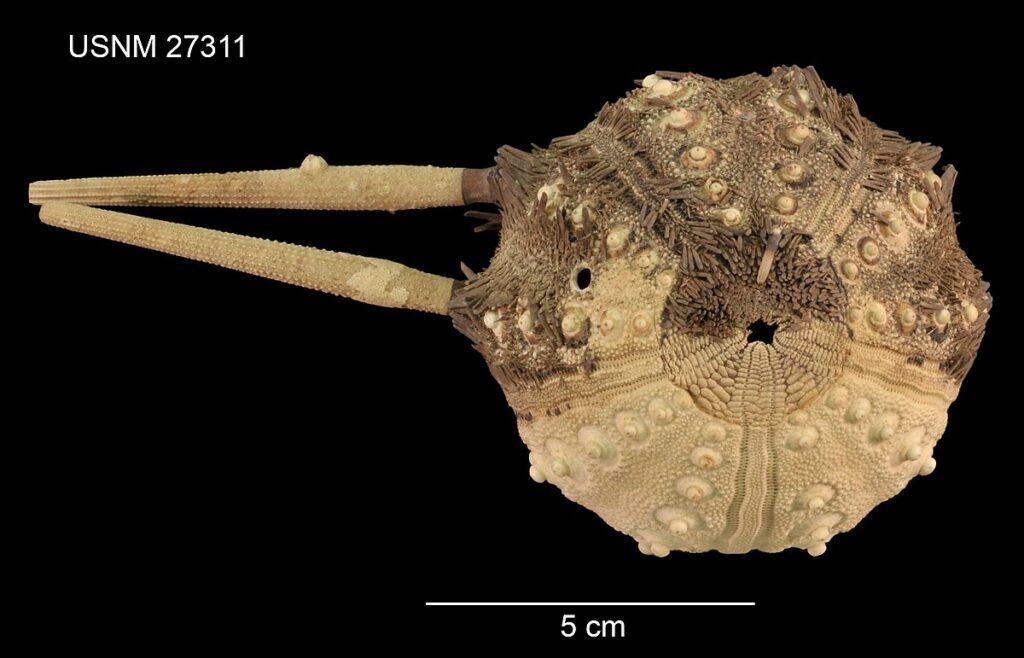
Prionocidaris thomasi, commonly known as Thomas’s urchin, is a species of echinoderms belonging to the family Cidaridae.[1]
Description
This urchin is characterised by its fuzzy-looking spines and bright maroon color. The fuzz on its spines is caused by algae growth, and its characteristic maroon color comes from the smaller secondary spines located below the larger, thicker spines.[2] The largest size it can reach is about 5 or 6 in (130 or 150 mm) including their spines.[2]
Feeding and mobility
Prionocidaris thomasi uses small tube feet underneath its body to move across the rocks it inhabits.[3] It uses five calcareous teeth, called Aristotle’s lantern, to scrape algae off rocks.[3]
Reproduction
Prionocidaris thomasi can reproduce both sexually and asexually.[3] Like most other echinoderms, Thomas’s urchin releases gametes into the water so that they can be fertilized during mass spawning events.[3] After a few months of swimming around and eating phytoplankton, P. thomasi larvae will find a suitable area to transform into their juvenile form, which more closely resembles their adult form.[3]
Distribution
This species of urchins is native to the central and eastern Pacific Ocean. It can be found across the islands within the Papahānaumokuākea Marine National Monument, as well as on Kauaʻi and Oʻahu.[4] It is typically found around 150 ft (46 m) deep but can be found in shallower areas as well.[2]
Geographic range and habitat
Typically it is found at depths of 100–150 m (330–490 ft).[5] However, it is occasionally seen in as little as 9 m (30 ft) of water in places like Sharks Cove on the North Shore of Oahu and other protected reefs, such as those around Midway Atoll.[6]
Conservation
Prionocidaris thomasi, just like many other sea urchins, faces the threat of aquarium collectors, and climate change which causes coral to bleach and die.[7]
References

