


The Punjab government has revised school timings starting Monday in response to worsening smog across the province, with daily sessions now beginning at 8:45am.
Lahore has ranked as the world’s most polluted city for the past three days, with air quality plummeting to hazardous levels as smog blanketed the city and the overall Air Quality Index (AQI) hitting 412, prompting health warnings and a province-wide crackdown on pollution sources.
The Punjab Disaster Management Authority (PDMA) issued a high alert across the eastern districts of the province, including Lahore, Gujranwala, Sheikhupura, Kasur, Nankana Sahib, Faisalabad, Multan, Bahawalpur, Rahim Yar Khan and Khanpur. According to Director General PDMA Irfan Ali Kathia, the intensity of smog is expected to increase from November to mid-December, citing forecasts from the Meteorological Department.
The announcement was made by Punjab Education Minister Rana Sikandar Hayat on his X account, in light of the current smog situation.
“Winter school timing — 8:45am to 1:30pm”, the minister announced.
Separately, commenting on the smog situation, Punjab Senior Minister Marriyum Aurangzeb said during a media briefing that the province now had a comprehensive digital and AI-based forecasting system in place.
She said it had been developed using data from previous years, adding that it was accessible to the public through the air quality portal and was released a day in advance by the Environmental Protection Agency (EPA).
Reflecting on opinions regarding the smog situation, she said, “First of all, all those who have suddenly become environmental experts these days and issue reports or make statements as they please, I want to clarify that smog is a seasonal phenomenon.”
She said the seasons last for only three months, when the easterly corridor from east to west causes temperature inversions and cold air forms a lid over the atmosphere.
“Within that lid, particulate pollutants become trapped because the air above is cold. That lid, together with atmospheric pressure, creates a haze that we call smog,” she explained.
Marriyum emphasised that the people of Lahore and Punjab must realise that “it cannot be that yesterday the AQI was 160 and today, because of local pollutants, it has suddenly jumped to 380.”
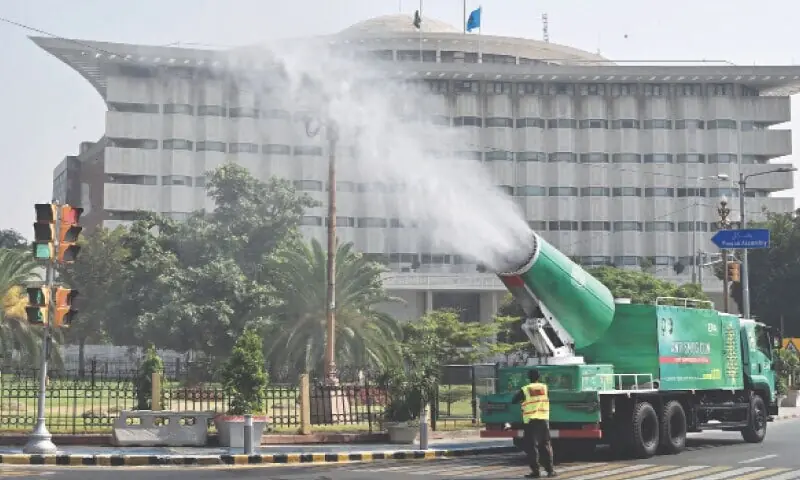
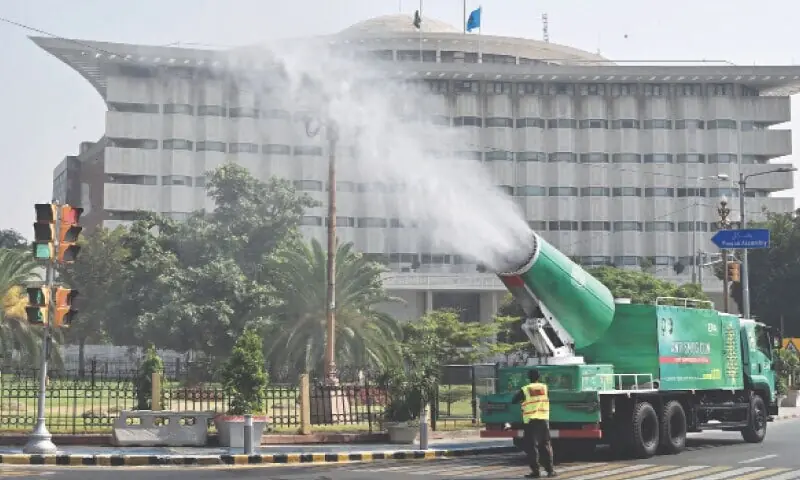
She explained that it is common for pollution levels to rise early in the morning due to colder temperatures, but as the day warms and upper-air conditions shift, the air becomes denser and “particulate matter starts to disperse.” She added that smog guns were being used only as an artificial and temporary measure.
She added that previously, smog was managed during the season by shutting schools, restaurants and imposing lockdown-style restrictions.
“But for the first time, we are not only managing smog in the season without resorting to closures; we are also improving Lahore’s Air Quality Index,” she said
Marriyum said the government’s work extended beyond the smog season. “We are not only active during these three months,” she said, “but carrying out smog mitigation efforts throughout the year.”



