
From Wikipedia, the free encyclopedia
Content deleted Content added
|
|
|||
| Line 40: | Line 40: | ||
|
| |
| |
||
|
!Translation |
!Translation |
||
|
::{{quote|ROMÁN.- Invent it |
::{{quote|ROMÁN.- Invent it, because, them and us will take advance of their inventions. Because i trust and i hope you are convinced, as i am, that electric lamp lights here very good like the place was invented.<p> |
||
|
SABINO.- Maybe better.|”El pórtico del templo”}} |
SABINO.- Maybe better.|”El pórtico del templo”}} |
||
|
| |
| |
||
Latest revision as of 06:45, 30 October 2025


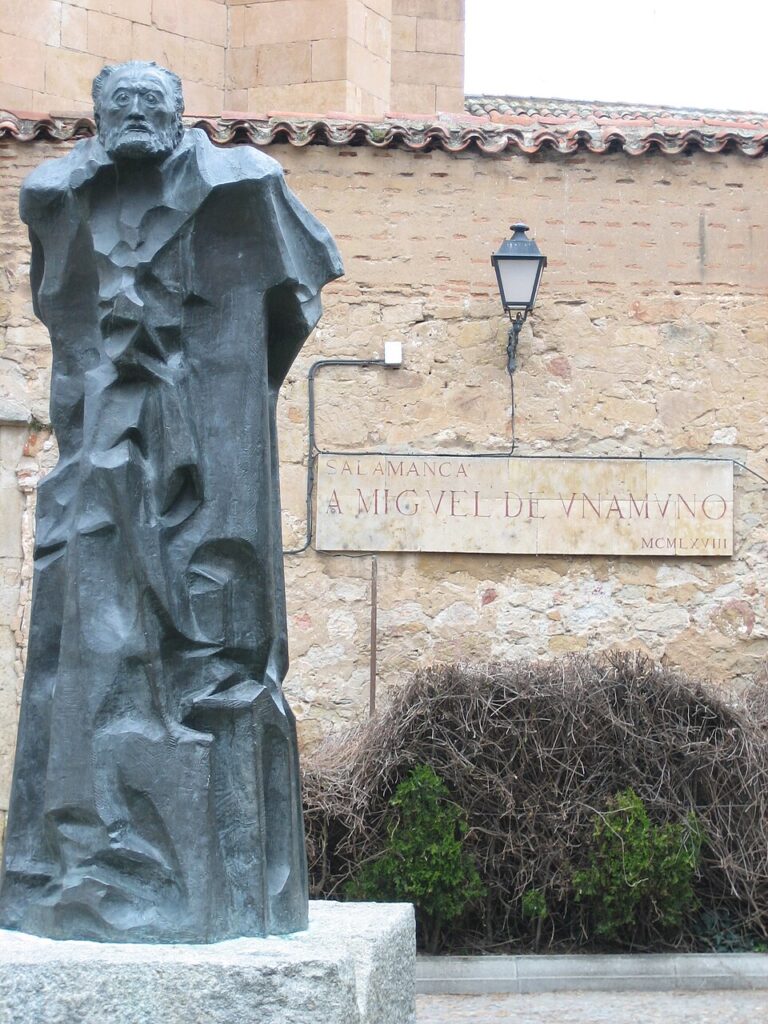
¡Que inventen ellos! (english: ¡Let them invent!) is a lapidary expresion of Miguel de Unamuno whose repeated use and abuse has produced a motif or cliché used with oposed senses.[1]
The motif is a sign of the science and the technology has been in Spain a marginal reality in their organization and social context,[2]so has becomed to convert in a species of a national spanish stereotype, few times rejected for impropial or humilliant and sometimes asumed with pride and disdain, like their original purpouse.
The fortune of the use of the phrase has produced even his paraphrase, in some case in a feminist sense, revindicating the work of the women on science; Que inventen ellas (let them invent).[3]
The original controversy
[edit]
The controversy surged with José Ortega y Gasset, from 1906 and at least to 1912, about the theme who becomed known as the europeization of Spain or the Spanishization of Europe and that gains an acid definition of this (africanist deviation from the professor and salamantine morabite), and an agrious final accusation (Don Miguel de Unamuno, energic spaniard, has failed to the truth).[4][5]
Part from the essay La España Moderna
| Spanish | ||
|---|---|---|
|
Translation
|
For Unamuno, who reactes in their maturity against his initial positivism, the scientific ortodoxy of today or the scientific Inquisition contrasted with the spanish science, who identifies with the mystique. The science removes the wisdom to the man… the object of the science is the life and the object of the wisdom is the death.[6]
The phrase is given in disctint althrough coincident formulations: First in a letter of Unamuno to Ortega in 30 may 1906
Spanish
|
Translation
|
|---|
Later, in july of the same year, in El pórtico del templo,[7] an article in form of dialogue between two characters:
Spanish
SABINO.- Acaso mejor. — El pórtico del templo |
Translation
SABINO.- Maybe better. — El pórtico del templo |
|---|
- ^ Three examples of periodistic utilization:
The “let them invent” of Unamuno is still current. Spain continues aground, according to the repport about innovation in 2006 published yesterday by Brussels. His entepreneur spirit cruises a stage of failing layer, his enterprises don’t want neither hear of invest in innovation and their patents shines of their absense.
- ^ Glick, Thomas F.; Portela Marco, Eugenio; Navarro, Víctor (1982). “La historia de la ciencia en España como realidad marginal en su organización y contexto social” [The history of the science in Spain as a marginal reality in their organization and social context]. Anthropos: Boletín de información y documentación (in Spanish). 20: 2. ISSN 0211-5611. 1431884 – via Dialnet.
- ^ Sánchez, Esther (12 September 2003). “Logros científicos de mujeres en la muestra ‘¡Que inventen ellas!”. El País (in Spanish). Retrieved 30 October 2025.
- ^ Abellán, José Luís (1994-05-10). El “¡que inventen ellos!” de Unamuno [¡Let them invent! of Unamuno]. Las grandes polémicas de la cultura española (in Spanish). Retrieved 30 October 2025 – via Fundación Juan March.
- ^ Ortega y Gasset, José (27 September 1909). “Unamuno y Europa, fábula”. El Imparcial (in Spanish). No. 15284. Retrieved 30 October 2025 – via filosofia.org.
- ^ Abellán, minute 10.
- ^ Quevedo, Luís (13 December 2014). “Las raíces del ‘que inventen ellos’“ [The roots of ‘Let them invent’] (in Spanish). El Mundo (Spain). Retrieved 27 April 2016.

