
From Wikipedia, the free encyclopedia
Content deleted Content added
|
|
|||
| Line 9: | Line 9: | ||
|
*{{harvnb|Duren|2000|loc=Appendix B}}</ref> |
*{{harvnb|Duren|2000|loc=Appendix B}}</ref> |
||
|
:Suppose ”g” is a real-valued continuous function on the interval [”a”,”b”] and ”S” is the set of ”x” in [”a”,”b”] such that there exists a ”y”∈(”x”,”b”] with ”g”(”y”) > ”g”(”x”). (Note that ”b” cannot be in ”S”, though ”a” may be.) Define ”E” = ”S” ∩ (”a”,”b”). |
:Suppose ”g” is a real-valued continuous function on the interval [”a”,”b”] and ”S” is the set of ”x” in [”a”,”b”] such that there exists a ”y”∈(”x”,”b”] with ”g”(”y”) > ”g”(”x”). (Note that ”b” cannot be in ”S”, though ”a” may be.) Define ”E” = ”S” ∩ (”a”,”b”). |
||
|
:Then ”E” is an open set, and it may be written as a countable union of disjoint intervals |
:Then ”E” is an open set, and it may be written as a countable union of disjoint intervals |
||
|
::<math>E=\bigcup_k (a_k,b_k)</math> |
::<math>E=\bigcup_k (a_k,b_k)</math> |
||
|
:such that ”g”(”a”<sub>”k”</sub>) = ”g”(”b”<sub>”k”</sub>), unless ”a”<sub>”k”</sub> = ”a” ∈ ”S” for some ”k”, in which case ”g”(”a”) < ”g”(”b”<sub>”k”</sub>) for that one ”k”. Furthermore, if ”x” ∈ (”a”<sub>”k”</sub>,”b”<sub>”k”</sub>), then ”g”(”x”) < ”g”(”b”<sub>”k”</sub>). |
:such that ”g”(”a”<sub>”k”</sub>) = ”g”(”b”<sub>”k”</sub>), unless ”a”<sub>”k”</sub> = ”a” ∈ ”S” for some ”k”, in which case ”g”(”a”) < ”g”(”b”<sub>”k”</sub>) for that one ”k”. Furthermore, if ”x” ∈ (”a”<sub>”k”</sub>,”b”<sub>”k”</sub>), then ”g”(”x”) < ”g”(”b”<sub>”k”</sub>). |
||
Latest revision as of 15:53, 13 December 2025

In mathematical analysis, the rising sun lemma is a lemma due to Frigyes Riesz, used in the proof of the Hardy–Littlewood maximal theorem. The lemma was a precursor in one dimension of the Calderón–Zygmund lemma.[1]
The lemma is stated as follows:[2]
- Suppose g is a real-valued continuous function on the interval [a,b] and S is the set of x in [a,b] such that there exists a y∈(x,b] with g(y) > g(x). (Note that b cannot be in S, though a may be.) Define E = S ∩ (a,b).
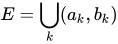
- Then E is an open set, and it may be written as a countable union of disjoint intervals
- such that g(ak) = g(bk), unless ak = a ∈ S for some k, in which case g(a) < g(bk) for that one k. Furthermore, if x ∈ (ak,bk), then g(x) < g(bk).
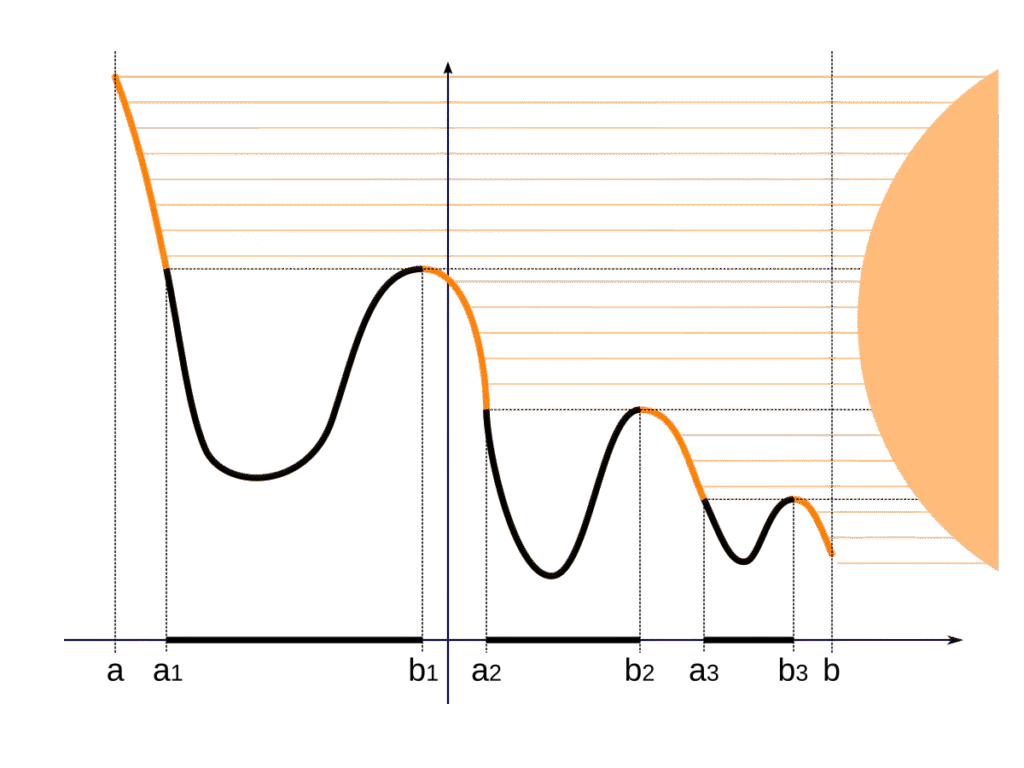
The colorful name of the lemma comes from imagining the graph of the function g as a mountainous landscape,
with the sun shining horizontally from the right. The set E consist of points that are in the shadow.
We need a lemma: Suppose [c,d) ⊂ S, but d ∉ S. Then g(c) < g(d).
To prove this, suppose g(c) ≥ g(d).
Then g achieves its maximum on [c,d] at some point z < d.
Since z ∈ S, there is a y in (z,b] with g(z) < g(y).
If y ≤ d, then g would not reach its maximum on [c,d] at z.
Thus, y ∈ (d,b], and g(d) ≤ g(z) < g(y).
This means that d ∈ S, which is a contradiction, thus establishing the lemma.
The set E is open, so it is composed of a countable union of disjoint intervals (ak,bk).
It follows immediately from the lemma that g(x) < g(bk) for x in
(ak,bk).
Since g is continuous, we must also have g(ak) ≤ g(bk).
If ak ≠ a or a ∉ S, then ak ∉ S,
so g(ak) ≥ g(bk), for otherwise ak ∈ S.
Thus, g(ak) = g(bk) in these cases.
Finally, if ak = a ∈ S, the lemma tells us that g(a) < g(bk).
- Duren, Peter L. (2000), Theory of Hp Spaces, New York: Dover Publications, ISBN 0-486-41184-2
- Garling, D.J.H. (2007), Inequalities: a journey into linear analysis, Cambridge University Press, ISBN 978-0-521-69973-0
- Korenovskyy, A. A.; A. K. Lerner; A. M. Stokolos (November 2004), “On a multidimensional form of F. Riesz’s “rising sun” lemma”, Proceedings of the American Mathematical Society, 133 (5): 1437–1440, doi:10.1090/S0002-9939-04-07653-1
- Riesz, Frédéric (1932), “Sur un Théorème de Maximum de Mm. Hardy et Littlewood”, Journal of the London Mathematical Society, 7 (1): 10–13, doi:10.1112/jlms/s1-7.1.10, archived from the original on 2013-04-15, retrieved 2008-07-21
- Stein, Elias (1998), “Singular integrals: The Roles of Calderón and Zygmund” (PDF), Notices of the American Mathematical Society, 45 (9): 1130–1140.
- Tao, Terence (2011), An Introduction to Measure Theory, Graduate Studies in Mathematics, vol. 126, American Mathematical Society, ISBN 978-0821869192
- Zygmund, Antoni (1977), Trigonometric Series. Vol. I, II (2nd ed.), Cambridge University Press, ISBN 0-521-07477-0

