


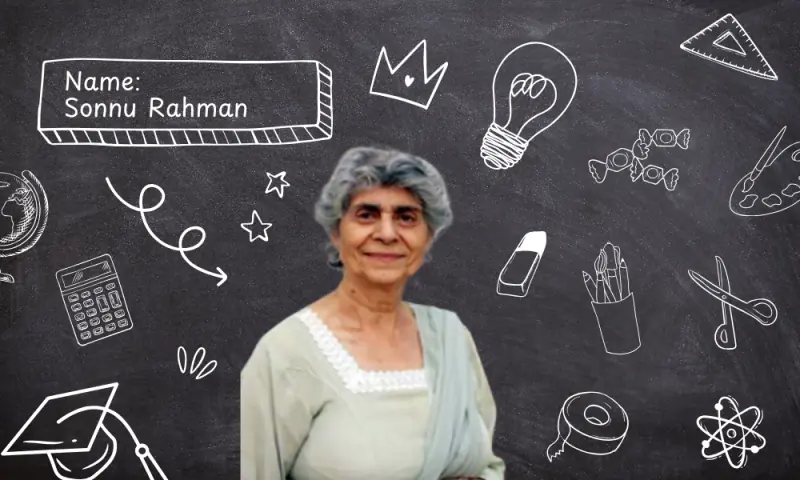
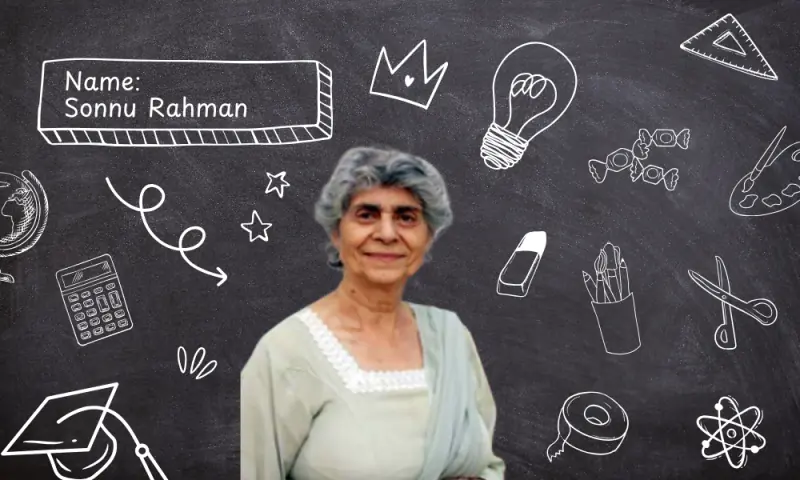
In a system that prizes grades over growth, Mrs Rahman kept alive a humanist tradition where learning meant wonder, dialogue, and expression.
I first came to know Aunty Sonnu in the twilight of the Zia years, through my friendship with her youngest daughter, Laila Rahman. What began as her good-humoured acceptance of a young outsider in her household, gradually deepened into a bond of genuine connection, moored in three common devotions: an abiding love for Laila, her youngest and most impassioned child; a fierce attachment to Lahore; and an enduring affection for Government College — the institution that shaped so much of who she became.
After Laila and I wed, that bond ripened into shared life itself. Together, we weathered seasons of joy and passages of grief, during which I came to understand the many worlds she gracefully inhabited. To her husband’s family in Mardan, she was Baabijan; to her friends and kin, Aunty Sonnu or Sonnu Khala; and to generations of students she mentored and inspired, she remained, Mrs Rahman.
Sohni Sondhi was born, raised, and educated at Government College, where her father, Professor G.D. Sondhi, taught. It was within those familiar halls that she met Abdul Rahman Khan and entered into a bond so profound that she embraced Islam and left her beloved Lahore to marry him, making a new home in his ancestral town of Mardan.
There, she found belonging, forming lasting ties with both family and community. She became fluent in Pashto, bridging a language divide that still fragments our communities today. Through all these years, she remained a voracious reader and gifted storyteller — a passion she passed on to her children, her grandchildren, and to the many young people fortunate enough to cross her path.
While much is being written about the many journeys that defined her life, I wish to reflect on Mrs Rahman, the educator. The truest way to honour her, I believe, is to pause and ask what her life reveals about the mission of education in Pakistan; a cause she served with rare distinction.
When questions mattered more than answers
To grasp the scale of her impact on generations of young people, we must first return to her own educational beginnings at Government College Lahore in the mid-twentieth century. At the time, the College was more than an academic institution — it was a bastion of the humanist tradition, intent on preparing its students for the responsibilities of civic life.
Its mission extended beyond the narrow confines of disciplinary instruction, insisting instead on the cultivation of eloquent speech and writing, the practice of persuasive and reasoned argument, and the habits of critical and creative thought. Students were trained not only as specialists in their fields but also in the arts of debate, literature, and performance, with a special emphasis on drama.
The humanist tradition came alive through pioneering teachers like A. S. Bokhari, Sufi Tabassum, Thapar, Sirajuddin, Verma, Latif, Chawla, Kashyap, and G. D. Sondhi. They believed education was not about cramming facts but about sparking ideas. Their classrooms buzzed with debate, where students learned to think independently and creatively and teachers welcomed being challenged in turn.
Teaching to the test had no place in their vision. They dismissed rote learning not just as inadequate, but as the very opposite of what education should be. They championed a greater pursuit: the awakening of curiosity, the cultivation of imagination, and the nurturing of courage to ask difficult questions and attempt original answers. These were the qualities they believed gave education its true purpose — the very qualities that exam-driven schooling, with its drills and memorisation, so often drains from young minds.
They also instilled in their students the value of tolerance. The College’s student body, though drawn largely from the elite, was a blend of ethnicities, sects, and faiths. Within its classrooms, differences were respected and coexistence was treated as a principle to be lived rather than preached. They offered a striking counterpoint to the narrow and exclusionary forces that, then as now, work to fracture society.
A legacy written in minds, not titles
Mrs Rahman was the very spirit of this tradition, never more alive than when she was with her students. She took up teaching at the age of 60, but it was never a job taken up late in life — it was a vocation. She taught history but refused to treat it as a dull record of names and dates. Instead, she taught it as a living narrative, showing how societies rise and change, and how those shifts leave their mark on human lives.
Beyond the classroom, she was an avid explorer travelling to historic sites, wandering through museums, and seeking out conversations with scholars and fellow travellers. What she discovered, she carried back to her classroom — every journey fed her teaching and became a story to share. In this way, she gave her students more than lessons; she gave them a sense of wonder.
The classroom was her canvas, and her students the co-creators. Her vitality and love of learning made her not just a devoted teacher, but an unforgettable one. She embodied the very curiosity, wit, and spirit of tolerance and coexistence that she sought to awaken in her students.
Her education in the humanist tradition at Government College paved the way for this vision. It gave her a lifelong resolve to transcend the boundaries of narrow disciplinary instruction, putting language, argument, and the art of critical thought at the heart of education.
As a founding faculty member of the Lahore College of Arts and Sciences (LACAS), she spearheaded the revival of debates and theatre at the school level — a bold undertaking during Zia’s authoritarian era, when censorship stifled expression and the humanities languished in once-vibrant institutions like Government College.
At LACAS, she helped equip students from diverse backgrounds with the tools of critical thought. Her efforts culminated in the revival of debating at the national level, nurturing a new generation of students who went on to distinguish themselves in remarkable ways. And she did it all from the ground up, through unrelenting effort within the strictures of the system.
The outpouring of messages from her former students and mentees till date, stands as a quiet testament to those efforts. She changed lives, not by virtue of position or title, but through sheer passion for learning and kindling in others the joy of questioning, discovery, and expression.
How learning has become an atomised enterprise
Yet, ironically, instead of building on such examples, much of the global education system has moved in the opposite direction. It has become increasingly grade-obsessed, killing the desire to learn and narrowing horizons at the expense of the broader critical skills essential for civic life. Teachers are reduced to functionaries, bound to pre-set rubrics, stripped of the autonomy to shape learning.
The rise of exam-driven academies and limited subject choices have left scant space for the study of languages, rhetoric, and the art of critical and creative thought. In the process, education has been hollowed into an atomised enterprise — alienating both teachers and students from the pursuit of knowledge, and producing citizens deprived of the very skills needed to question, to challenge, and to imagine alternatives.
What Mrs Rahman’s legacy as an educator makes clear is that Pakistan’s much-touted rise as a “knowledge economy” will remain an empty claim unless we build a culture that truly empowers teachers who value the transmission of learning and the production of knowledge. Education must prepare the young to question, to create, and to step confidently into public life.
Seen against this backdrop, Mrs Rahman’s example shines all the more brightly: she embodied a humanist tradition, and through her life and work, offers a living reminder of what education in Pakistan could, and should, be.



