
From Wikipedia, the free encyclopedia
Content deleted Content added
|
|
|||
| Line 14: | Line 14: | ||
|
| region = [[Dagestan]] |
| region = [[Dagestan]] |
||
|
| ethnicity = Sanzhi [[Dargwa people|Dargwa]] ({{lang|dar|sunglan-te}}) |
| ethnicity = Sanzhi [[Dargwa people|Dargwa]] ({{lang|dar|sunglan-te}}) |
||
|
| ELP = 10988 |
|||
|
| ELPname = Sanzhi Dargwa |
|||
|
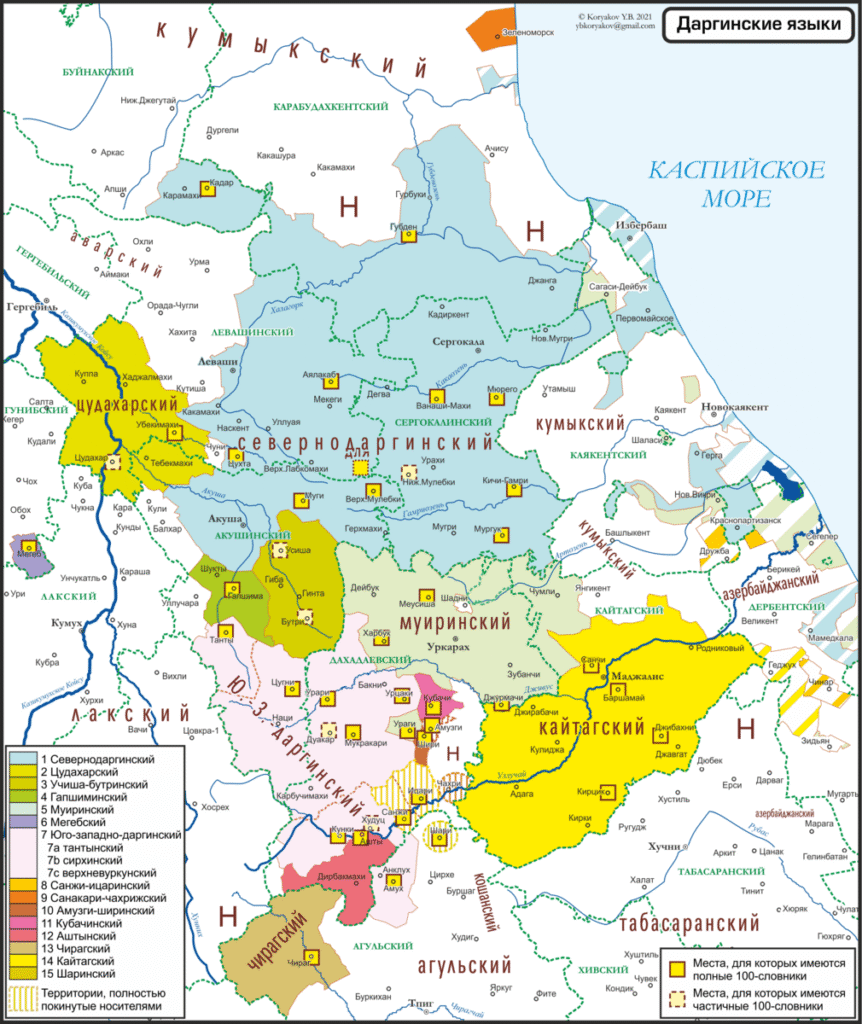
| map = File:Dargwa_map_(Koryakov)_2021.png |
| map = File:Dargwa_map_(Koryakov)_2021.png |
||
|
| mapcaption = {{legend|#fdcd00|Sanzhi (and Itsari)}} |
| mapcaption = {{legend|#fdcd00|Sanzhi (and Itsari)}} |
||
Latest revision as of 05:51, 16 October 2025
Dargin language
Sanzhi (Sanzhi: sunglan ʁaj, also called Sanzhi Dargwa)[1] is an endangered Dargin language spoken by about 250 people in Dagestan, closely related to Itsari. It is considered critically endangered due to its obsolescence in favor of Russian.[4][5] The language is unwritten.
In the 1970s, the Sanzhis left their original village of Sanzhi, which is believed to have been inhabited for around 10,000 years,[7] and moved to the lowlands, predominantly the village of Druzhba. In the summers, however, they still return to Sanzhi to do various activities like fishing and berry picking.
| Bilabial | Alveolar | Postalveolar | Palatal | Velar | Uvular | Pharyngeal/ Epiglottal |
Glottal | ||||
|---|---|---|---|---|---|---|---|---|---|---|---|
| plain | lab. | plain | lab. | ||||||||
| Stop | plain | p | t | k | kʷ | q[a] | qʷ | ʡ | ʔ | ||
| voiced | b | d | g | gʷ | |||||||
| ejective | pʼ | tʼ | kʼ | kʼʷ | qʼ | qʼʷ | |||||
| geminate | pː | tː | kː | kːʷ | qː | qːʷ | |||||
| Fricative | plain | s | ʃ | x | xʷ | χ | χʷ | ħ | h | ||
| voiced | z | ʒ | ʁ | ʁʷ | |||||||
| geminate | sː | ʃː | xː | χː | χːʷ | ||||||
| Affricate | plain | t͡s | t͡ʃ | ||||||||
| ejective | t͡sʼ | t͡ʃʼ | |||||||||
| geminate | t͡sː | t͡ʃː | |||||||||
| Naal | m | n | |||||||||
| Liquid | r l | ||||||||||
| Semivowel | w | j | |||||||||
- ^ /q/ and /qʷ/ are realized with significant affrication, such that they are pronounced more like /q͡χ/ and /q͡χʷ/. This is not present in the ejective /q’/ and the geminates /qː/ and /qːʷ/.
Younger speakers tend to pronounce the labialized consonants as plain ones.
Sanzhi has 7 vowels, 4 plain ones and 3 pharyngealized vowels.
| Front | Central | Back | ||||
|---|---|---|---|---|---|---|
| plain | phar. | plain | phar. | plain | phar. | |
| Close | i | [iˁ] | u | uˁ | ||
| Mid | e | |||||
| Open | a | aˁ | ||||

