


Introduction
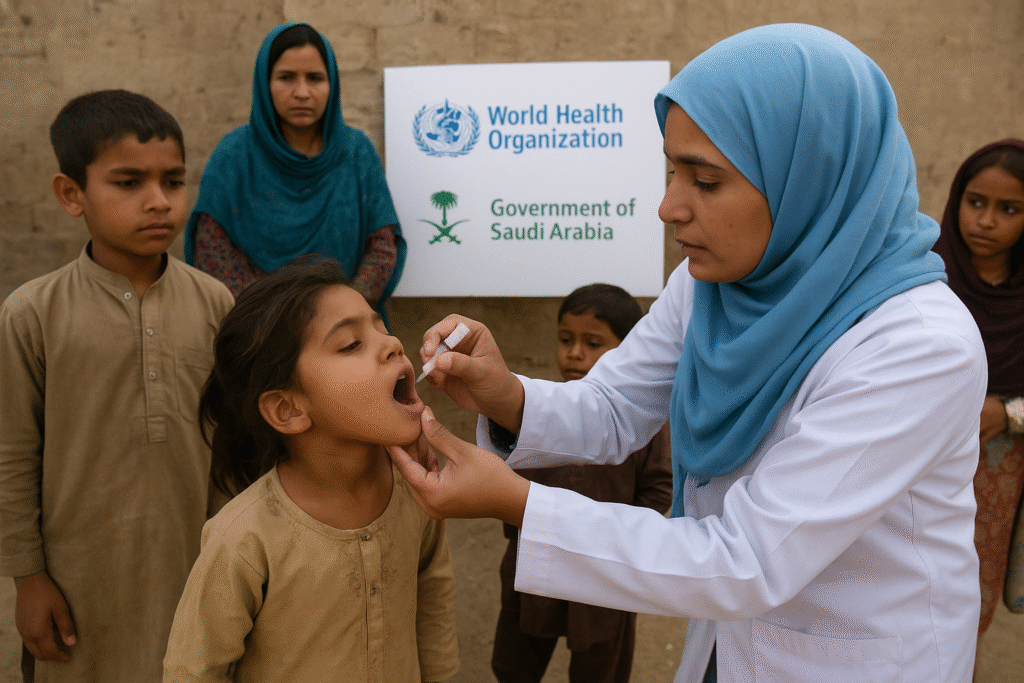
Polio has long been a global health challenge, especially in countries like Pakistan and Afghanistan where it remains endemic. In February 2025, Saudi Arabia announced a $500 million commitment to the Global Polio Eradication Initiative (GPEI). This historic pledge has the potential to accelerate worldwide eradication efforts and bring the world closer to a polio-free future.
Why Saudi Arabia’s Commitment Matters
H3: A Landmark Pledge
Saudi Arabia’s $500 million contribution stands as one of the largest single-country donations for polio eradication in recent years. According to the World Health Organization (WHO), the funding will be strategically directed toward high-risk regions, with Pakistan and Afghanistan at the center of operations.
H3: Supporting Global Goals
WHO has set 2027 as the target year for eradicating wild poliovirus and 2029 for vaccine-derived variants. This pledge strengthens the financial backbone of that ambitious plan, ensuring vaccination campaigns, data collection, and awareness programs continue without disruption.
Current Status of Polio in Pakistan and Afghanistan
H3: The Epicenter of Global Polio Cases
Despite decades of progress, Pakistan and Afghanistan remain the last two countries where polio is endemic. Issues like vaccine misinformation, rural inaccessibility, and attacks on health workers have slowed progress.
H3: The Challenge of Misinformation
Mistrust of vaccines has fueled hesitancy in several communities. Myths linking vaccines to infertility or foreign agendas have undermined campaigns, requiring stronger communication strategies and community engagement.
H3: Security and Access Barriers
Healthcare workers often face violence while administering vaccines, especially in conflict-prone areas. Saudi funding can help reinforce safety protocols and expand remote delivery systems like mobile vaccination teams.
How the $500 Million Will Be Used
H3: Strengthening Vaccination Drives
The funding will expand door-to-door vaccination campaigns, ensuring that children in remote villages are not left behind.
H3: Building Public Trust
Saudi Arabia’s support also emphasizes community-driven awareness programs. Religious leaders, educators, and local influencers will play a greater role in building trust and countering misinformation.
H3: Surveillance and Technology
Enhanced surveillance networks will be established to detect new polio cases quickly. Digital tracking tools will help monitor vaccination coverage and identify high-risk zones.
Global Response to Saudi Arabia’s Pledge
WHO and UNICEF praised the announcement, calling it a “game-changing moment” for global health. The GPEI partnership, which includes WHO, Rotary International, CDC, and others, emphasized that strong international cooperation is vital to finally end polio.
Other nations are expected to follow Saudi Arabia’s lead with additional funding commitments. This could result in renewed global momentum for eradication after years of challenges.
Impact on the Future of Global Health
Saudi Arabia’s commitment is more than just financial aid—it reflects the growing recognition that disease eradication requires united global action. Success against polio will also strengthen global health systems to fight other diseases like measles, cholera, and even future pandemics.
FAQs (Frequently Asked Questions)
Q1: How much did Saudi Arabia pledge for polio eradication?
Saudi Arabia pledged $500 million to the Global Polio Eradication Initiative in February 2025.
Q2: Which countries will benefit the most?
The funding will primarily support efforts in Pakistan and Afghanistan, the last two countries where polio is endemic.
Q3: When does WHO expect polio to be eradicated?
WHO has set 2027 for wild poliovirus eradication and 2029 for vaccine-derived variants.
Q4: Why is polio still a problem in Pakistan?
Challenges include vaccine misinformation, rural access issues, and attacks on healthcare workers, which disrupt campaigns.
Q5: How will this funding improve vaccination campaigns?
It will boost door-to-door vaccination efforts, awareness campaigns, technology-driven surveillance, and health worker safety measures.
Final Thoughts
Saudi Arabia’s $500 million pledge marks a turning point in the global fight against polio. If used effectively, this funding can accelerate vaccination coverage, strengthen health worker safety, and restore trust in immunization programs.
For Pakistan and Afghanistan, this is not just financial assistance—it is a lifeline to achieve what the world has been striving for decades: a future free from polio.
Related : Writozy



