


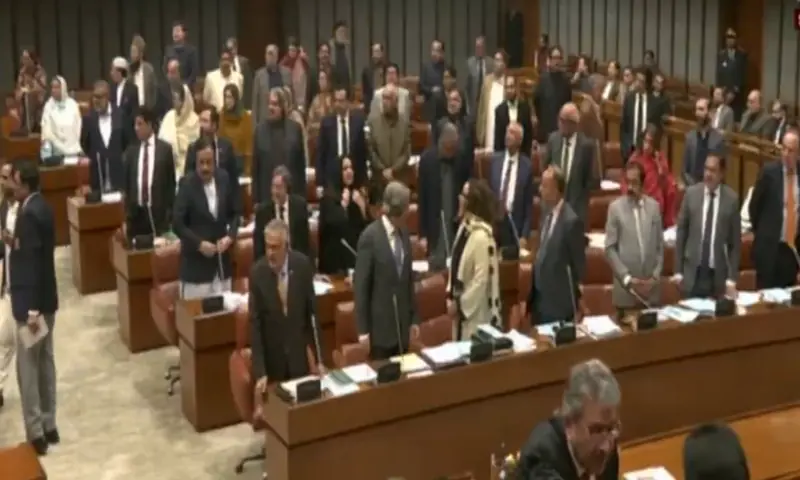
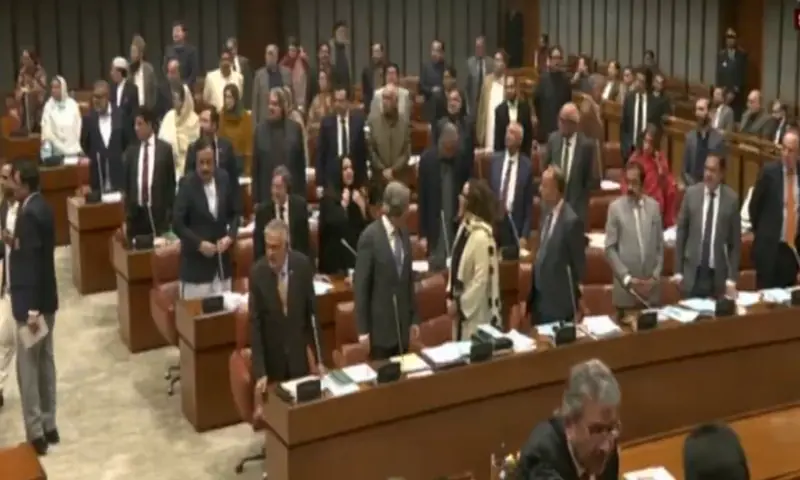
The Senate approved the contentious 27th Constitutional Amendment bill on Thursday after voting on it for a second time amid the opposition’s protest.
Announcing the result, Senate Chairman Yousuf Raza Gilani said 64 votes had been cast in favour of the bill and four against it.
The house first voted on the bill clause by clause and then by division. While clause-by-clause voting was under way, slogans of aain ki tabahi, na manzoor (destruction of the Constitution, unacceptable) filled the house, prompting Gilani to say at one point, “No slogans”.
Law Minister Azam Nazeer Tarar again tabled the bill in the upper house of Parliament today.
The bill was initially presented in the Senate for voting on Monday and passed the same day. It was then referred to the NA, which approved it with some amendments yesterday. Therefore, the proposed legislation has now been presented in the Senate again to consider the latest changes.
Immediately after Tarar tabled the bill, PTI Senator Ali Zafar highlighted that the house would be voting for the second time on the constitutional amendment. The amendment, he said, would need the support of a two-thirds majority in the Senate, which meant at least 64 votes.
He recalled that during the first instance of voting, PTI’s Saifullah Abro and another senator from the Jamiat Ulema-i-Islam (Fazl) had voted in favour of the amendment and against the party line.
After casting his vote, Abro had announced his resignation on the floor of the house.
Senate Chairman Yousuf Raza Gilani was asked about it while he was speaking to the media earlier today. In his response, Gilani said after formally receiving Abro’s resignation in writing, he would call him and maybe, “I am able to convince him”.
Later, PTI’s Zafar pointed out to him in the Senate that the defection by Abro led to the application of Article 63-A, which stipulated that Abro stood disqualified. Moreover, he said, Abro had also announced his resignation.
In light of these developments, he requested that the votes of the defecting senator not be counted.
“Otherwise, we will have to challenge this entire process,” he said.
Speaking after him, JUI-F’s Kamran Murtaza complained that “a member of ours was won over”.
“He voted in favour of the amendment, and it could not have been a choice he made out of his own good conscience,” he said, adding that “we have spent our time with the ruling PML-N in a respectful manner”.
“But we were also disgraced,” he rued. “I think it was unfair.”
Murtaza said he wanted to put forward his party leader’s message that “our grievance to the PML-N should be conveyed that we did not like what happened. But life goes on, and what happened will remain in our memory”.
He further stated that the defecting senator from the JUI-F, Ahmed Khan, had been expelled from the party, his resignation as a senator had been sought, and the party had also sought the invocation of Article 63-A.
Considering this, Khan had no right to still vote against the party line and betray the party’s trust, Murtaza added.
“And what I am saying right now, take it as our notice pertaining to Article 63-A. We will be voting against the amendment, and if anyone [from the JUI-F] does not, Article 63-A would apply to them as well. This is the message from Maulana, our party leader, and the decision of our parliamentary leader,” he said.
Ruckus in NA
Yesterday, a revised draft of the 27th Amendment bill was passed by the NA during a session attended by political bigwigs and marred by noisy protests and a walkout by opposition lawmakers.
The bill had 59 clauses and eight were changed in the final draft tabled before the lower house of Parliament. The draft was slightly different from the one initially passed by the Senate on Monday. The fresh changes are mostly related to the chief justice of Pakistan.
At the outset, the NA proceedings moved forward smoothly, and several MNAs, including opposition alliance leader Mehmood Khan Achakzai, spoke on the floor of the house. The situation began turning chaotic when Prime Minister Shehbaz Sharif, his brother and PML-N President Nawaz Sharif and PPP Chairman Bilawal Bhutto-Zardari arrived in the hall. At this point, PTI lawmakers started chanting slogans targeting the PML-N leaders and against the constitutional amendment.
During the protest, PML-N MNAs made a shield in front of the PM and Nawaz Sharif to prevent the PTI members from approaching the premier and the party chief. Similarly, the security guards of the Parliament House also came closer to the PM for his security. The protest also disrupted the law minister’s and the PPP chief’s speeches, and the opposition members tore up the copies of the bill and flung them towards the PM’s chair.
Interestingly, PTI firebrand leader Sher Afzal Marwat did not join the protest and remained seated even after the opposition MNAs walked out of the house in protest. Later, he went directly to PPP Chairman Bilawal Bhutto-Zardari to meet him and listened to the PM’s speech. As the premier spoke in the house, PTI MNA Iqbal Khan Afridi again entered the house with a banner in his hands, which carried the portrait of PTI founder Imran Khan. He went to the speaker’s dais and kept displaying the banner to the PM throughout his speech.
When the law minister started reading clauses of the bill, the opposition members gathered in front of the speaker’s dais to continue with their noisy protest. The bill, however, was passed with the required majority.
During the session, PPP’s Bilawal had vowed that the party would never support the rollback of the 18th Amendment — a change that is said to have been proposed in the bill’s initial draft — and of any laws that would go against the basic rights of the people. He said his party decided to support the changes in Article 243 (command of armed forces) in the “context that Pakistan is going through a situation of war”.
“On the one hand, we defeated India. On the other hand, India hosted the Afghan foreign minister, and what is happening on our second border after that, the spilling of blood of our citizens is in front of you,” he said. The PPP leader said terrorism was once again on the rise, but Pakistan had managed to defeat the menace before and would do so again.
“In the 27th Amendment, we are about to fulfill the unfulfilled promises of the Charter of Democracy. We are about to establish constitutional courts, and in Article 243 — after defeating India, the prime minister decided to make the army chief the field marshal — not only are we providing constitutional protection to that rank of field marshal, but also bringing some changes to the defence institutions,” he said.
For his part, PM Shehbaz thanked President Asif Ali Zardari, Nawaz, Bilawal and other allies. He said the amendment had become part of the Constitution after the consultation process, adding that the Charter of Democracy had always envisioned a constitutional court, and now that “dream” was fulfilled.
“I also want to thank Chief Justice of Pakistan Yahya Afridi for supporting us within the ambit of the Constitution,” he added.
Opposition to the bill
The bill proposes the creation of a Federal Constitutional Court (FCC) as well as changes to the military leadership structure.
After its approval by the NA yesterday, PTI Chairman Barrister Gohar Ali Khan assailed the development, stating that in rushing the amendments, “you have sunk the ship of democracy and judicial independence”.
Opposition alliance Tehreek Tahafuz Ayeen-i-Pakistan has announced a nationwide protest movement against the proposed amendment, urging the people to take a stand against the “extremely dark and dangerous” change in the Constitution.
Former and sitting judges, as well as lawyers, have also voiced opposition to the proposed amendment, particularly citing its implications for the Supreme Court.
Contentious bill
The government’s plan to make a 27th Amendment to the Constitution is taking shape roughly a year after it managed to get the 26th Constitutional Amendment approved.
The 26th Amendment was passed by Parliament during an overnight session in October 2024, with the PTI claiming seven of its lawmakers were abducted to gain their favour as the party opposed the legislation. The Balochistan National Party-Mengal (BNP-M) also alleged its two senators were being pressured, with both later defying party line to vote in the tweaks’ favour.
In the following months, even though the 26th Amendment remained mired in controversy and continued to face challenges in the court, the power corridors in Islamabad remained abuzz with talk of a possible 27th Constitutional Amendment.
The speculation about whether the government intended to further tweak the Constitution was put to rest when Bilawal announced on social media platform X on November 3 that a PM Shehbaz-led delegation had sought his party’s support for the amendment.
Subsequently, PM Shehbaz also held consultations with other ruling allies to secure support for the controversial amendment.
The bill was then tabled in the Senate on Nov 8, just hours after it was approved by the federal cabinet in a meeting chaired by PM Shehbaz via a video link from Baku. It was subsequently referred to the parliamentary standing committees on law and justice, which approved it the very next day with some minor changes to the initial draft.
The law minister tabled it in the Senate for voting on Nov 10. The contentious bill was approved by the upper house of Parliament after 64 lawmakers voted in its favour, with members of the opposition staging a noisy walkout. The PML-N led coalition government had managed to secure a two-thirds majority to get the bill passed with the unexpected support of two opposition senators who voted against their party lines.
On November 12, the bill was passed by the National Assembly after the introduction of some changes, mostly related to the chief justice of Pakistan.
In the house of 336 members, 224 votes were required to meet the mandatory two-thirds majority for the passage of the bill. The ruling lawmakers cast 234 votes in its favour, while four votes were polled against the bill by the Jamiat Ulema-i-Islam (JUI-F) members. The JUI-F has 10 MNAs, but only four attended the sitting. The PTI members, meanwhile, boycotted the process by staging a walkout.



