


From Wikipedia, the free encyclopedia
Content deleted Content added
|
|
|||
| Line 178: | Line 178: | ||
|
|- |
|- |
||
|
|} |
|} |
||
|
Abelisauridae indet.- Known only from teeth, indicating a variety of sizes and niches. some were large <ref>https://doi.org/10.1016%2Fj.palaeo.2020.109870</ref> <ref>https://www.sciencedirect.com/science/article/abs/pii/S0895981123005345?via%3Dihub</ref> |
|||
|
Abelisauroidea- Indeterminate abelisauroid, possibly referrable to noasauridae <ref>https://www.researchgate.net/publication/255172288_A_new_Abelisauroid_from_the_Upper_Cretaceous_of_Brazil</ref> |
|||
|
=== Pterosaurs === |
=== Pterosaurs === |
||
Latest revision as of 22:58, 18 October 2025
Geological formation in Brazil
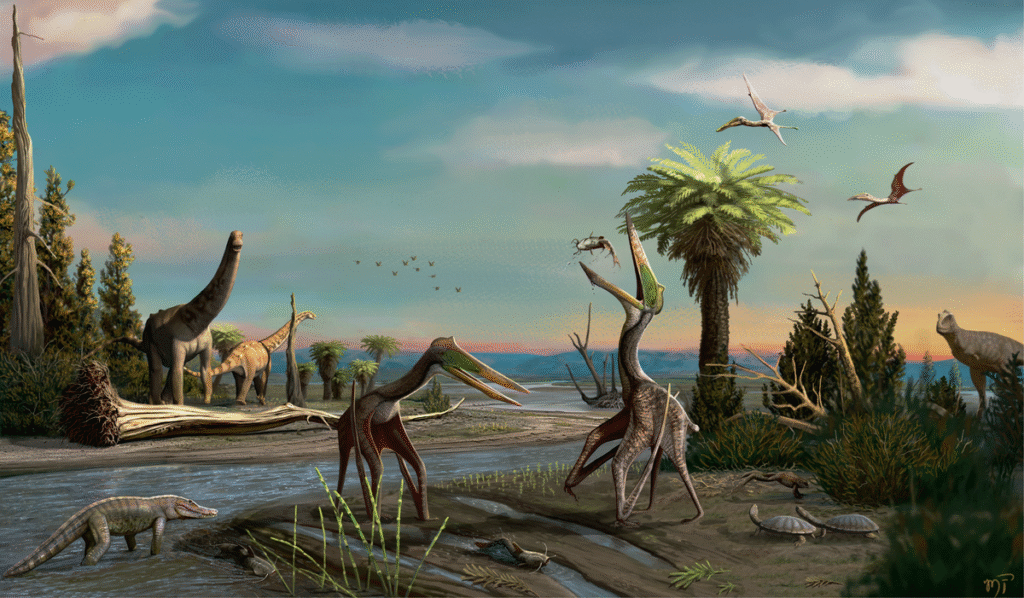
The Serra da Galga Formation is a geological formation in Minas Gerais state of southeastern Brazil. Its strata date back to the Maastrichtian, and are part of the Bauru Group.[1] It was originally considered a member of the Marília Formation.[2]
Dinosaur remains are among the fossils that have been recovered from the formation.[3]
The serra de galga formation is interpreted as having been deposited under a hot,dry climate [4] . The formation is considered to be of a Late Maastrichtian age [5] [6].
| Color key | Notes Uncertain or tentative taxa are in small text; |
| Crocodylomorphs of the Serra da Galga Formation | ||||||
|---|---|---|---|---|---|---|
| Genus | Species | Location | Materials | Notes | Images | |
| Itasuchus | I. jesuinoi | Area 2 | A skull | Basal notosuchian[7] |
  |
|
| Labidiosuchus | L. amicum | Serra do Veadinho, Area 2 | An incomplete lower jaw with the anterior part of the dentary complete, lacking most of the right mandibular ramus and the end of the left mandibular ramus | A notosuchian with bizarre dentition[8] | ||
| Peirosaurus | P. torminni | Area 2 | A fragmented skull and partial postcranial skeleton | A peirosaurid[7] | ||
| Uberabasuchus | U. terrificus | Serra do Veadinho, Area 2 | A peirosaurid[7] | |||
| Color key | Notes Uncertain or tentative taxa are in small text; |
Three distinct titanosaurids denoted as forms A, B, and C have been found in Area 4.[7] Titanosaurine remains are known from Areas 1 and 2.[7] Indeterminate theropod remains known from Area 1.[7] Indeterminate maniraptor remains known from Area 1.[7] Indeterminate abelisaurid remains are known from Areas 1 and 2.[7] The abelisaurids appeared to have came in a variety of sizes, some grew large.[9] Enantiornithines have also been recovered.[10] An indeterminate abelisauroid tibia, potentially referrable to noasauridae, is known as well [11] .
| Theropods of the Serra da Galga Formation | ||||||
|---|---|---|---|---|---|---|
| Genus | Species | Location | Stratigraphic position | Material | Notes | Images |
| “Lopasaurus“[15] | None given | A dromaeosaur. The holotype went missing shortly after 1980 and it has not been recovered since[15] |
 |
|||
| Ypupiara[15] | Y. lopai | A right maxilla and dentary (which was associated with a fish jaw) | A unenlagiinae paravian[15] | |||
Abelisauridae indet.- Known only from teeth, indicating a variety of sizes and niches. some were large [16] [17]
Abelisauroidea- Indeterminate abelisauroid, possibly referrable to noasauridae [18]
| Pterosaurs of the Serra da Galga Formation | ||||||
|---|---|---|---|---|---|---|
| Genus | Species | Location | Stratigraphic position | Material | Notes | Images |
| Galgadraco[19] | G. zephyrius | Serra da Galga Geosite | A fragment of the upper beak | An azhdarchid pterosaur; the first pterosaur described from the Bauru Group | ||
- ^ “Marília Formation”. Fossilworks.org.
- ^ Marcus Vinícius Theodoro Soares; Giorgio Basilici; Thiago da Silva Marinho; Agustín Guillermo Martinelli; André Marconato; Nigel Philip Mountney; Luca Colombera; Áquila Ferreira Mesquita; Julia Tucker Vasques; Francisco Romero Abrantes Junior; Luiz Carlos Borges Ribeiro (2021). “Sedimentology of a distributive fluvial system: The Serra da Galga Formation, a new lithostratigraphic unit (Upper Cretaceous, Bauru Basin, Brazil)” (PDF). Geological Journal. 56 (2): 951–975. Bibcode:2021GeolJ..56..951S. doi:10.1002/gj.3987. S2CID 224928245.
- ^ Weishampel, David B.; Dodson, Peter; Osmólska, Halszka, eds. (2004). The Dinosauria (2nd ed.). Berkeley: University of California Press. pp. 600–604. ISBN 0-520-24209-2. Retrieved 2019-02-21.
{{cite book}}: CS1 maint: publisher location (link) - ^ https://onlinelibrary.wiley.com/doi/10.1111/j.1475-4983.2008.00781.x#b22
- ^ https://onlinelibrary.wiley.com/doi/10.1111/j.1475-4983.2008.00781.x#b22
- ^ https://onlinelibrary.wiley.com/doi/10.1002/spp2.70039
- ^ a b c d e f g h i j k l m Candeiro, 2009
- ^ Kellner et al., 2011
- ^ Delcourt, Rafael; Brilhante, Natan S.; Grillo, Orlando N.; Ghilardi, Aline M.; Augusta, Bruno G.; Ricardi-Branco, Fresia (October 2020). “Carcharodontosauridae theropod tooth crowns from the Upper Cretaceous (Bauru Basin) of Brazil: A reassessment of isolated elements and its implications to palaeobiogeography of the group”. Palaeogeography, Palaeoclimatology, Palaeoecology. 556 109870. Bibcode:2020PPP…55609870D. doi:10.1016/j.palaeo.2020.109870.
- ^ Candeiro, Carlos Roberto A.; Agnolin, Federico; Martinelli, Agustín G.; Buckup, Paulo Andreas (September 2012). “First bird remains from the Upper Cretaceous of the Peirópolis site, Minas Gerais state, Brazil”. Geodiversitas. 34 (3): 617–624. Bibcode:2012Geodv..34..617C. doi:10.5252/g2012n3a8.
- ^ https://www.researchgate.net/publication/255172288_A_new_Abelisauroid_from_the_Upper_Cretaceous_of_Brazil
- ^ a b Silva Junior JC, Martinelli AG, Marinho TS, da Silva JI, Langer MC (2022). “New specimens of Baurutitan britoi and a taxonomic reassessment of the titanosaur dinosaur fauna (Sauropoda) from the Serra da Galga Formation (Late Cretaceous) of Brazil”. PeerJ. 10 e14333. doi:10.7717/peerj.14333. PMC 9673870. PMID 36405026.
- ^ a b Silva Jr., Julian C.G.; Marinho, Thiago S.; Martinelli, Agustín G.; Ribeiro, Luiz C.B.; Langer, Max C. (2023), “The largest known titanosaur (Dinosauria, Sauropoda) tooth and other isolated dental elements from the Serra da Galga Formation (Cretaceous of Southeast Brazil)”, Cretaceous Research 105656, doi:10.1016/j.cretres.2023.105656, S2CID 259942879
- ^ Salgado & De Carvalho, 2008
- ^ a b c d Arthur S. Brum; Rodrigo V. Pêgas; Kamila L. N. Bandeira; Lucy G. Souza; Diogenes A. Campos; Alexander W. A. Kellner (2021). “A new unenlagiine (Theropoda, Dromaeosauridae) from the Upper Cretaceous of Brazil”. Papers in Palaeontology. 7 (4): 2075–2099. Bibcode:2021PPal….7.2075B. doi:10.1002/spp2.1375. S2CID 238854675.
- ^ https://doi.org/10.1016%2Fj.palaeo.2020.109870
- ^ https://www.sciencedirect.com/science/article/abs/pii/S0895981123005345?via%3Dihub
- ^ https://www.researchgate.net/publication/255172288_A_new_Abelisauroid_from_the_Upper_Cretaceous_of_Brazil
- ^ Giaretta, Ariovaldo A.; Navarro, Bruno A.; Marinho, Thiago S.; Pêgas, R. Vargas (September 2025). “The first pterosaur from the Bauru Group: an azhdarchid from the Upper Cretaceous of Brazil”. Papers in Palaeontology. 11 (5) e70039. doi:10.1002/spp2.70039. ISSN 2056-2799.
- Candeiro, C.R.A (2009). “Vertebrates of the Marília Formation (late Maastrichtian) from the Peirópolis paleontological site: Toward a better understanding” (PDF). Earth Sciences Research Journal. 13 (1): 6–15. Archived from the original (PDF) on 2012-03-10. Retrieved 2019-02-16.
- Kellner, Alexander W.A.; Figueiredo, Rodrigo G.; Azevedo, Sergio A.K.; Campos, Diogenes A. (2011). “A new cretaceous notosuchian (Mesoeucrocodylia) with bizarre dentition from Brazil”. Zoological Journal of the Linnean Society. 163 (s1): S109 – S115. doi:10.1111/j.1096-3642.2011.00711.x. Retrieved 2019-02-16.
- Salgado, Leonardo; De Carvalho, Ismar de Souza (2008). “Uberabatitan ribeiroi, a new titanosaur from the Marília Formation (Bauru Group, Upper Cretaceous), Minas Gerais, Brazil”. Palaeontology. 51 (4): 881–901. Bibcode:2008Palgy..51..881S. doi:10.1111/j.1475-4983.2008.00781.x. S2CID 128831758. Retrieved 2019-02-16.




