
==Art==
==Art==
Ancient poetry describes him as traveling in a carriage with fluttering emerald banners, ribbons, and a peacock feather canopy, holding a long sword in one hand and a child in the other. However, in paintings, he is not always depicted holding a weapon or a child, nor is he always depicted driving a carriage. Instead, he is depicted holding scrolls and brushes, or with nothing in his hands.
Ancient poetry describes him as traveling in a with fluttering emerald banners, ribbons, and a peacock feather canopy, holding a long sword in one hand and a child in the other. However, in paintings, he is not always depicted holding a weapon or a child, nor is he always depicted driving a carriage. Instead, he is depicted holding scrolls and brushes, or with nothing in his hands.
Some paintings depict him with maids or pageboys following behind, while others do not.
Some paintings depict him with maids or pageboys following behind, while others do not.
| Shao Siming | |
|---|---|
 |
|
| Other names | Lesser Siming Lesser Master of Fate |
| Weapon | Changjian (Long Sword) |
| Texts | Jiu Ge |
Shao Siming (Chinese: 少司命; pinyin: Shǎo sī mìng) is an primordial Chinese deity of fate, paired with Da Siming (大司命) as one of a dual male dyadic pair of gods representing complementary aspects of destiny.[1] His name has also been translated as Lesser Siming or Lesser Master of Fate.
Since the mid-to-late 20th century, influenced by the spread of Western gender binary concepts, some modern Chinese popular culture and some academic circles have tended to depict Shao Siming as a female deity[2], while some also describe him as a deity of ambiguous gender.
Appearance
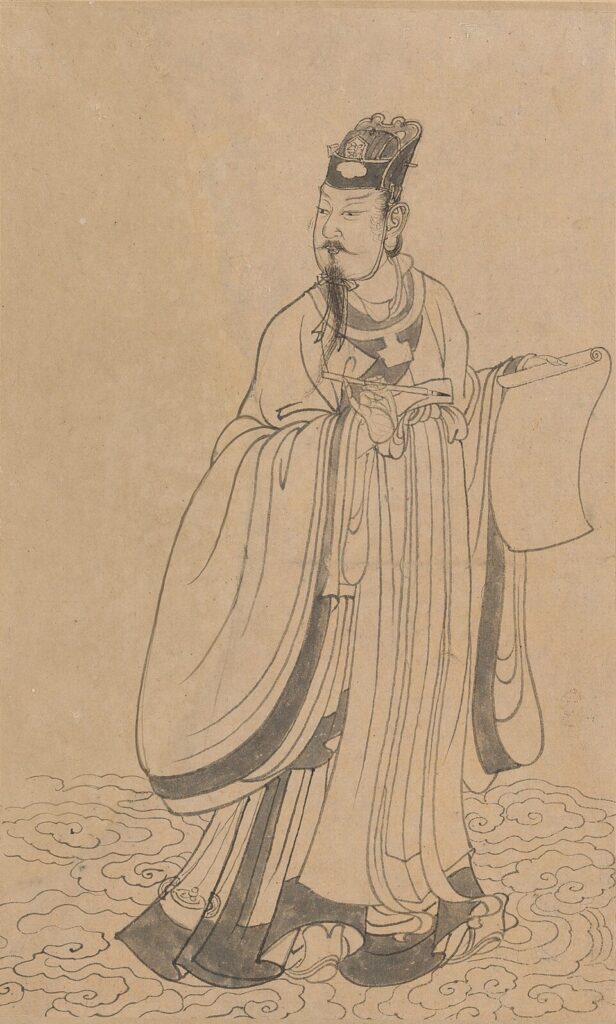
Shao Siming is often depicted as a handsome, well-dressed young gentleman, with facial hair tied into a traditional Chinese topknot bun, dressed in Hanfu (Chinese traditional clothing) and a Chinese crown or hat.
Occasionally, he is also depicted as a boy or teenager.
Powers and duties
As the god of destiny, Shao Siming is in charge of human affairs, including fortune, misfortune, fertility, love, and marriage, while Da Siming, who corresponds to him, is responsible for different aspects of destiny.
Astronomy and Astrology
He and Da Siming are also considered celestial asterism, and they are considered an asterism called “Siming” (司命).
In Chinese astronomy and Chinese astrology, the astronomical Siming (actually part of asterism 虛, “Emptiness”) consists of the Deified Judge of Life star group. Sīmìngyī: (24 Aquarii, 司命一) and Sīmìngèr (26 Aquarii, 司命二).
As an asterism, or apparent stellar constellation, Siming is associated both with the Wenchang Wang star pattern, near the Big Dipper, in Aquarius, and with a supposed celestial bureaucrat official of fate.
Art
Ancient poetry describes him as traveling in a chariots with fluttering emerald banners, ribbons, and a peacock feather canopy, holding a long sword in one hand and a child in the other. However, in paintings, he is not always depicted holding a weapon or a child, nor is he always depicted driving a carriage. Instead, he is depicted holding scrolls and brushes, or with nothing in his hands.
Some paintings depict him with maids or pageboys following behind, while others do not.
There are even some paintings that simply depict his back.

