


===Pigs Bay Military Railway===
===Pigs Bay Military Railway===
==Services and other operations==
===Historic Services===
Because it is the end of the line and where overnight stabling has taken place, Shoeburyness has always enjoyed regular trains to the capital.Some trains have not started from there and have started at [[Southend Central railway station|Southend Central]] or [[Thorpe Bay railway station| Thorpe Bay]] running empty to the sidings. Most trains have been routed via Laindon rather than Tilbury.
In 1884 when the station started operation nearly all London trains were extended to or from Shoeburyness and a few short workings between Shoeburyness and Leigh-on-Sea to fill in the gaps. Services were at this time routed via Tilbury and when the shorter route via Laindon opened n 1 July 1866 only 5 down and 6 up services were routed this way. In the 1890s more trains were diverted via LAindon with a connecting Tilbury service at Pitsea.
The [[Whitechapel and Bow Railway]], opened in 1902, permitted through trains to operate from the [[District Railway]] on to the LTSR. This was initially used for inner suburban District Railway trains that did not go beyond Upminster.<ref>{{cite book |last1=Horne |first1=Mike A. C. |title=London’s District Railway: A History of the Metropolitan District Railway Company. Twentieth Century. Volume two |date=2019 |publisher=Capital Transport Publishing |isbn=978-1-85414-430-0 |language=en}}</ref> In 1909 and 1910 trial joint through services were run from [[Ealing Broadway tube station|Ealing Broadway]] to Southend, changing from electric District to steam LTSR locomotives en route. This became a regular timetable in 1911, with a limited number of those daily trains extended to Shoeburyness. The service ended on 11 September 1939.<ref>{{cite book |last1=Kay |first1=Peter |title=The London, Tilbury & Southend Railway: A History of the Company and Line. 1912-1939, the Midland and LMS years. vol. 3 |date=2010 |publisher=Peter Kay |location=Wivenhoe |isbn=978-1-899890-43-9 |language=en}}</ref>
The all electric timetable of June 1962 saw six trains in the weekday off-peak with two via Tilbury and two via Laindon.
===Modern services===
As of the June 2024 timetable, the typical Monday to Friday off-peak service is:<ref>{{cite web |title=c2c Train Times |url=https://www.c2c-online.co.uk/app/uploads/2024/05/6655b351d3b4b-6655b351d3b4c5362_Working_TT_Booklet_Digital_Landscape.pdf.pdf |publisher=c2c |access-date=1 June 2024 |date=15 May 2024}}</ref>
* 4 tph (trains per hour) westbound to [[Fenchurch Street railway station|London Fenchurch Street]], via [[Basildon railway station|Basildon]] (2 tph all stations and 2 tph semi-fast)
All services are operated by c2c, which operates [[British Rail Class 357|Class 357 ”Electrostar”]] and [[British Rail Class 720|Class 720 ”Aventra”]] [[electric multiple units]] on the route.
===Goods services===
The goods yard was located immediately south of the station. Initially this was not connected to the military railway so any items for the base would have been unloaded here and moved by horse and cart the short distance to the base.
Public goods services ceased on 5 June 1967 although military trains continued to operate and indeed have a path in the May 2025 timetable although they appear to run rarely if at all.
===Engine Shed===
Please see the entry on [[Shoeburyness Depot]].
A tramway was opened some time in the 1860s. Its main purpose was to move supplies and rail mounted artillery around the area south of what would become the station site.
A tramway was opened some time in the 1860s. Its main purpose was to move supplies and rail mounted artillery around the area south of what would become the station site.
Railway station in Essex, England
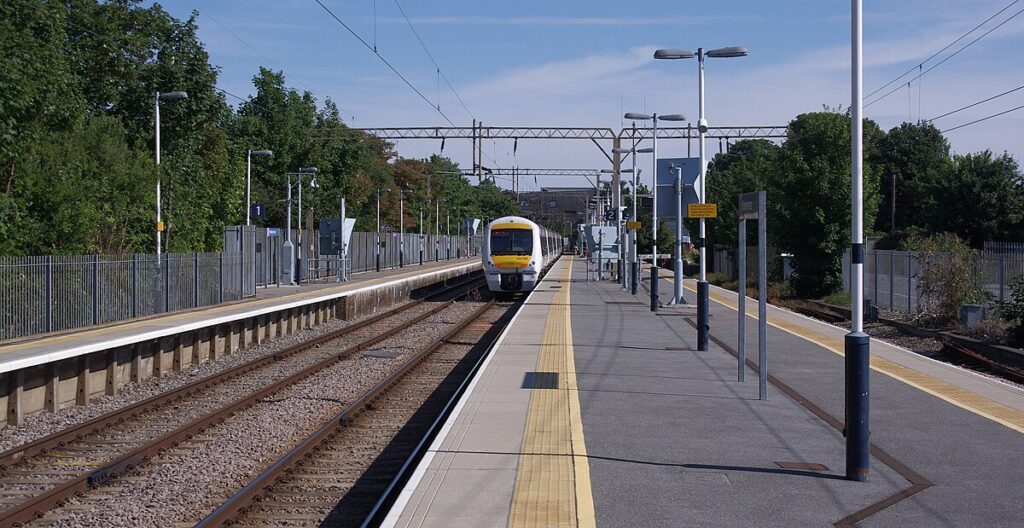
Shoeburyness railway station is the eastern terminus of the London, Tilbury and Southend Line (Engineer’s Line Reference FSS),[1] serving the coastal town of Shoeburyness, Essex. It is 39 miles 40 chains (63.57 km) down the main line from London Fenchurch Street via Basildon; the preceding station is Thorpe Bay. Its three-letter station code is SRY.
The line and station were opened in 1884 when the London, Tilbury and Southend Railway extended east from Southend. The station and all trains serving it are currently operated by c2c.
Early Years (1884-1922)
[edit]
In 1849, the Board of Ordnance purchased land at South Shoebury with a view to setting up an artillery testing and practice range. Until then, Plumstead Common and Woolwich Common had been used, but these were no longer viable due to the increasing power and range of the weapons.[2]
A tramway was established on the site and was located south of the existing site. At this time supplies for the military site arrived by river and three piers which were connected to a location called Camp Field.[Note 1][3]
As early as 1855 Morton Peto (a partner in the London, Tilbury and Southend Railway) had suggested an extension from Southend to Shoeburyness. Two independent schemes foundered in 1866 and 1868 and the LT&SR tried again in 1876 but found the War Department were not in favour of the scheme.[4]
By the 1880s the London, Tilbury and Southend Railway was beginning to outgrow its cramped site at Southend as the town grew and commuter traffic to London developed. In 1881 the War Department had a change of heart and had written a letter supporting the extension of the LT&SR to Shoeburyness. A contract to construct the line was let in 1882 and Shoeburyness railway station was opened to passenger and goods services on 1 February 1884 and at that point was the only station after Southend with Southend East and Thorpe Bay being added later.[5]
In the first few years no engine shed was provided at Shoeburyness so locomotives worked from Southend to form the early morning departures. This lasted until 1889 when Shoeburyness engine shed was opened. This move also freed up space at Southend to enable further development there.
London Midland & Scottish (1923-1947)
[edit]
Following the Railways Act 1921 the station became the responsibility of the London Midland and Scottish (LMS) Railway from 1 January 1923. From September 1939 to May 1945 passenger services were reduced as a result of World War II.
On 18 August 1940 the Midland Raiway designed signal box was hit by a bomb and destroyed. A replacement was provided the same year.[6]
British Railways (1948-1994)
[edit]
Following nationalisation of Britain’s railways in 1948, the station transferred under British Railways to the London Midland Region. On 20 February 1949, the whole LTS line was transferred to the Eastern Region, yet despite the organisational changes, the old LTSR still was a distinctive system operated by former LTS and LMS steam locomotives until electrification.[7]
During the late 1950s the LTS was being electrified and resignalled. This saw the remodelling of the thorat of the station to give more operational flexibility and the provision of additional carriage sidings and lengthening of others. New colour light signalling waas installed and bought into service in October 1960 and a full electric service began in June 1962.[8][9][10]
_298_1964_Barking.jpg)
A full electric timetable started operating in June 1962 which was primarily worked by Class 302 EMUs.
The LTS line and Shoeburyness station became part of the London and South Eastern sector of British Rail in 1982, and in June 1986 this was rebranded as Network South East (NSE). With the Conservative government of the early 1990s looking to privatise the railways, the operation of the NSE passenger train service was put under the control of a Train Operating Unit.
The privatisation era (1994-2025)
[edit]
On privatisation in 1994, infrastructure ownership passed to Railtrack and Prism Rail took over operations of the franchise, marketing the route as LTS Rail. Prism Rail were bought out by National Express in 2000 and in 2002 the line was rebranded as c2c.
Ownership of the infrastructure passed to Network Rail in 2002.
National Express sold the operation of the franchise to Trenitalia in 2017.
The station and all trains serving it are currently operated by c2c and are operated by Class 357 and Class 720/6 EMUs.
A more detailed history of the franchises can be found on the c2c page.
Private operation of the London, Tilbury and Southend line by Trenitalia c2c ceased on 20 July 2025, with the new publicly owned operator c2c taking over.[11]
Shoeburyness is arranged in a through-station layout despite being a terminus. As a result of this layout, the station has step-free access from the town’s high street to all of its platforms. Platforms 1 and 2 have an operational length for thirteen-coach trains and Platform 3 an operational length for nine-coach trains.[12]
A connection exists to the Ministry of Defence site nearby at Pig’s Bay, to the east over a level crossing on the high street, and extensive carriage sidings exist to the west comprising 31 sidings.[12]
The ticket office is equipped with the Tribute ticket issuing system. The station has sheltered bicycle storage, a taxicab rank, and a car park.[13]
The station was renovated in January 2013 to improve customer safety, security and facilities for the c2c customers.[14]
Services and other operations
[edit]
Because it is the end of the line and where overnight stabling has taken place, Shoeburyness has always enjoyed regular trains to the capital.Some trains have not started from there and have started at Southend Central or Thorpe Bay running empty to the sidings. Most trains have been routed via Laindon rather than Tilbury.
In 1884 when the station started operation nearly all London trains were extended to or from Shoeburyness and a few short workings between Shoeburyness and Leigh-on-Sea to fill in the gaps. Services were at this time routed via Tilbury and when the shorter route via Laindon opened n 1 July 1866 only 5 down and 6 up services were routed this way. In the 1890s more trains were diverted via LAindon with a connecting Tilbury service at Pitsea.
The Whitechapel and Bow Railway, opened in 1902, permitted through trains to operate from the District Railway on to the LTSR. This was initially used for inner suburban District Railway trains that did not go beyond Upminster.[15] In 1909 and 1910 trial joint through services were run from Ealing Broadway to Southend, changing from electric District to steam LTSR locomotives en route. This became a regular timetable in 1911, with a limited number of those daily trains extended to Shoeburyness. The service ended on 11 September 1939.[16]
The all electric timetable of June 1962 saw six trains in the weekday off-peak with two via Tilbury and two via Laindon.
As of the June 2024 timetable, the typical Monday to Friday off-peak service is:[17]
All services are operated by c2c, which operates Class 357 Electrostar and Class 720 Aventra electric multiple units on the route.
The goods yard was located immediately south of the station. Initially this was not connected to the military railway so any items for the base would have been unloaded here and moved by horse and cart the short distance to the base.
Public goods services ceased on 5 June 1967 although military trains continued to operate and indeed have a path in the May 2025 timetable although they appear to run rarely if at all.
Services and other operations
[edit]
Because it is the end of the line and where overnight stabling has taken place, Shoeburyness has always enjoyed regular trains to the capital.Some trains have not started from there and have started at Southend Central or Thorpe Bay running empty to the sidings. Most trains have been routed via Laindon rather than Tilbury.
In 1884 when the station started operation nearly all London trains were extended to or from Shoeburyness and a few short workings between Shoeburyness and Leigh-on-Sea to fill in the gaps. Services were at this time routed via Tilbury and when the shorter route via Laindon opened n 1 July 1866 only 5 down and 6 up services were routed this way. In the 1890s more trains were diverted via LAindon with a connecting Tilbury service at Pitsea.
The Whitechapel and Bow Railway, opened in 1902, permitted through trains to operate from the District Railway on to the LTSR. This was initially used for inner suburban District Railway trains that did not go beyond Upminster.[18] In 1909 and 1910 trial joint through services were run from Ealing Broadway to Southend, changing from electric District to steam LTSR locomotives en route. This became a regular timetable in 1911, with a limited number of those daily trains extended to Shoeburyness. The service ended on 11 September 1939.[19]
The all electric timetable of June 1962 saw six trains in the weekday off-peak with two via Tilbury and two via Laindon.
As of the June 2024 timetable, the typical Monday to Friday off-peak service is:[20]
All services are operated by c2c, which operates Class 357 Electrostar and Class 720 Aventra electric multiple units on the route.
The goods yard was located immediately south of the station. Initially this was not connected to the military railway so any items for the base would have been unloaded here and moved by horse and cart the short distance to the base.
Public goods services ceased on 5 June 1967 although military trains continued to operate and indeed have a path in the May 2025 timetable although they appear to run rarely if at all.
Please see the entry on Shoeburyness Depot.
Pigs Bay Military Railway
[edit]
Pigs Bay military railway
[edit]
A tramway was opened some time in the 1860s. Its main purpose was to move supplies and rail mounted artillery around the area south of what would become the station site.
The arrival of the LT&SR in Shoeburyness in 1884 did not seem initially to affect the military railway and it was not until 1890 that the two systems were joined south of the station. In 1890/1 the south end of the tramway was altered and the tramway extended north to a new platform on Pigs Bay. An exchange line was provided south of the carriage sidings allowing goods traffic to move to and from the the Pigs Bay network.[21]
Further northward extensions followed to Havengore Point in 1905 and a second parallel line slightly inland was constructed between 1906 and 1925 eventually extending to Havengore Island. A further new line was added c1958 in the vicinity of the engine shed.
In 1953 the site had 20 active steam and diesel shunting locomotives and also used some pre-grouping rolling stock for passenger duties.[22]
Use of the site declined in the 1980s and the following decade it was home to 400 items of ex British Rail stock that were held in storage for some years.[23] In 1991 the allocation consisted on three diesel shunters and two Baguely-Drewry Railcars for passenger use. [24][Note 2]Cite error: A <ref> tag is missing the closing </ref> (see the help page)..
Brickworks tramways and siding
[edit]
Pre-dating the arrival of the LTSR extensive brick fields existed north of the station area and operated a narrow gauge tramway which linked through to Shoeburyness East Beach where there were further brickworks and where bricks were loaded into barges on piers. The tramway crossed the Pigs Bay branch on the level.[25]
A siding on the north side of the Shoeburyness line was provided for mainline brick traffic in 1895 and was known as Eastwood’s Siding. the siding also dealt with traffic for the gas works.[26] The connection from the station was removed during the 1950s.
The brick fields fell out of use in 1963 but it is not clear if the tramway ceased operation before then. Remnants of the tramway are still extant at East Beach.[27]

- ^ “Engineer’s Line Reference”.
- ^ “A History of Shoebury Garrison”. Southend Council. Retrieved 12 March 2016.
- ^ Course, Edwin (2002). Barking to Shoeburyness. Midhurst, UK: Middleton Press. p. 113. ISBN 1 901706 80 X.
- ^ Kay, Peter (1996). The London Tilbury and Southend Railway Volume 1. Teignmouth, UK: Peter Kay. p. 55. ISBN 1 899890 10 6.
- ^ Kay 1996, p. 61
- ^ Kay 2020, p. 672 harvnb error: no target: CITEREFKay2020 (help)
- ^ Connor, J E; Phillips, Charles (August 1998). Fenchurch Street to Barking. Midhurst, UK: Middleton Press. p. 8. ISBN 1-901706-20-6.
- ^ Kay, Peter (2019). London Tilbury and Southend – a history of the company and line Volume 7. Wivenhoe: Peter Kay. p. 517. ISBN 978 1 899890 51 4.
- ^ Kay 2019, pp. 534, 535
- ^ Kay 2019, p. 538
- ^ Adams, Lewis. “Trains return to public ownership in south Essex”. BBC NEWS. BBC. Archived from the original on 28 July 2025. Retrieved 25 July 2025.
- ^ a b Brailsford, Martyn (2016). Railway Track Diagrams Book 2: Eastern. Frome: Trackmaps. p. 3. ISBN 978-0-9549866-8-1.
- ^ c2c. “c2c Online – Shoeburyness station”. Archived from the original on 25 July 2008. Retrieved 21 July 2008.
{{cite web}}: CS1 maint: numeric names: authors list (link) - ^ Echo (10 January 2013). “Shoebury station re-opens after £700k revamp”. Archived from the original on 20 April 2013. Retrieved 26 January 2013.
- ^ Horne, Mike A. C. (2019). London’s District Railway: A History of the Metropolitan District Railway Company. Twentieth Century. Volume two. Capital Transport Publishing. ISBN 978-1-85414-430-0.
- ^ Kay, Peter (2010). The London, Tilbury & Southend Railway: A History of the Company and Line. 1912-1939, the Midland and LMS years. vol. 3. Wivenhoe: Peter Kay. ISBN 978-1-899890-43-9.
- ^ “c2c Train Times” (PDF). c2c. 15 May 2024. Retrieved 1 June 2024.
- ^ Horne, Mike A. C. (2019). London’s District Railway: A History of the Metropolitan District Railway Company. Twentieth Century. Volume two. Capital Transport Publishing. ISBN 978-1-85414-430-0.
- ^ Kay, Peter (2010). The London, Tilbury & Southend Railway: A History of the Company and Line. 1912-1939, the Midland and LMS years. vol. 3. Wivenhoe: Peter Kay. ISBN 978-1-899890-43-9.
- ^ “c2c Train Times” (PDF). c2c. 15 May 2024. Retrieved 1 June 2024.
- ^ Kay, Peter (2010). The London Tilbury & Southend Railway – a history of the company and line Volume 3. Wivenhoe,UK: Peter Kay. p. 227. ISBN 978 1 899890 43 9.
- ^ Course 1999, p. 113 harvnb error: no target: CITEREFCourse1999 (help)
- ^ Kay 1996, p. 118
- ^ Industrial Locomotives Handbook 9EL. London: Industrial Railway Society. 1991. pp. 266, 267. ISBN 0 901096 62 8.
- ^ Kirton, Richard. “Sandpit Cottages Shoebury”. Barling and Wakering villages plus. Barling and Wakering villages plus. Retrieved 25 September 2025.
- ^ Kay, Peter (2010). The London Tilbury & Southend Railway – a history of the company and line Volume 3. Wivenhoe,UK: Peter Kay. pp. 226–227. ISBN 978 1 899890 43 9.
- ^ “Brickworks Railways”. SEERS. South East Essex Railway Society. Retrieved 25 September 2025.



