


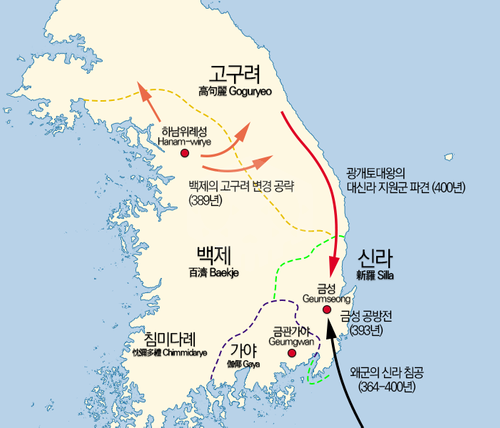
4th to 5th century war in Korea
The Silla–Goguryeo and Paekche–Kaya–Wa War (Korean: 나여–제야왜 전쟁; Hanja: 羅麗・濟倻倭 戰爭; RR: Nayeo–Jeyawae Jeonjaeng; MR: Nayŏ–Cheyawae Chŏnjaëng) was a series of conflicts that spanned for 40 years from the mid 4th century to the early 5th century between the Silla–Goguryeo alliance and the Paekche–Kaya–Wa alliance according to the Samguk sagi, Samguk yusa, Nihon Shoki, and inscriptions found in the Gwanggaeto Stele.
It was the first and only time where all four nations of Korea (Goguryeo–Silla–Paekche–Kaya) were involved in a single war, and Wa (Japan)’s first international conflict prior to the introduction of the Yamato Kingship and the following Battle of Baekgang that soon came after.

During the Three Kingdoms period, Korea was divided into three kingdoms (Goguryeo, Paekche, Silla) and one confederacy of smaller kingdoms (Kaya).
Goguryeo, a kingdom that was built by Prince Chumong (King Dongmyeong) of Buyeo alongside the native Koreans in the ruins of Gojoseon,[5] expanded its territories southward, overthrowing and absorbing the Four Commanderies of Han that were established after the Han dynasty invaded and destroyed Gojoseon.[6] The kingdom reclaimed most of the lost lands from the Han by the early 4th century and successfully repelled incoming invasions from the Chinese dynasties.
Paekche was a kingdom that arose from an earlier confederacy (Mahan confederacy) that was part of the Samhan period of Korea. It is said that King Dongmyeong’s second son, Onjo moved to Mahan and united the people there to create a new kingdom.[7] Paekche became a powerful naval kingdom that had good diplomatic ties with Japan.
Kaya was a confederacy that succeeded its former polity known as the Byeonhan confederacy, it was the only region in Korea that did not become a single nation,[8] but remained as a key trading hub for kingdoms in East Asia. The confederacy was composed of smaller kingdoms, but was unilaterally managed under the leadership of Geumgwan Gaya.
Silla was built under the leadership of Hyeokgeose who united the old kingdoms of the Jinhan confederacy into one.[9] It was considered relatively small and had rivalries with its neighboring kingdoms such as Paekche. It mostly depended on bigger kingdoms such as Goguryeo in its earlier years, and later the Tang dynasty. However, the kingdom quickly resisted its allies once they were deemed unprofitable (i.e. Silla–Tang War), and ultimately became the first kingdom to unify the peninsula in Korean history.
Outside of Korea, Japan (known as Wakoku) became heavily invested in Korean affairs due to trade and cultural dependence. Prior to the establishment of the Yamato Kingship, Wakoku (as well as the Korean kingdoms) was considered as a “primitive” or “barbaric” nation by the Chinese (see Dongyi), hence being given the characters “Wa (倭)” which meant “dwarf” or “small”, and “Koku (國)” which meant “nation”.[10] Korean kingdoms did not share the same sentiment as the Chinese, instead deeming Wakoku as a valuable trading partner as well as a culturally compatible nation. Many new technologies were passed over to Japan through Toraijins from the kingdoms and provided Japan with cultural enlightenment such as Confucianism, Buddhism, Chinese characters (Kanbun/Kanji), medicine, lunar calendar, and cultural practices such as Sue ware production and weaving.[11] Wakoku also understood the importance of the Korean kingdoms at the time, thus forming alliances with them and providing military support in exchange for their knowledge.
During the late 4th century, friction between the kingdom of Silla and the confederacy of Kaya was beginning to emerge since the fall of the Lelang Commandery caused by Goguryeo. Prior to this, the two kingdoms’ predecessors: Byeonhan and Jinhan, were known to show a strong sense of rivalry despite being recorded as “culturally and ethnically almost identical” by Chinese historians.[12] This sentiment is believed to have been carried over even after the two confederacies evolved into newer polities.
The confederacy, known for its production of iron, often traded with the neighboring Korean kingdoms, as well as the Chinese Lelang Commandery and the Japanese Wakoku or “Wa”.[13] However, after the fall of the commandery by Goguryeo forces, Kaya lost an important trading partner. Silla, which was considered as the least influential kingdom at the time, was able to create an alliance with Goguryeo which opened up a new gateway for trade routes that expanded into the bigger continental regions rather than being confined within the peninsula.[14] Sensing the threat and having pre-existing rivalry with Silla, Kaya in turn allied with Paekche and Wa of Japan, and attacked Silla for dominance over the region of southern Korea.
The two factions tried to maintain an amicable relationship at first, with many of the Kaya royals marrying into the Silla aristocracy.[15] However, with more tensions arising due to political unrest and economic diversion, Kaya began to align itself more with the kingdom of Paekche and later Wa of Japan. Paekche, a kingdom that already had a good relationship with Wa,[16] begun militarily aiding Kaya in destroying Silla as Paekche also deemed the kingdom as a growing threat.
Silla, on the other hand, began to search for an ally in the region due to many of its neighbors already forming one. With no other choice, Silla decided to request an alliance with Goguryeo by declaring it as the “superior” kingdom.[17] With two clear alliances being made in the Korean peninsula, cooperation began almost immediately with Kaya supporting invasion campaigns made by the Wa on Silla, providing them with provisions and military personnel.[18] This caused Kaya and Silla to get involved in conflicts constantly, with allies from their respective alliances sending reinforcements. This ongoing Kaya–Silla battles allowed Wa to continue attacking Silla under Kaya’s supervision.[15]
Under the pressure of trying to maintain close allies within the Korean peninsula, Wa sent military aid to Kaya and Paekche. However, due to geographical proximity, Wa forces often fought skirmishes with Silla troops, resulting in full scale battles in the mid-late 4th century.[19] In April of 364, it states that Wa led a massive attack on the kingdom of Silla, closing in on the capital of Seorabeol. Despite the uneven odds, it is said that King Naemul successfully repelled the incoming Wa forces with only a thousand troops by using a clever tactic.[19]

Japanese historians posit that this was in fact the Invasion of the Three Koreas (三韓征伐; Sankan Seibatsu); also known as the Invasion of Silla (新羅征伐; Shinra Seibatsu) of Japan, led by Empress Jingū and her Grand Minister (Ōomi), Takenouchi no Sukune.[20] According to the Nihon Shoki, Empress Jingū, who was the wife of Emperor Chūai and mother to Emperor Ōjin, was given a message from the heavens, instructing her to hastily invade Silla (Korea) stating that it was her “promised land”. She allegedly returned to Japan victorious after three years.[21]
However, due to the empress’s inconsistent age and the nature of the Nihon Shoki being very generous to supposed accomplishments made by Japan, the theory is often scrutinized.[22] Modern historians claim that “the message” the empress received was an invented reasoning for her to attack Silla in order to reclaim her supposed “promised land”, and a good excuse to execute the invasion as Empress Jingū was a Silla royalty herself (through Amenohiboko, a prince of Silla) according to the Kojiki.
Similarly, the book claimed that Jingū’s expedition helped her conquer a region in southern Korea in the 3rd century AD naming it “Mimana“,[23][24] a name that is read as “Imna” in Korea that is synonymous with Kaya. With Kaya being the center stage of the Silla–Goguryeo and Paekche–Kaya–Wa War, it can be deduced that the Nihon Shoki used the war as a reasoning for embellishing the claim that Japan successfully subjugated a Korean kingdom. This sentiment was in fact carried out by historians such as Suematsu Yasukazu who in 1949, proposed that Mimana (Kaya) was a Japanese colony on the Korean peninsula that existed from the 3rd to the 6th century.[25] However, the claim is heavily criticized in modern times where in 2010, a joint study group of historians sponsored by the governments of Japan and South Korea agreed that Kaya (Mimana/Imna) had never been militarily colonized by ancient Japan.[26]
Historically, it is said that Emperor Nintoku (Emperor Ōjin’s son and Empress Jingū’s grandson) was the reigning Tennō during the Silla–Wa War which likely passed on to his son, Emperor Richū‘s reign. However, similar to Empress Jingū’s story, these claims are also found within the Nihon Shoki, therefore, historians remain skeptical.[27]
Goguryeo–Paekche War
[edit]
Under the leadership of King Asin of Paekche, many battles were ensued from Paekche to Goguryeo to weaken the kingdom’s military prowess. Since his ascension to the throne in November of 392, Asin faced many losses in his fight against Goguryeo.[28] One of his biggest failures was in August of 393, where 10,000 Paekche troops had to retreat due to shortage of provisions,[28] and another in July of 394, where he singlehandedly lost a battle against Goguryeo’s 5,000 cavalries.[28]
After receiving multiple provocations from Paekche, Gwanggaeto of Goguryeo ultimately led an army in 396 to counterattack Paekche. In the progress, he destroyed 58 villages out of 700 and arrived very close to Wiryeseong, the capital of Paekche.[29] With no other choice, Asin sent 1,000 young men and women alongside 1,000 layers of silk, and declared to be “a forever inferior to the king of Goguryeo”. As a result, Goguryeo forces retreated back to their kingdom, but while taking Asin’s brother and 10 of his personal ministers back to Gungnae (capital of Goguryeo) as hostages.[30]
Feeling humiliated, Asin organized another attack on Goguryeo. In May of 397, he broke the treaty forbidding Paekche from interacting with Wa of Japan by sending his son, Jeonji as a political hostage.[31] Later, he began the construction of castle exteriors alongside reforming his political systems. Finally in August of 398, he dispatched another invasion to Goguryeo, but was called off very soon after a big meteorite hit his camp, believing it to be an ominous sign.[28]
Later, due to political unrest and constant defeats, Asin decided to halt any invasions to Goguryeo, rather focusing on maintaining a good relationship with his people (who were also exhausted from the constant battles) and his ally nations.[28] This allowed Paekche, Kaya and Wa to devise a plan to ultimately invade and subjugate Silla.
Also known as the Gwanggaeto’s Rescue of Silla (광개토대왕의 신라 구원) in Korea, the Goguryeo–Wa War is one of the major battles that ultimately turned the tides for the bigger Silla–Goguryeo and Paekche–Kaya–Wa conflict.
In 400, recuperated forces of Paekche and its joint allied forces of Kaya and Wa invaded the kingdom of Silla where the army of Wa arrived the earliest.[29] Sensing the looming danger, King Naemul of Silla sent a messenger to Gwanggaeto urgently requesting for aid as his “inferior” and “citizen”, stating that the “forces of Wa have already crossed the border”. Inspired by Naemul’s bravery, Gwanggaeto replied with a military tactic then quickly amassed his soldiers and began his rescue mission of Silla.[29]

According to the Gwanggaeto Stele, it is said that Gwanggaeto dispatched 50,000 soldiers to the capital of Silla.[32] By the time Gwanggaeto and his Goguryeo forces arrived, the armies of Kaya and Paekche had already rendezvoused with the Wa forces. Upon seeing Goguryeo’s arrival, Silla quickly joined its forces with the Goguryeo reinforcement and the five armies had a standoff. According to the stele, the collective number of the Goguryeo–Silla forces pushed the Wa–Kaya–Paekche armies out of the capital; having nowhere to go, the invading three armies retreated to Kaya, but were quickly pursued by Goguryeo–Silla troops into a castle in Alla (Ara Gaya; sometimes interpreted as Geumgwan Gaya) where they ultimately surrendered.[33]
A few more skirmishes happened after the Goguryeo–Wa War, however, the outcomes did not change and in 404, the alliance of Goruyeo and Silla became victorious.
The defeat of the invading armies marked the end of the 40 years war which resulted in Goguryeo making both Silla and Paekche its subjects, bringing about a short-lived alliance of the Three Kingdoms of Korea that lasted about 50 years.[34] Goguryeo remained a super power, while Paekche and Wa lost influence in the regions.
King Asin of Paekche died a year later in 405 prompting his son Jeonji, who was in Japan as a political hostage at the time, to return to his home kingdom to become his successor.[31] Jeonji, now king of Paekche, was known to have frequently attacked Goguryeo to avenge his father during his reign.
Kaya, specifically Geumgwan Gaya, did not recover from the loss. Geumgwan Gaya’s leadership dwindled and was eventually succeeded to Daegaya, another city-state of Kaya in the 5th century. Daegaya allied with Paekche and Silla to attack Goguryeo, but failed. Similar to Geumgwan Gaya, due to multiple losses, the leadership of Daegaya was transferred over to Ara Gaya in the 6th century. However, despite the constant transfer of leadership, Kaya eventually capitulated to Silla in 532 AD where its royal houses was accepted into the Silla aristocracy.[35][36]
Silla, though becoming a tributary state to Goguryeo, became the second most dominant kingdom within the peninsula after Goguryeo. They gained much land from Paekche and Kaya, and even absorbed the entire region of the latter when it later capitulated.[37][38] However, the alliance/tributary relations with Goguryeo did not last, as Silla later allied with the Tang dynasty in order to defeat the remaining two kingdoms: Paekche and Goguryeo (Battle of Baekgang). After their defeat, Silla quickly removed the Tang, their once ally, from the peninsula (Silla–Tang War)[39] ultimately becoming the only remaining nation in the region.
In Japan, anti-Silla sentiment began to grow after the war with many of the narratives that surrounded Silla being revised to paint a negative picture on the kingdom which may explain the legend of Japan’s conquer of Silla by Empress Jingū.[40] With one of its supportive allies gone and the growing threat of Silla, Japan began creating a stronger tie with Paekche, the only remaining ally in the peninsula. Even after Wa became the Yamato Kingship, Japan constantly sent military aids to Paekche later seen in the Battle of Baekgang where it battled with Silla yet again.
- 396: Gwanggaeto the Great led his troops and attacked Paekche, conquering many castles along the way. Gwanggaeto captured the Paekche capital and forced Asin to surrender and become his subject. Gwanggaeto gained 58 towns and 700 villages, and returned home with hostages, including a Paekche prince and several ministers.
- 399: Paekche broke its previous allegiance to Goguryeo and allied with Wa. In Pyongyang, Gwanggaeto was greeted by the Silla envoy Silseong who notified him that Paekche and Wa troops were crossing the border to invade Silla, and requested Goguryeo’s aid. As Silla was a loyal ally of Goguryeo, Gwanggaeto agreed to help them.
- 400: Gwanggaeto sent 50,000 soldiers to defend Silla. As Goguryeo troops reached the Silla capital, the Paekche–Kaya–Wa armies retreated toward Kaya. The Goguryeo and Silla alliance attacked and pursued the Paekche and Wa forces to the castle in Alla, where the Paekche, Wa, and Kaya troops surrendered.
- 404: Wa unexpectedly invaded the southern border of the former Daifang territory. Gwanggaeto led his troops and defeated the Wa forces in the vicinity of Pyongyang. The Wa army was defeated and many Wa soldiers were killed.
- ^ Mizoguchi, Koji. The Archaeology of Japan: From the Earliest Rice Farming Villages to the Rise of the State. Cambridge University Press. p. 51.
- ^ Kamstra, Jacques H. Encounter Or Syncretism: The Initial Growth of Japanese Buddhism. p. 38.
- ^ Matsumoto, Naoko; Bessho, Hidetaka; Tomii, Makoto. Coexistence and Cultural Transmission in East Asia. p. 155.
- ^ Batten, Bruce Loyd. Gateway to Japan: Hakata in War And Peace, 500-1300. p. 16.
- ^ 모두루묘지(牟頭婁墓誌). Encyclopedia of Korean Culture. Retrieved 11 September 2021.
- ^ “Samguk Sagi Book 13 History of Goguryeo Part 1 Section 1”. db.history.go.kr. Retrieved 8 September 2021.
- ^ “Samguk Sagi Book 23 History of Baekje Part 1 Section 1”. db.history.go.kr. Retrieved 15 September 2021.
- ^ Ebrey, Patricia; Walthall, Anne (2013-01-01). Pre-Modern East Asia: A Cultural, Social, and Political History, Volume I: To 1800. Cengage Learning. p. 101. ISBN 978-1133606512.
- ^ 박혁거세, 朴赫居世, Naver Encyclopedia
- ^ 歴史の謎を探る会編『学校で習った日本史が信じられなくなる本』(夢文庫、2010)p.90-91
- ^ 第2版,世界大百科事典内言及, 日本大百科全書(ニッポニカ),ブリタニカ国際大百科事典 小項目事典,旺文社日本史事典 三訂版,百科事典マイペディア,デジタル大辞泉,精選版 日本国語大辞典,世界大百科事典. “渡来人(とらいじん)とは? 意味や使い方”. コトバンク (in Japanese). Retrieved 2023-02-06.
{{cite web}}: CS1 maint: multiple names: authors list (link) CS1 maint: numeric names: authors list (link) - ^ Records of the Three Kingdoms: Book of Wei – Volume 30
- ^ Farris, William (1996). “Ancient Japan’s Korean Connection”. Korean Studies. 20: 6–7. doi:10.1353/ks.1996.0015. S2CID 162644598.
- ^ “[이사부를 찾아서] 금관가야 병합” [[In search of Isabu] Absorption of Geumgwan Gaya]. se-cu.com (in Korean). 2017 [April 5th].
- ^ a b Samguk yusa: 駕洛國記 (Garakguk-gi): 金官國 (Geumgwan Gaya)
- ^ Kitagawa, Joseph (2013). The Religious Traditions of Asia: Religion, History, and Culture. Routledge. p. 348. ISBN 9781136875908.
- ^ Lee, Jong-Rok (2017-08-31). “An Analysis on the Contents of the Stele of Koguryŏ in Ji’an with Regard to Koguryŏ’s Reorganization of Sumyoje”. International Journal of Korean History. 22 (2): 47–81. doi:10.22372/ijkh.2017.22.2.47. ISSN 1598-2041.
- ^ 倭5王問題と韓日關係: A Focus on the 3rd to 6th centuries (in Korean). The University of Michigan: 景仁文化社. 2005. p. 71. ISBN 9788949903040.
- ^ a b Samguk sagi: 新羅本記《第三》(Silla Chronicles <Chapter 3>): 奈勿王 (King Naemul)
- ^ Rambelli, Fabio (2018). The Sea and the Sacred in Japan: Aspects of Maritime Religion. Bloomsbury Publishing. p. 218. ISBN 9781350062870.
- ^ “Nihon Shoki, Volume 9”. Archived from the original on 2014-04-25. Retrieved November 5, 2019.
- ^ Joanna Rurarz (2014). Historia Korei (in Polish). Wydawnictwo Akademickie Dialog. p. 89. ISBN 9788363778866.
- ^ Seth, Michael J. (2006). A Concise History of Korea: From the Neolithic Period Through the Nineteenth Century. Rowman & Littlefield. p. 31. ISBN 9780742540057.
- ^ Joanna Rurarz (2014). Historia Korei (in Polish). Wydawnictwo Akademickie Dialog. p. 89. ISBN 9788363778866.
- ^ Joanna Rurarz (2014). Historia Korei (in Polish). Wydawnictwo Akademickie Dialog. p. 89. ISBN 9788363778866.
- ^ Yukiko Ishikawa and Masahiko Takekoshi, “History gap still hard to bridge”, Yomiuri Shimbun, 25 March 2010.
- ^ “大阪の仁徳天皇陵古墳は日本一|世界遺産のおすすめの古墳めぐりコースは?”. 【なんかいくらし】南海沿線の暮らし役立ち情報発信Webマガジン (in Japanese). 2023-07-26.
仁徳天皇(にんとくてんのう)は、日本の伝説的な天皇であり、紀元前4世紀から5世紀初頭にかけて在位したとされています。しかし、彼の実在性については歴史的な証拠がほとんどなく、神話や伝説の中で語られる存在です。そのため現在では他の天皇の墓であるという説や、そもそも仁徳天皇は実在すらしていなかったという説もあるようです。
- ^ a b c d e Samguk sagi: 百濟本記《第三》(Paekche Chronicles <Chapter 3>): 阿莘王 (King Asin)
- ^ a b c Samguk sagi: 高句麗本記《第十五》(Goguryeo Chronicles <Chapter 15>): 廣開土王 (King Gwanggaeto)
- ^ Lee, Jong-Rok (2017-08-31). “An Analysis on the Contents of the Stele of Koguryŏ in Ji’an with Regard to Koguryŏ’s Reorganization of Sumyoje”. International Journal of Korean History. 22 (2): 47–81. doi:10.22372/ijkh.2017.22.2.47. ISSN 1598-2041.
- ^ a b Samguk sagi: 百濟本記《第三》(Paekche Chronicles <Chapter 3>): 腆支王 (King Jeonji)
- ^ Kim, Djun (2014). The History of Korea, 2nd Edition. Santa Barbara, CA: ABC-CLIO. p. 32. ISBN 9781610695817.
- ^ Kim, Djun (2014). The History of Korea, 2nd Edition. Santa Barbara, CA: ABC-CLIO. p. 32. ISBN 9781610695817.
- ^ De Bary, Theodore and Peter H. Lee, “Sources of Korean Tradition”, pp. 25–26
- ^ Barnes, Gina L. (2001). Introducing Kaya History and Archaeology. In State Formation in Korea: Historical and Archaeological Perspectives, pp. 179–200. Curzon, London.
- ^ (2001). Kaya. In The Penguin Archaeology Guide, edited by Paul Bahn, pp. 228–229. Penguin, London.
- ^ 日本書紀 (Nihon Shoki) 卷第十九 天國排開廣庭天皇 欽明天皇 > 欽明天皇 2年 4月 > 夏四月. 安羅次旱岐夷呑奚·大不孫·久取柔利, 加羅上首位古殿奚, 卒麻旱岐, 散半奚旱岐兒, 多羅下旱岐夷他, 斯二岐旱岐兒, 子他旱岐等, 與任那日本府吉備臣[闕名字.], 往赴百濟, 俱聽詔書. 百濟聖明王謂任那旱岐等言, 日本天皇所詔者, 全以復建任那. 今用何策, 起建任那. 盍各盡忠, 奉展聖懷. 任那旱岐等對曰, 前再三廻, 與新羅議. 而無答報. 所圖之旨, 更告新羅, 尙無所 報. 今宜俱遣使, 往奏天皇. 夫建任那者, 爰在大王之意. 祇承敎旨. 誰敢間言. 然任那境接新羅. 恐致卓淳等禍[等謂㖨己呑·加羅. 言卓淳等國, 有敗亡之禍.]. 聖明王曰, 昔我先祖速古王·貴首王之世, 安羅·加羅·卓淳旱岐等, 初遣使相通, 厚結親好. 以爲子弟, 冀可恆 隆. 而今被誑新羅, 使天皇忿怒, 而任那憤恨, 寡人之過也. 我深懲悔, 而遣下部中佐平麻鹵·城方甲背昧奴等, 赴加羅, 會于任那日本府相盟. 以後, 繫念相續, 圖建任那, 旦夕無忘. 今天皇詔稱, 速建任那. 由是, 欲共爾曹謨計, 樹立任那等國. 宜善圖之. 又於任那境, 徵召新羅, 問聽與不. 乃俱遣使, 奏聞天皇, 恭承示敎. 儻如使人未還之際, 新羅候隙, 侵逼任那, 我當往救. 不足爲憂. 然善守備, 謹警無忘. 別汝所噵, 恐致卓淳等禍, 非新羅自强故, 所能爲也. 其㖨己呑, 居加羅與新羅境際, 而被連年攻敗. 任那無能救援. 由是見亡. 其南加羅, 蕞爾狹小, 不能卒備, 不知所託. 由是見亡. 其卓淳, 上下携貳. 主欲自附, 內應新羅. 由是見亡. 因斯而觀, 三國之敗, 良有以也. 昔新羅請援於高麗, 而攻擊任那與百濟, 尙不剋之. 新羅安獨滅任那乎. 今寡人, 與汝戮力幷心, 翳賴天皇, 任那必起. 因贈物各有差. 忻忻而還.
- 1st Sabi Conference in Emperor Kinmei 2 year April (AD 541)
- ^ 日本書紀(Nihon Shoki) 卷第十九 天國排開廣庭天皇 欽明天皇 > 欽明天皇 5年 11月 > 十一月, 百濟遣使, 召日本府臣·任那執事曰, 遣朝天皇, 奈率得文·許勢奈率奇 麻·物部奈率奇 非等, 還自日本. 今日本府臣及任那國執事, 宜來聽勅, 同議任那. 日本吉備臣, 安羅下旱岐大不孫·久取柔利, 加羅上首位古殿奚·卒麻君·斯二岐君·散半奚君兒, 多羅二首位訖乾智, 子他旱岐, 久嗟旱岐, 仍赴百濟. 於是, 百濟王聖明, 略以詔書示曰, 吾遣奈率彌麻佐·奈率己連·奈率用奇 多等, 朝於日本. 詔曰, 早建任那. 又津守連奉勅, 問成任那. 故遣召之. 當復何如, 能建任那. 請各陳謀. 吉備臣·任那旱岐等曰, 夫建任那國, 唯在大王. 欲冀遵王, 俱奏聽勅. 聖明王謂之曰, 任那之國, 與吾百濟, 自古以來, 約爲子弟. 今日本府印岐彌[謂在任那日本臣名也.], 旣討新羅, 更將伐我. 又樂聽新羅虛誕謾語也. 夫遣印岐彌於任那者, 本非侵害其國[未詳.], 往古來今, 新羅無道. 食言違信, 而滅卓淳. 股肱之國, 欲快返悔. 故遣召到, 俱承恩詔, 欲冀, 興繼任那之國, 猶如舊日, 永爲兄弟. 竊聞, 新羅安羅, 兩國之境, 有大江水. 要害之地也. 吾欲據此, 修繕六城. 謹請天皇三千兵士, 每城充以五百, 幷我兵士, 勿使作田, 而逼惱者, 久禮山之五城, 庶自投兵降首. 卓淳之國, 亦復當興. 所請兵士, 吾給衣粮. 欲奏天皇, 其策一也. 猶於南韓, 置郡令·城主者, 豈欲違背天皇, 遮斷貢調之路. 唯庶, 剋濟多難, 殲撲强敵. 凡厥凶黨, 誰不謀附. 北敵强大, 我國微弱. 若不置南韓, 郡領·城主, 修理防護, 不可以禦此强敵. 亦不可以制新羅. 故猶置之, 攻逼新羅, 撫存任那. 若不爾者, 恐見滅亡, 不得朝聘. 欲奏天皇, 其策二也. 又吉備臣·河內直·移那斯·麻都, 猶在任那國者, 天皇雖詔建成任那, 不可得也. 請, 移此四人, 各遣還其本邑. 奏於天皇, 其策三也. 宜與日本臣·任那旱岐等, 俱奉遣使, 同奏天皇, 乞聽恩詔. 於是, 吉備臣·旱岐等曰, 大王所述三策, 亦協愚情而已. 今願, 歸以敬諮日本大臣[謂在任那日本府之大臣也.] 安羅王·加羅王, 俱遣使同奏天皇. 此誠千載一會之期, 可不深思而熟計歟.
- 2nd Sabi Conference in Emperor Kinmei 5 year November (544)
- ^ Encyclopedia of World History, Vol II, P371 Silla Dynasty, Edited by Marsha E. Ackermann, Michael J. Schroeder, Janice J. Terry, Jiu-Hwa Lo Upshur, Mark F. Whitters, ISBN 978-0-8160-6386-4
- ^ Choi, Heejoon. “Silla’s Perception of the International World Order as Seen through Diplomatic Documents”. International Journal of Korean History.



