


WHILE the government insists that it has provided all possible facilities to Imran Khan, a key cabinet minister claimed on Friday that Khyber Pakhtunkhwa Chief Minister Sohail Afridi’s quest to meet his incarcerated party leader was in violation of the jail manual.
Information Minister Atta Tarar’s assertion prompted an indignant response from the PTI, which maintains that their court-decreed schedule of meetings — on Tuesdays and Thursdays — is not being honoured.
In separate remarks, Parliamentary Secretary Barrister Danyal Chaudhry also termed the KP CM’s demand “to seek political guidance from a convicted individual… a clear violation of prison laws”.
But what does the jail manual actually say about prisoners’ visitation rights, and do political prisoners enjoy more leeway than others? These and other ancillary questions have doubtless popped up in the minds of many observers.
Visitation, phone calls allowed to prisoners are linked to their ‘good behaviour’, meaning the jail superintendent has the discretion to allow or disallow meetings
Former and current prison officials Dawn spoke to said that all prisoners in Punjab’s jails — including political prisoners confined — are allowed meetings with five people per week, including their lawyers and relatives. In addition, they are allowed 30 minutes of phone time per week.
Even condemned prisoners are eligible to meet their lawyers and family members once a week, along with 30 minutes of phone time, which is exercised through the several public call offices (PCOs) that are operational in Adiala jail.
Official say jail authorities have the ability to conduct ‘automatic monitoring’ of prisoners’ phone conversations, so they can listen to any communication made by any prisoner, when necessary.
In addition, political prisoners are kept in special cells under strict security, and their medical check-up is supposed to be conducted on a daily basis to ensure that they are in good health.
‘Subjective’ rules
However, the rules stipulate that these meetings are linked to the “prisoner’s behaviour”, i.e. their obedience to prison rules, making their enforcement necessarily subjective.
According to officials, certain serious offenses, such as terrorism and involvement in anti-state activities, could render an inmate ineligible for these provisions.
A retired senior officer from the prison department told Dawn that according to the rules, the decision whether or not to allow an incarcerated or under trial prisoner access to his/her lawyers or relatives was at the discretion of the concerned jail superintendent.
If the incarcerated prisoner’s behaviour is ‘not good’, it will be up to the jail authorities to disallow meetings or telephonic conversations.
In addition, the visitation rights of any prisoners, especially political ones, can be suspended if the government apprehends unrest or a law and order situation.
This could be a major stumbling block for the PTI, as prison authorities have repeatedly complained about the conduct of Mr Khan’s visitors, especially taking issue with the press conferences that Aleema Khan or others hold after meeting with the incarcerated party founder.
In recent weeks, these have often culminated in sit-ins and protests outside the prison, which the jail authorities could cite as a potential law and order risk.
In his remarks, Barrister Danyal Chaudhry maintained that jail meetings are only possible under judicial orders. However, the PTI maintains that in spite of a court-ordered meeting schedule, jail authorities were arbitrarily disallowing meetings with the inmate.
However, PM’s aide Senator Rana Sanaullah seemed to strike a softer note, voicing his support for meetings between incarcerated PTI founder Imran Khan and his family members, albeit subject to certain conditions.
“There should be permission for meetings and they should definitely take place, but a 90-minute press conference cannot take place after an hour’s meeting; no law allows this,” he told Geo News on Friday.
Past precedent
One official said that many political prisoners — like PML-N leader Nawaz Sharif, his daughter Maryam Nawaz and son-in-law Safdar Awan — had availed the telephone facility during their imprisonment, thanks to ‘good behaviour’.
The PML-N leader used to keep a stopwatch with him while talking to his family members or others to monitor the time, he recalled.
In addition, a seasoned journalist who had visited several political prisoners in different jails across the country in the past — such as Javed Hashmi and ex-PM Yousuf Raza Gilani — said that visitors were only allowed to meet prisoners with their consent.
He explained that, on scheduled meeting days, prisoners generally provide the jail authorities with a list of their guests or visitors, which is then scrutinised and approved by the jail superintendent.
At times, the journalist recalled, they had to identify themselves as “family members” or “a friend of the prisoner” to avoid being denied access.
Party infighting over who controls the all-important list, which contains the names of those who would be allowed to meet the prisoner has also not helped the PTI’s cause, as Secretary General Salman Akram Raja and Barrister Ali Zafar have previously found themselves at odds over the issue.
Published in Dawn, November 29th, 2025
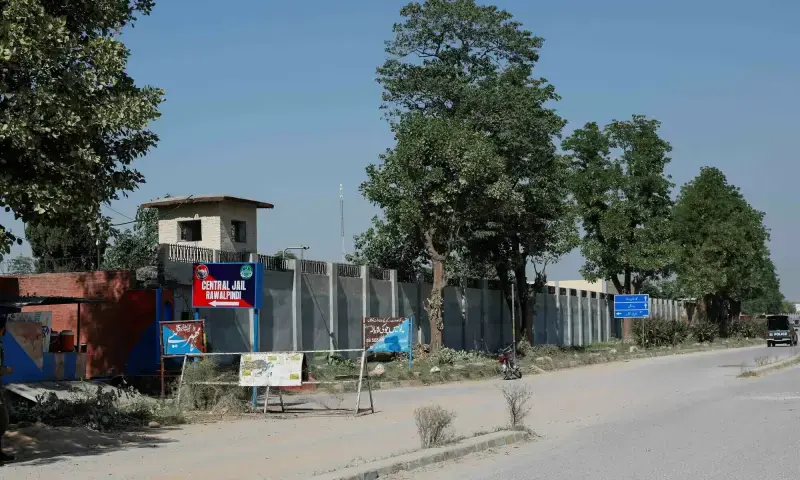
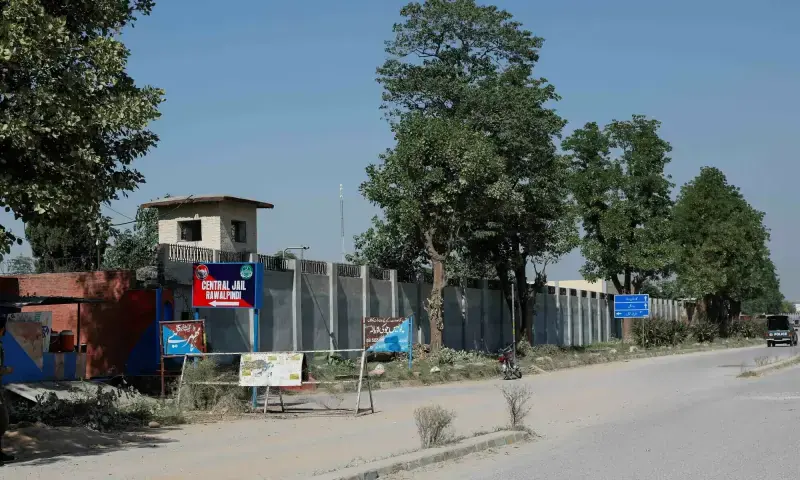
Header image: This image shows an exterior wall of the Adiala jail in Rawalpindi on October 5, 2024. — Reuters/File



