
Content deleted Content added
|
|
|||
| Line 90: | Line 90: | ||
|
== Raising the wreck == |
== Raising the wreck == |
||
|
[[File:2025 Wrack U-16 U-Boot – by 2eight – 9SC 7309.jpg|thumb|left|Aft and turret of the wreck]] |
[[File:2025 Wrack U-16 U-Boot – by 2eight – 9SC 7309.jpg|thumb|left|Aft and turret of the wreck]] |
||
|
With two institutions in charge of the wreck, the [[Institute for Federal Real Estate (Germany)|Institute for Federal Real Estate]] (BlmA) and |
With two institutions in charge of the wreck, the [[Institute for Federal Real Estate (Germany)|Institute for Federal Real Estate]] (BlmA) and ”Wasserstraßen- und Schifffahrtsamt Elbe-Nordsee”, the fate of U-16 remained unsettled. Experts feared, the wreck, lying at a depth of 20 meters and stuck in the mud of the [[Wadden Sea]] up to the original waterline, could move further into the mouth of the [[Elbe]], a major shipping lane to [[Hamburg]] and threaten commercial shipping, so the ”Wasserstraßen- und Schifffahrtsamt Elbe-Nordsee” finally decided to raise the wreck.<ref name=”ing2025″>{{Cite web |last=Hochwarth |first=Dominik |title=„Was unten bleiben kann…“ – Experten empört über U16-Bergung |url=https://www.ingenieur.de/technik/fachbereiche/verkehr/bergung-von-u-boot-u16-blick-auf-technik-und-geschichte/ |access-date=2025-09-05 |website=ingenieur.de |language=de}}</ref> Without BlmA approval.<ref name=”dpa25″>{{Cite web |last= |first= |title=Zweite Hälfte von U-Boot aus Kaiserzeit auf dem Trockenen |url=https://www.sueddeutsche.de/wissen/spektakulaerer-aktion-zweite-haelfte-von-u-boot-aus-kaiserzeit-auf-dem-trockenen-dpa.urn-newsml-dpa-com-20090101-250904-930-996087|access-date=2025-09-06 |website=sueddeutsche.de |language=de}}</ref> |
||
|
During the night of 31 August to 1 September 2025, the wreck was raised from a depth of about 20 meters by the dutch [[crane vessel]] ”Matador 3”.<ref name=”ing2025″/> During the operation, the submarine broke apart. Part of the vessel remained on the seabed off Scharhörn, the rest was brought to [[Cuxhaven]].<ref>{{Cite web |last=Lippke |first=Alicia |title=U-Boot aus dem Jahr 1919: Wrack zerbricht bei Bergung aus 20 Metern Tiefe |url=https://www.ndr.de/nachrichten/niedersachsen/oldenburg_ostfriesland/auf-nordsee-gesunken-u-boot-aus-dem-jahr-1911-zerbricht-bei-bergung,wrack-112.html |access-date=2025-09-02 |website=ndr.de |language=de}}</ref> The remaining bow section was raised two days later.<ref name=”dpa25″/> Museums expressed interest in obtaining some smaller pieces of equipment from the wreck, but the conservation status of the hull was considered to be too bad to save it.<ref name=”ing2025″/> Others estimated a preservation to be possible but too expensive.<ref name=”dpa25″/> |
During the night of 31 August to 1 September 2025, the wreck was raised from a depth of about 20 meters by the dutch [[crane vessel]] ”Matador 3”.<ref name=”ing2025″/> During the operation, the submarine broke apart. Part of the vessel remained on the seabed off Scharhörn, the rest was brought to [[Cuxhaven]].<ref>{{Cite web |last=Lippke |first=Alicia |title=U-Boot aus dem Jahr 1919: Wrack zerbricht bei Bergung aus 20 Metern Tiefe |url=https://www.ndr.de/nachrichten/niedersachsen/oldenburg_ostfriesland/auf-nordsee-gesunken-u-boot-aus-dem-jahr-1911-zerbricht-bei-bergung,wrack-112.html |access-date=2025-09-02 |website=ndr.de |language=de}}</ref> The remaining bow section was raised two days later.<ref name=”dpa25″/> Museums expressed interest in obtaining some smaller pieces of equipment from the wreck, but the conservation status of the hull was considered to be too bad to save it.<ref name=”ing2025″/> Others estimated a preservation to be possible but too expensive.<ref name=”dpa25″/> |
||
|
The entire recovery was labeled “stuporous” by a BlmA archeologist. After his judgement, moving the wreck a few meters away from the shipping lane would have been sufficient.<ref name=”dpa25″/> |
The entire recovery was labeled “stuporous” by a BlmA archeologist. After his judgement, moving the wreck a few meters away from the shipping lane would have been sufficient.<ref name=”dpa25″/> |
||
|
==Summary of raiding history== |
==Summary of raiding history== |
||
Latest revision as of 22:30, 1 October 2025

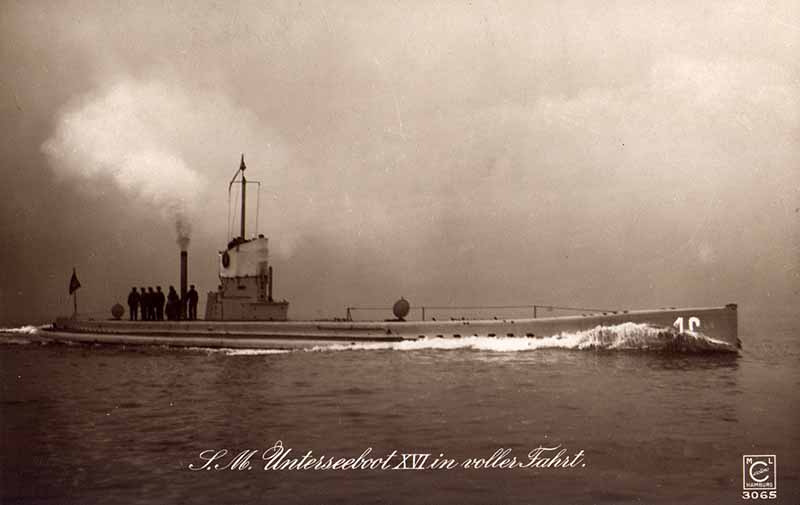
SM U-16 Underway. |
|
| Class overview | |
|---|---|
| Operators |  Imperial German Navy Imperial German Navy |
| Preceded by | Type U 13 |
| Succeeded by | Type U 17 |
| Completed | 1 |
| History | |
 Germany Germany |
|
| Name | U-16 |
| Ordered | 26 August 1909 |
| Builder | Germaniawerft, Kiel |
| Cost | 2,539,000 Goldmark |
| Yard number | 157 |
| Laid down | 10 May 1910 |
| Launched | 29 August 1911 |
| Commissioned | 28 December 1911 |
| Fate | Sunk in February 1919 in an accident at position 53°59′N 08°29′E / 53.983°N 8.483°E while on passage to surrender. Its wreck was raised on September 2025. |
| General characteristics | |
| Class & type | Unique submarine |
| Displacement | |
| Length | 57.80 m (189 ft 8 in) |
| Beam | 6.00 m (19 ft 8 in) |
| Draught | 3.36 m (11 ft 0 in) |
| Propulsion | |
| Speed |
|
| Test depth | 50 m (160 ft) |
| Complement | 4 officers, 25 men |
| Armament | |
| Service record | |
| Part of: |
|
| Commanders: | |
| Operations: | 4 patrols |
| Victories: | |
SM U-16[Note 1] was one of the 329 submarines serving in the Imperial German Navy in World War I.
U-16 was a pre-war U-boat, built by Friedrich Krupp Germaniawerft and served up to 1915 when she was utilized as a training submarine. It engaged in the naval warfare and took part in the First Battle of the Atlantic.
During its service, it sunk 11 ships, damaged 2, and took a Swedish ship as a prize.
After the war ended, in 1919 the ship was en route to Harwich to be turned in as war booty. However, an accident occurred wherein U-16 sunk off the island of Scharhörn.

With two institutions in charge of the wreck, the country´s Institute for Federal Real Estate (BlmA) and the state of Hamburg´s Wasserstraßen- und Schifffahrtsamt Elbe-Nordsee, the fate of U-16 remained unsettled. Experts feared, the wreck, lying at a depth of 20 meters and stuck in the mud of the Wadden Sea up to the original waterline, could move further into the mouth of the Elbe, a major shipping lane to Hamburg and threaten commercial shipping, so the Wasserstraßen- und Schifffahrtsamt Elbe-Nordsee finally decided to raise the wreck.[3] Without BlmA approval.[4]
During the night of 31 August to 1 September 2025, the wreck was raised from a depth of about 20 meters by the dutch crane vessel Matador 3.[3] During the operation, the submarine broke apart. Part of the vessel remained on the seabed off Scharhörn, the rest was brought to Cuxhaven.[5] The remaining bow section was raised two days later.[4] Museums expressed interest in obtaining some smaller pieces of equipment from the wreck, but the conservation status of the hull was considered to be too bad to save it.[3] Others estimated a preservation to be possible but too expensive.[4]
The entire recovery was labeled “stuporous” by a BlmA archeologist. After his judgement, moving the wreck a few meters away from the shipping lane would have been sufficient.[4]
Summary of raiding history
[edit]
- ^ “SM” stands for “Seiner Majestät” (English: His Majesty’s) and combined with the U for Unterseeboot would be translated as His Majesty’s Submarine.
- ^ Tonnages are in gross register tons
- Gröner, Erich; Jung, Dieter; Maass, Martin (1991). German Warships 1815–1945, U-boats and Mine Warfare Vessels. Vol. 2. Translated by Thomas, Keith; Magowan, Rachel. London: Conway Maritime Press. ISBN 0-85177-593-4.

