


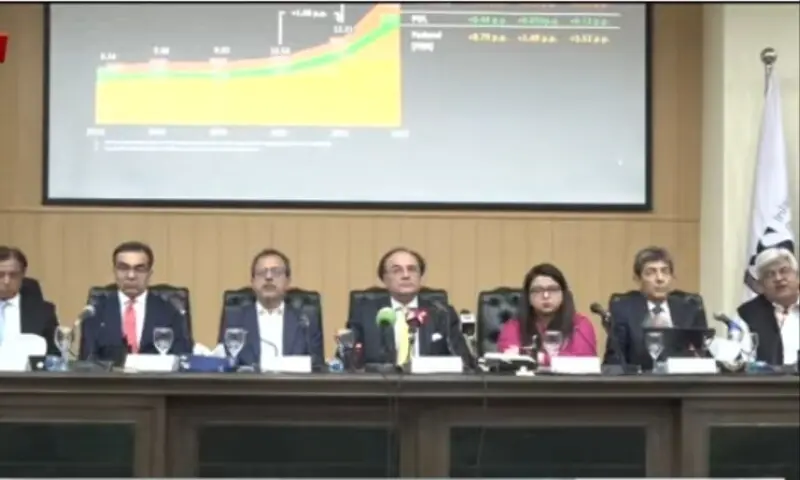

Finance Minister Muhammad Aurangzeb on Monday said that Pakistan’s economic direction had been set right through a series of structural reforms, which were now being operationalised to ensure sustainable and inclusive growth.
“I believe there is a broad consensus that we have made significant inroads and achieved considerable progress in terms of macroeconomic stability,” he said while addressing a joint news conference on economic reforms.
He was accompanied by Power Minister Awais Leghari, Information Technology Minister Shaza Fatima Khawaja, Federal Board of Revenue (FBR) Chairman Rashid Mahmood Langrial and Adviser to the Prime Minister on Privatisation Muhammad Ali.
Aurangzeb said the government had achieved macroeconomic stability, as evidenced by external validation: three leading international rating agencies upgraded Pakistan after a gap of three years. “These agencies are now aligned not only on where we stand but also on our positive outlook,” he added.
He said the successful completion of the second International Monetary Fund (IMF) review and the subsequent staff-level agreement in Washington reaffirmed that the country’s economic trajectory was on the right path.
When the exchange rate stabilises, foreign exchange reserves rise, inflation declines, and the policy rate comes down, the benefits are evident for industries, the minister remarked, adding that investors had repatriated more than four million dollars in profits and dividends.
Aurangzeb said investor confidence was crucial for attracting new foreign direct investment (FDI). “Until our existing investors are satisfied, we cannot talk about further FDI,” he said, adding that the government had moved in the right direction toward stability.
Highlighting the next phase of economic management, the finance minister said Pakistan must now focus on avoiding historical boom-and-bust cycles and move toward sustained and inclusive growth.
Pakistan today stands at a unique confluence of economic stability and favourable geopolitical tailwinds, he said, pointing to stronger trade and investment opportunities with China, the United States, and Gulf Cooperation Council (GCC) countries.
He stressed that structural reforms were indispensable for achieving sustainable growth.
The minister said the government’s reform agenda covered key areas, including taxation, energy, restructuring of state-owned enterprises (SOEs), privatisation, rightsizing of the federal government, digital transformation, debt management, and pension reforms.
These are the areas consistently highlighted by analysts, think tanks, and our bilateral and multilateral partners, he added.
More to follow.



