


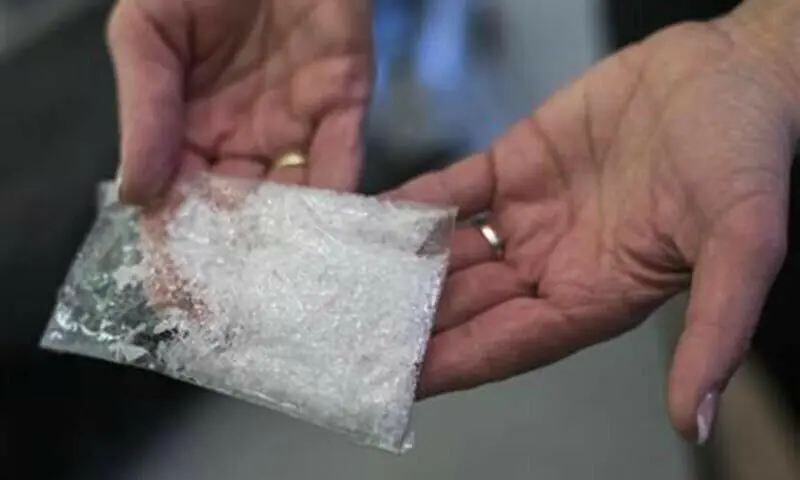
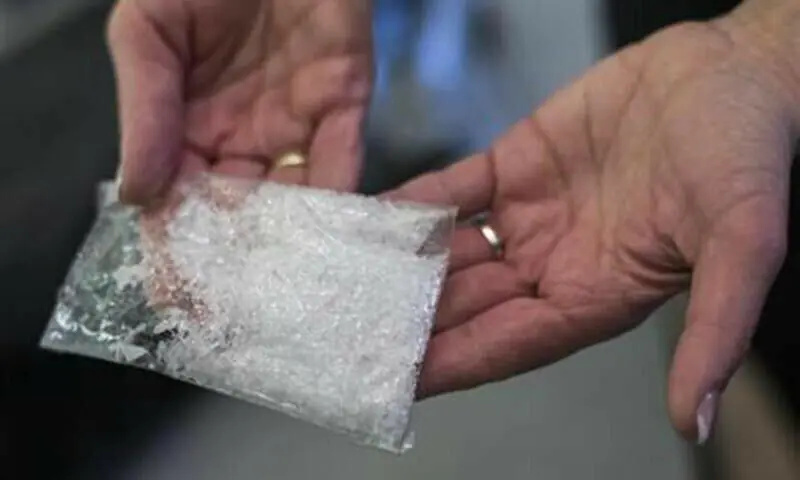
In a span of 48 hours the Pakistan Navy’s ship Yarmook intercepted two dhow sailing boats in the Arabian Sea and confiscated nearly two and a half tons of crystal methamphetamine, known popularly as ‘Ice’, and about 50kg of cocaine — one of the largest maritime drug busts in history. Altogether that is a market value of around $972 million; only slightly less than the $1billion dollar tranche Pakistan received from the International Monetary Fund in May.
The seizure is curious for two reasons: firstly, the Arabian Sea is not traditionally known as a major drug route; that distinction belongs to Southeast Asian waters and of course the Atlantic and Pacific routes that Central and South American gangs use to funnel drugs to North America and Europe.
Secondly, seizing such a large quantity of ice is something that we would imagine taking place in Southeast Asia, where the lower Mekong countries, in particular Laos, Cambodia and Myanmar, have historically been the epicenters of crystal meth production and trafficking.
In the past 10 years, meth seizures in Southeast Asia have skyrocketed. At the same time, we have also seen our part of the world emerge onto the map as not only a region where meth use in increasing, but also as a trafficking route and, indeed, a production hub.
Meth from the neighboring country’s lucrative drug production line finds its way to Pakistan, which has become a trafficking route and consumer
In this decade, meth use in Pakistan has reached epidemic proportions, replacing heroin as the drug of choice of hardcore addicts. Proof of this can be found in the increase in meth-related crime and the testimony of drug rehab centres. Today, we find that Ice use is most prevalent in Khyber Pakhtunkhwa, and in Sindh, drug rehab centres tell us that as many as 70 per cent of their clients are now Ice addicts.
Pakistan isn’t just a consumer, it’s also a stop on the trafficking route. Proof of this was found in November 2020 when a joint operation by the coast guards and the army found over 100kg of ice hidden in the hills of Pasni, on the Balochistan coast; it was stored there to be picked up and loaded onto boats to be smuggled overseas. A year later, the navy and coast guards intercepted a sailing boat off the same coast and nabbed over 200kg of Ice this time, along with 227kg heroin. These are just two such cases.
If they manage to evade detection, the smugglers might make it to Sri Lanka where, in 2020, two trawlers carrying 100kg of Ice and 400kg of heroin were intercepted in what was then billed as Sri Lanka’s ‘biggest ever’ drug bust, valued at $33m. Just four years later that record was broken when another ship carrying 400kg of Ice was intercepted.
So now we know something of where ice is being used in this region and how it is trafficked. But where is it coming from? The answer may surprise you: it’s Afghanistan.
Don’t take my word for it; the United Nations Office on Drugs and Crime raised the alarm in 2023, pointing to Afghanistan as an emerging producer of methamphetamine and noting that meth linked to Afghanistan has been reportedly apprehended “from places as far away as the European Union, the Near and Middle East, South-east Asia and Eastern Africa.” This year the International Narcotics Control Board echoed the United Nations Office on Drugs and Crime (UNOD) by saying that the increase in meth production in Afghanistan poses ‘serious challenges’ for neighbouring countries, of which Pakistan, unfortunately, is one.
In November 2020, a joint operation by the coast guards and the army found over 100kg of Ice hidden in the hills of Pasni, on the Balochistan coast there to be smuggled overseas
This begs the question: how do they know this meth was from Afghanistan? To determine that we must first understand how meth is made: crystal methamphetamine production is entirely chemical and requires, among other ingredients, a steady supply of Ephedrine or pseudoephedrine.
These chemicals are used in the legitimate manufacture of pharmaceuticals, but given that Afghanistan has no pharmaceutical or chemical industries to speak of, how are they making so much meth? The answer lies in a local herb named ephedra that can also be distilled to produce ephedrine.
We first heard about this in the mainstream media from journalist Lynzy Billing who interviewed the then-head of Afghanistan’s counter narcotics police, Khalid Nabizada who explained, “International buyers know it can be made easily and cheaply here, the chemicals used are not controlled, and this ephedra plant is everywhere,” he said.
Experimentations with ephedra reportedly began as early as 2015, and just three years later, became the choice method of production. The Taliban seem to have taken full advantage of this shift, with the Foreign Policy magazine noting in a 2023 article, “After cornering the market on heroin [the Taliban] pivoted to a quicker and more profitable alternative,” namely, Meth.
In fact, the lack of governance (and official patronage) mean that Afghan meth, while comparable in quality, is one-tenth the price of its Southeast Asian equivalent. It’s a lucrative trade and it is estimated that the meth trade in the Bakwa district in Farah province alone was worth $240m in 2021.
And that’s how we know the meth being trafficked and caught is from Afghanistan as the UNODC noted earlier; chemical testings show that they were synthesised by using ephedra and not other, more traditional, methods.
This then adds a new dimension to Pakistan’s already fraught relations with Afghanistan and also adds another factor to why the Afghan Taliban are so insistent that free movement across the Pak-Afghan border be allowed, even going so far as to object to Pakistan’s fencing of the border. As they say, you have to follow the money.
The writer is a columnist and hosts a TV show
Published in Dawn, The Business and Finance Weekly, October 27th, 2025



