


{{Authority control}}
{{Authority control}}
[[Category:Art museums and galleries]]
[[Category:Art museums and galleries in France]]
[[Category:Art museums and galleries in France]]
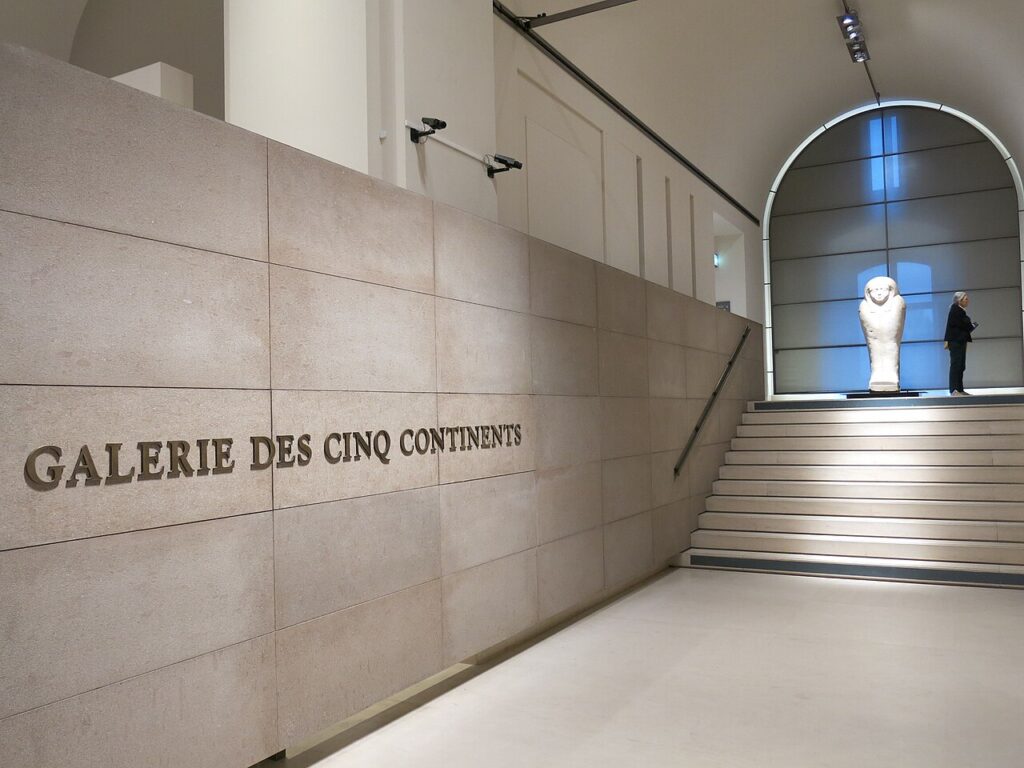
Art gallery at the Louvre, Paris
.jpg)
The Gallery of the Five Continents (French: Galerie des cinq continents) is a permanent exhibition space at the Louvre art museum in Paris, France. It has been dedicated to displaying works of art and material culture from across the five continents Africa, the Americas, Asia, Europe, and Oceania in a unified museographical framework. The gallery opened on 3 December 2025, replacing the former Pavillon des Sessions and representing an extensive institutional effort to present non-European artistic traditions alongside Western art in a global narrative of world cultures.

The space now known as the Gallery of the Five Continents occupies the former Pavillon des Sessions, a building within the Denon Wing of the Louvre originally constructed under the Second French Empire to host sessions of the French legislative assembly. The pavilion was repurposed in 2000 to exhibit works from Africa, Asia, Oceania and the Americas drawn principally from the collections of the Musée du Quai Branly–Jacques Chirac, reflecting a growing awareness in museum practice of the importance of presenting non-Western arts on an equal level with traditional Western narratives.[1] In late 2025, after renovations and a reimagined museography, the pavilion was inaugurated as the Gallery of the Five Continents. This transformation was funded in part through private sponsorship for enhancements to the entrance and visitor facilities.[2][3]
Collections and display
[edit]

The gallery presents a selection of 130 major works and cultural objects from the Louvre and other French public collections, including the Musée du Quai Branly–Jacques Chirac, the Musée Guimet, the Musée d’Aquitaine, the Bibliothèque nationale de France, an artwork loaned from Nigeria and others, as well as loans from international partners. The selection spans a wide chronological range, from ancient artefacts to historic and ritual objects, and is organised to encourage cross-cultural conversation and thematic connections across continents and eras. The exhibition context emphasises relations between cultures by juxtaposing objects traditionally exhibited in separate historical or regional departments, such as European antiquities and African sculpture, to encourage visitors to consider universal themes such as birth, death, belief systems, authority, and human engagement with the natural world.[1]
Museographical approach
[edit]
.jpg)
A central aim of the gallery’s design is to foster a dialogue between diverse artistic traditions and to present a more inclusive and interconnected story of human creativity. The layout and interpretive material are organised to support comparative encounters, with multilingual explanatory texts and detailed labels to guide the visitor’s interpretation. Thus, an African wooden sculpture of a woman with child is exhibited next to a European religious sculpture of The Virgin with Child as an example of maternity.[4]
This approach reflects broader shifts in museology toward decentring Eurocentric narratives and giving due importance to the value and sophistication of global artistic expression. The interior spaces, characterised by broad, light-filled rooms designed by architect Jean-Michel Wilmotte, provide a setting that supports the gallery’s global scope. The renovation included improvements to visitor amenities and accessibility, with a new entrance via the museum’s Porte des Lions, which also offers easier access to nearby collections within the museum.[1]
While the Gallery of the Five Continents has been praised as a significant step in presenting non-Western art within the Louvre’s core narrative, commentary in academic and museological circles has also highlighted ongoing debates regarding the framing of global art in historically Western institutions. Some scholars have argued that such universalising presentations must remain critically attentive to issues of provenance, colonial histories, and power dynamics embedded in museum collections.[5]



