


From Wikipedia, the free encyclopedia
Ti Tốp Island, or Titov Island is a small island that belongs to Hạ Long Bay, Quảng Ninh province, Vietnam.[1] The island is far away from Bãi Cháy port at about 7–8 kilometres (4.3–5.0 mi) towards the southeast. This is a small island inside Cửa Lục Bay, in front of Sửng Sốt Cave on Bồ Hòn Island, to the west is Dầm Nam Island, and to the north is Dầm Bắc Island.
According to many documents and maps from different periods and according to folklore, this island was once called Hồng Thập Tự Island (Red Cross Island) or Nghĩa Địa Island (Cemetery Island). The reason for this name is because in 1905, a French cargo ship entering Ha Long Bay, because it did not have a navigator familiar with the bay, crashed into a reef and sank in Con Cóc Lagoon. The sailors who died were buried on this island. Many years later, the island became deserted. In a French map of Ha Long Bay drawn at the end of the 19th century, this island was called Cát Nàng.
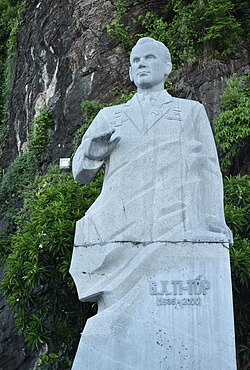
On January 22, 1962, president Hồ Chí Minh and Soviet astronaut Gherman Titov visited the island.[2] To commemorate that trip, Hồ Chí Minh named the island Ti Tốp Island. A monument in his honor was erected on the island in 2015.

Ti Tốp is an island with steep banks, one sloping bank with a flat, white sand beach. Cruise ships often stop here. Visitors go ashore to swim or climb to the top of the mountain to see the whole view of the island. From above, Ti Top Beach looks like a crescent moon hugging the foot of the island.
Unlike many other tourist attractions in Hạ Long Bay, Ti Top Island also has a beautiful beach, called Ti Top Beach. Although the beach is not large in area, it is quiet, airy and very clean. The sand on the beach is constantly washed by the tide, and the sea water is clear all year round.
Views of the island’s shoreline is provided by watercraft and by seaplane to see it from above. The New York Times once voted the experience of viewing Bái Tử Long Bay and Hạ Long Bay from a seaplane as one of the most attractive tourist services in 2015.[3]
- Vietnam National Authority of Tourism (2007), Non Nước Việt Nam, Hà Nội Publishing House




