
From Wikipedia, the free encyclopedia
Content deleted Content added
|
|
|||
| Line 61: | Line 61: | ||
|
[[Category:1988 drama films]] |
[[Category:1988 drama films]] |
||
|
[[Category:Films shot in Bulgaria]] |
[[Category:Films shot in Bulgaria]] |
||
|
[[Category:Films set in 17th-century Ottoman Empire]] |
[[Category:Films set in 17th-century Ottoman Empire]] |
||
|
[[Category:Films set in Bulgaria]] |
[[Category:Films set in Bulgaria]] |
||
|
[[Category:Films set in 1668]] |
[[Category:Films set in 1668]] |
||
Latest revision as of 10:47, 1 February 2026
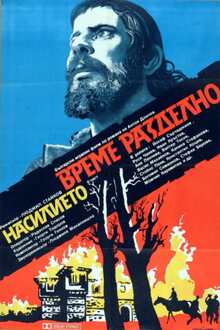
1988 Bulgarian film
| Time of Violence | |
|---|---|

Theatrical release poster |
|
| Directed by | Ludmil Staikov |
| Written by | Ludmil Staikob, Georgi Danailov, Mihail Kirkov, Radoslav Spasov |
| Based on | Time of Parting by Anton Donchev |
| Produced by | Hristo Nenov |
| Starring | |
| Cinematography | Radoslav Spasov |
| Edited by | Violeta Toshkova |
| Music by | Georgi Genkov |
| Distributed by | Boyana Film |
|
Release date |
|
|
Running time |
288 minutes |
| Country | Bulgaria |
| Language | Bulgarian |
Time of Violence (Bulgarian: Време разделно) is a 1988 Bulgarian film based on the novel Time of Parting by Anton Donchev. It consists of two episodes with a combined length of 288 minutes. It premiered at the 1988 Cannes Film Festival where it was screened in the Un Certain Regard section.[1] The film was selected as the Bulgarian entry for the Best Foreign Language Film at the 62nd Academy Awards, but was not nominated.[2]
The film is set in the Ottoman Empire, in 1668. As Köprülü Fazıl Ahmed Pasha concentrates his war efforts on the Cretan War, he grows paranoid of the Sultan’s Christian subjects, convinced that they are an uncontrollable threat to the empire unless Islamized.
One of the targets is Elindenya, a village located in a Rhodope valley where the Christian Bulgarians’ way of life was for the most part left alone under the Ottoman governor Süleyman Agha‘s rule. A sipahi regiment is dispatched to the valley with the mission of converting the Christian population to Islam, by force if necessary. The extraordinary thing is that the regiment is led by Kara Ibrahim, a fanatical devshirme from Elindenya, and although Süleyman Agha, feeling that his self-ordained rule is at stake, objects to forced conversions, Kara Ibrahim favors measures of extreme brutality against the local Bulgarians, including his own family.

