
From Palestinian perspective, the terms seem to largely align with Israel’s vision and fail to safeguard their interests.
There seems to be too much riding on President Donald Trump’s so-called “comprehensive plan” to end the Gaza war for it to fail completely.
The US president has made sure that all influential stakeholders — from Israel itself to the Muslim bloc and Europe — are on board with the plan, which envisions an ideal situation in the Palestinian territories, once the war ends.
But there are pressure points within the proposal that may yet elicit protestations — both from Tel Aviv and Palestinian groups — making it unlikely that the draft currently being pushed out by the White House will remain intact for very long.
For example, the proposal calls for giving members of Hamas — at least those who commit to peaceful co-existence and lay down their arms — amnesty and/or safe passage out of Gaza. This is unlikely to be palatable to hardline members of Benjamin ‘Bibi’ Netanyahu’s cabinet.
In addition, according to the BBC’s John Sudworth, “They won’t like the prohibition the plan imposes on Israel’s ability to occupy Gaza… And they’ll hate the pathway to Palestinian statehood contained in point 19.”
But, in his view, there is also “a get-out clause” in all of this: “If Hamas rejects the deal… then Israel will have America’s full backing to do what it needs to do,” he noted.
From the Palestinian perspective, the terms seem to largely align with Israel’s vision and fail to safeguard their interests. Hamas has stressed that it will not accept any plan that does not end the war and guarantee Israel’s withdrawal from Gaza, but it may find itself in a position where earlier drafts, which it has already rejected, would seem more attractive than the deal on offer.
According to Al Jazeera, the leader of Palestinian Islamic Jihad Ziad al-Nakhala has said he considers the US announcement on Gaza a “recipe to blow up the region”.
Transitional management
Although Trump’s “comprehensive plan” was publicly released for the first time on Monday night, it and a series of related proposals have been reported on by international news outlets over the past week.
Apart from visualising a Hamas-free Gaza, the 20-point draft dwells on post-war “redevelopment” of the war-torn enclave, with a transitional, technocratic set-up being handed the responsibility of delivering basic public and municipal services.
According to Israeli outlet Haaretz, this is probably a reference to the proposed Gaza International Transitional Authority.
The plan reveals a hierarchy in which an international board of billionaires and businesspeople sit at the top, while highly vetted “neutral” Palestinian administrators are at the bottom.
According to Middle East Eye, under the draft pitched by former UK PM Tony Blair, this authority will be run by an international board which has “supreme political and legal authority for Gaza during the transitional period”.
The administration would work closely with Israel, Egypt and the US, and, according to Israeli sources cited by Haaretz, has the backing of the White House.
The board will be in charge of all appointments and supervise every component of the authority.
This authority appears to be the ‘Board of Peace’ mentioned by Trump during last night’s press conference, which he said he would personally head.
In the view of BBC’s Tom Bateman, this would effectively make him the “governor of Gaza”.
The board is also likely to include a senior UN official, as well as “leading international figures with executive and financial expertise”. There will be “at least one qualified Palestinian representative”, potentially coming from the “business or security sector”, but it wasn’t clear what “qualified” here means.
Finally, the document says that the board would have “a strong representation of Muslim members to ensure regional legitimacy and cultural credibility”.These Muslim figures would ideally have the political support of their countries, but also “long-standing business credibility”.
Undermining Palestinian Authority?
Despite its name, the Palestinian Executive Authority (PEA) is at the very bottom of the proposed hierarchy in post-war Gaza, and has little to no independent authority.
According to Middle East Eye, it is separate from the Palestinian Authority, which administers parts of the occupied West Bank. The PEA would be made up of technocratic ministries that administer health, education, water supply and energy, labour market policies, housing, local criminal justice and welfare, among a few other policy areas.
It would be headed up by a “Palestinian Chief Executive Officer”, appointed by the international board. It’s notable that the language used for all roles throughout the document, like board, chairman and CEO, reflects a business structure rather than a country or territory.
The Palestinian CEO will lead the process of identifying “directors” (not ministers) to head up the various departments like health, education, infrastructure and planning. The directors will need to “meet standards of technical competence, integrity, and neutrality”.
The international board of billionaires and businesspeople will have the final say on appointments “to safeguard institutional legitimacy and independence”.
“All department heads are subject to performance review and can be dismissed or replaced in accordance with transitional governance procedures,” the leaked document notes.
Who will deal with Hamas?
In his remarks alongside Netanyahu, the US president was seemingly unequivocal; Muslim countries would be “dealing with Hamas”.
This seems to indicate that he is placing the onus of ensuring compliance on the Muslim bloc, which was ostensibly briefed on the finer points of this proposal during their meeting with Trump on the sidelines of the UN General Assembly last week.
But there are still things in the draft that may not go down well with these allies. So even though Hamas may now be pressured by Qatar and other Arab countries to accept the principles, that is when the real negotiations will begin, as both sides wrangle over the deliberately vague language contained in the “comprehensive draft”.
In that sense, according to the BBC’s Bateman, this latest development is not an end to the war, but more like a basis for restoring negotiations.
A joint statement, issued on behalf of the foreign ministries of the Muslim bloc — Pakistan, Saudi Arabia, Qatar, Jordan, Turkiye, UAE, Egypt, and Indonesia — said they will engage “constructively” towards finalising an agreement.
Welcoming what they called Trump’s “sincere efforts” to end the war, rebuild Gaza, and prevent the displacement of the Palestinian people, the statement also commended the US president’s refusal to allow the annexation of the West Bank.
The foreign ministers’ statement said they want to see a “just peace on the basis of the two-state solution”, and for Gaza to be fully integrated with the West Bank in a Palestinian state.
Then comes the question of the International Stabilisation Force (ISF), which will, to some extent, act like a peacekeeping force in Gaza.
The “comprehensive plan” calls on this force to establish “control and stability” while the IDF withdraws, setting key performance indicators for such a withdrawal.
This means that the White House, at least in theory, envisions some kind of coordination between the IDF and the new ISF.
At last night’s White House press conference, Netanyahu said that “Israel will retain security responsibility [over Gaza], including a security perimeter, for the foreseeable future”.
But in the words of Mosharraf Zaidi — one of PM Shehbaz Sharif’s advisers — Pakistan would never place its forces under any perimeter controlled by Israel. Other Muslim nations enlisted by Trump are bound to feel the same way.
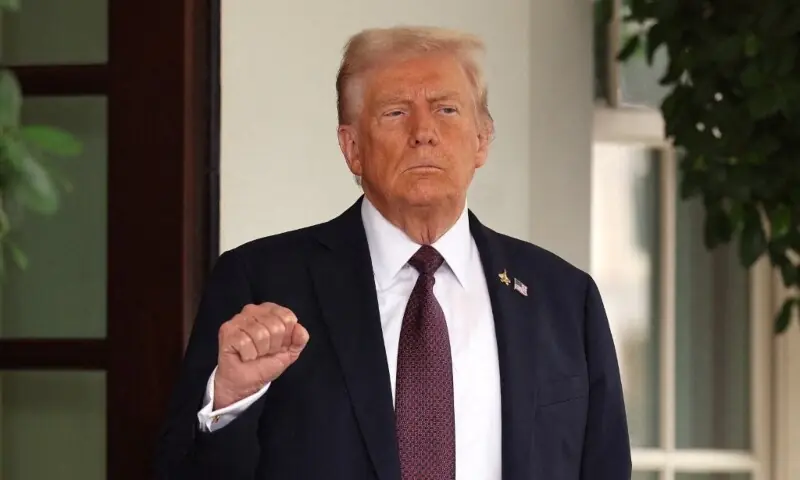
Header Image: US President Donald Trump pumps his first as he waits to welcome Israeli Prime Minister Benjamin Netanyahu at the White House on September 29, 2025 in Washington, DC. — AFP

