


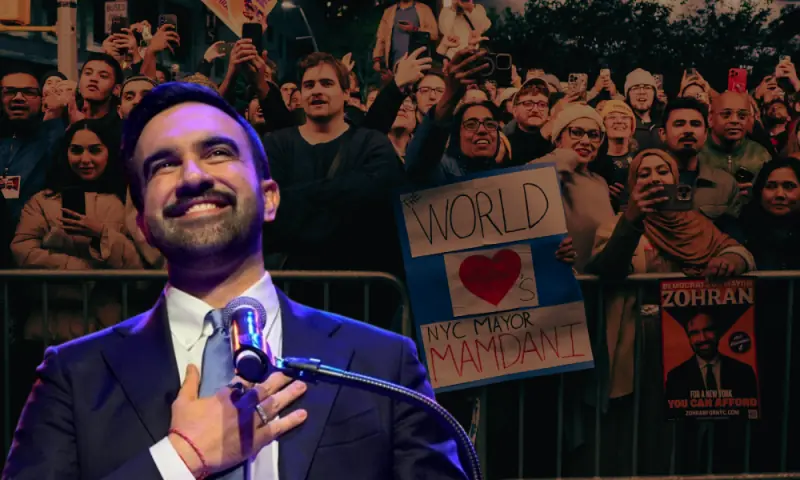

Forget everything you knew about New York politics: Zohran Mamdani just flipped the script.
Armed with working-class solidarity, digital fluency, and meme-literate storytelling, the 34-year-old Queens Assemblyman didn’t just beat Andrew Cuomo — he made history. In the early hours of Wednesday morning, Mamdani emerged as the city’s first Muslim and South Asian mayor, clinching just over 50 per cent of the vote in one of the most closely watched races in decades.
The shock wasn’t just in the result. It was in how he won. It was an insurgent campaign powered by aunties, taxi drivers, club DJs and night-shift nurses — not your average billionaires and consultants. Mamdani turned relentless field work into a campaign that made New Yorkers feel seen and the diaspora feel represented; a moment that spilled across boroughs and ricocheted through diasporas from Queens to Karachi.
And yet, this victory wasn’t about vibes or progressive ideology alone. It was a strategy rooted in something older and truer: proximity.
Mamdani embedded himself in the city’s daily rhythms from dawn at taxi depots to dusk at tai chi sessions, and from Queens bodegas to Bronx dance floors meeting New Yorkers where they actually live. While the existing political establishment figures such as Andrew Cuomo relied on TV ads and fundraisers, Mamdani relied on multilingual messaging, human contact and most importantly, the moral weight of showing up.
The architecture a movement
Long before declaring his run for Mayor, Mamdani stood shoulder to shoulder with medallion-debt taxi drivers, sleeping on pavements during their 2021 hunger strike. That solidarity didn’t fade with time; in fact, it matured into a network of trust. When he finally ran, those same drivers became his storytellers and precinct captains, spreading his name through garages, mosques, diners, and WhatsApp groups.
While traditional campaigns clocked off at sunset, Mamdani’s chose to come alive. Volunteers canvassed outside airports, hospitals, and bodegas at odd hours handing out tea, talking and logging contacts all in real time. In immigrant corridors such as Jackson Heights, Richmond Hill and Flushing, “pop-ups” replaced rallies in the form of micro-events filled with food, music, and one key message: We see you.
Moreover, in a race obsessed with youth turnout, Mamdani quietly also focused on seniors. He joined tai chi classes in Lower Manhattan parks, opting for softer introductions over hard pitches. It was low-ego politics that transformed sceptics into supporters. “He didn’t talk to us,” one volunteer recalled. “He moved with us.”
Politics is never really found on a dance floor, but Mamdani’s team leaned in. From salsa nights to queer venues based in Brooklyn, the campaign turned nightlife into voter registration drives with club promoters and DJs becoming unexpected messengers of policy, blending the beat to the sound of ballot reminders.
Then came the diaspora multiplier; the secret superstructure of the campaign. His campaigning understood the power of kinship. South Asian, Caribbean, West African and Arab communities were mobilised through WhatsApp groups, diaspora radio, Gen Z’s and auntie-driven relational networks where “Aunties for Zohran” became both a meme but also a massive movement.
But what appeared spontaneous was rigorously organised. Nearly 100,000 volunteers helped knock on over a million doors. Nightly debriefs, real-time mapping, and turf adjustments turned chaos into choreography.
Mamdani’s core promises were tailored to free buses, rent relief and childcare, which were repeated in every language, every borough. Simple, unfiltered and accessible. He told Time: “If your politics can’t be explained at a bus stop, it’s not politics for the people.”
The campaign’s short-form videos, meme-ready graphics, and participatory humour turned supporters into broadcasters. Every now and then, Mamdani let his personality slip through the political cadence — a lyric dropped mid-speech, a joke left hanging just long enough.
At one event, he wove a line from PinkPantheress into a point about political honesty, delivering it so casually that half the crowd caught it a beat late before bursting into laughter. It didn’t feel like a gimmick; it felt like someone speaking in the cultural shorthand of the city he was trying to lead. Unlike other campaigns that treated social media as more of an afterthought, Mamdani’s team engineered virality as a primal form of mobilisation, using key platforms such as Instagram, TikTok, and YouTube to feed real-world turnout.
Even the campaign’s visual identity felt like a love letter to the city.
Mamdani’s team didn’t just campaign at full throttle, they redlined the engine, moving at a pace that made the establishment look motionless. The team pulled from the design grammar of everyday New York: the hand-painted warmth of bodega signs, the punchy signage of Coney Island, flashes of taxi-yellow, and a bold purple reminiscent of vintage Brooklyn Dodgers iconography.
It also felt like the campaigning signage was layered with a touch of Bollywood’s saturated colour sensibility. The palette felt joyful rather than corporate; deeply human rather than consultant-made. It was an aesthetic born from the streets he canvassed, a visual dialect telling New Yorkers, before a single speech was delivered, ‘I speak your language.’
The establishment’s miscalculation
Andrew Cuomo entered the race assuming that name recognition, big donors, and a polished record would suffice. His campaign operated from Midtown boardrooms, not subway platforms; it was flush with billionaire donations yet starved of intimacy.
Cuomo ran a race built for an electorate that no longer exists. It wasn’t that he lacked achievements; in fact, his record was full of landmark reforms. As governor, he signed the NY SAFE Act, one of the nation’s strongest gun-control laws in the wake of Sandy Hook; expanded paid family leave; legalised same-sex marriage in New York; and positioned himself as a leader on climate action. But in this campaign, he rarely invoked those victories. Instead of defending a record that once resonated with working New Yorkers, he leaned on legacy and attacked his opponent.
The absence was telling as his policies may have been progressive on paper, but his campaign’s posture was unmistakably elite. While Mamdani was out walking subway platforms and sitting in taxi garages, Cuomo spoke from studios and fundraisers. The result was a contrast of scale and sincerity: one man meeting voters where they lived, and another trying to remind them who he used to be.
Institutional Democrats mistook endorsement lists for enthusiasm. Their outreach centred on press hits, corporate lunches, union halls, and Manhattan fundraisers, while Mamdani’s people were canvassing, dancing, and listening in the places politics tends to forget. The result was a rare thing in New York: a grassroots landslide that elite money couldn’t stop.
The view from the ground
And if policy analysts could see the strategy, ordinary New Yorkers could feel its effects even more sharply.
For Amal, 26, who lives in Manhattan, Mamdani’s win wasn’t just political, it was personal. “I’m Muslim and South Asian, and living in New York you can feel how much our community keeps this city running — cab drivers, Uber drivers, restaurant workers, small businesses. They’re the backbone of New York, but they’ve always been invisible in politics. This isn’t about being given a chance; it’s about finally being seen.”
“Zohran’s campaign captured the real essence of New York. People forget this city’s true demographic, that it’s a land of immigrants. He went everywhere — from Orthodox Jewish neighbourhoods to Queens — walking from Upper to Lower Manhattan and talking to people. He captured what New York really is: fast, chaotic, crazy, alive!”
Amal recalled the exact moment she realised his campaign understood the city’s texture. “I realised his campaign was different the moment he got on a Citi Bike. If you’re a New Yorker, you know that’s the great equaliser, everyone rides one. It told me he understood New York’s culture at a granular level. He wasn’t throwing money at consultants or hiding behind buzzwords. He was out there, doing the everyday things we do.” She added that it was a small gesture, but it revealed a larger truth about Mamdani: he communicates fluently in the city’s everyday language, not as performance, but as instinct.
“Right now, with everything happening globally, Islamophobia is rampant. I’m excited to see him challenge that, to break stereotypes around South Asians and Muslims in public life,” she remarked.
For Ryan, 30, also based in Manhattan, the win was less about symbolism and more about substance — a campaign that finally spoke to the city’s working realities. “I knew it was going to happen. 70pc of Mamdani’s votes came from people under 30, the generation feeling the full brunt of how unaffordable New York has become. You’d need to make around $150,000 before tax to afford a $5,000 rental, and even then, rent takes up 60-70pc of your income. That’s how out of reach living in this city is.”
Mamdani’s policies — from rent freezes to free childcare — didn’t just resonate ideologically; they answered the most basic urban question: how do we live here?
“This was the first time we had a candidate who was educated, informed, and not part of some political dynasty. People are tired of lineage politics. They want accountability. Most people in New York don’t have a sob story; we’re educated, ambitious, doing well on paper, but still struggling to afford life here. Mamdani represents those of us who are doing everything right but still can’t make the math work,” he said.
For Erica, a 30-year-old Brooklynite, Mamdani’s rise was less a surprise than a correction; the moment New York finally rewarded a campaign that felt genuinely built for its people. “He was everywhere. His campaign was chronically online and offline at the same time, and that meant he was reaching groups of New Yorkers who have never really felt seen by politicians before. You could feel how authentically he was out in the community, talking to people who agreed with him and people who didn’t. It felt very personal.”
Affordability was the point where her personal life and Mamdani’s message met most sharply. “It’s almost impossible as a young person trying to imagine a future here, owning a home and raising a family. So to have a candidate say openly that what we’ve tried in the past hasn’t worked and it’s time for something new, felt refreshing.”
Mamdani’s identity as a South Asian Muslim became a political talking point in itself, often weaponised by opponents who tried to frame his campaign as identity-driven rather than policy-driven. But Erica didn’t see performance; she saw focus. “It felt policy-grounded. He never strayed from his three main promises. He kept steering the conversation back to the three promises: free fast buses, a rent freeze and universal child care. Everyone knew exactly what he stood for,” she noted.
A turnout surge and future of city politics
More than two million New Yorkers voted, this being the city’s highest mayoral turnout this century. Mamdani secured 50.4pc of the votes, Cuomo trailed at 41.8pc, and Republican Curtis Sliwa fell below 7pc. In victory, Mamdani told supporters in Queens, “We built this with our hands, our phones, our feet. We proved that New York’s power doesn’t sit in the skyscrapers, it walks these streets.”
Mamdani’s win is a case study in how campaigns will be run, not only in New York, but in any city where trust has eroded and communities crave presence over polish. He turned political participation into something social, visible, and joyful.
The message to future candidates is simple: if you’re willing to do the hours, you can beat the machine. In a world tired of cynicism, Mamdani’s win offered something rare: proof that hope is not naïve but rather a strategy.
And as he walked out to the pulsing intro of Dhoom Machale, the message was clear: it wasn’t just a win; it was an arrival. This was a moment only he could pull off, a choice that sent the Gen Z and millennials into full-body joy. It was pop-culture mischief and political messaging at once, a South Asian anthem turned victory strut. It told New Yorkers exactly who their new mayor is.
Fall of the old guard
While Mamdani’s campaign strategy was undoubtedly decisive, elections are rarely won on tactics alone. His rise was aided by a confluence of factors and demographic shifts, record youth turnout, and widespread disillusionment with establishment politics.
Issues like housing affordability, public transport, and cost of living had reached a boiling point, creating fertile ground for his message. Cuomo’s overreliance on legacy power and donor networks only sharpened that contrast.
Mamdani’s victory, then, wasn’t a fluke of charisma or digital virality, it was the political expression of a city that had outgrown the comfort of its old elite.



