
<ref name=”SL”>{{cite encyclopedia|page=3874|first1= K. J.|last1= Kutsch|first2= Leo|last2= Riemens|encyclopedia=[[Grosses Sängerlexikon]]|publisher=[[K. G. Saur Verlag]]|editor-first=Hansjörg|editor-last= Rost|title=Reichmann, Theodor |year=2003|url=https://www.google.com/books/edition/Großes_Sängerlexikon/dsfq_5dFeL0C?hl=en}}</ref>
<ref name=”SL”>{{cite encyclopedia|page=3874|first1= K. J.|last1= Kutsch|first2= Leo|last2= Riemens|encyclopedia=[[Grosses Sängerlexikon]]|publisher=[[K. G. Saur Verlag]]|editor-first=Hansjörg|editor-last= Rost|title=Reichmann, Theodor |year=2003|url=https://www.google.com/books/edition/Großes_Sängerlexikon/dsfq_5dFeL0C?hl=en}}</ref>
<ref name=”grove”>{{Cite encyclopedia|date=2001|entry=Reichmann, Theodor|encyclopedia=Grove Music Online|publisher=[[Oxford University Press]] |doi=10.1093/gmo/9781561592630.article.23105|author=[[Elizabeth Forbes (musicologist)|Elizabeth Forbes]]}}</ref>

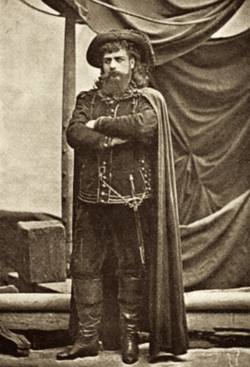
Theodore Reichmann
He initially worked as a clerk, but then decided to train his voice. He studied with Elssler in Berlin, then with Johannes Ress in Prague, and completed his training in Milan with Francesco Lamperti. In 1869, he made his stage debut at the Magdeburg City Theater as Ottokar in Weber’s “Freischütz.”
This was followed by an eventful career traveling from one stage to another: he sang at the Nowak Theater in Berlin (1869-70), at the German Opera House in Rotterdam (1870), in Cologne (1871, debut as Count Luna in “Troubadour”) and Strasbourg (1872), at the Hamburg City Theater (Opera House) (1873-75, inaugural role: Telramund in “Lohengrin”), and finally at the Munich Court Opera (1875-82; inaugural role: William Tell by Rossini).
In 1883, he accepted a call to the Vienna Court Opera, where he remained a member of the ensemble until 1889 and again from 1893 to 1903, where he enjoyed considerable success.
In 1882, he participated in the major European tour organized by Angelo Neumann with his traveling Wagner Theater, as he was generally considered a great Wagner interpreter. From 1882 to 1885, he was a frequent guest at the Frankfurt Opera House. At the Bayreuth Festival in 1882, he sang Amfortas in the premiere of “Parsifal” on July 26, 1882.
Later, he also sang Hans Sachs in “Die Meistersinger” and Wolfram in “Tannhäuser” in Bayreuth.
In 1902, he sang Amfortas again in Bayreuth.
From 1889 to 1891, he was engaged at the Kroll Opera in Berlin, following disagreements with the management of the Vienna Opera. In 1893, however, he returned to the Vienna Court Opera, where he remained until his death.
In 1884 and 1892, he performed his major Wagner roles at Covent Garden Opera in London, partly under the famous Wagner conductor Hans Richter. In the 1880s and 1890s, he made further guest appearances in England. From 1889 to 1891, he was a member of the Metropolitan Opera in New York (his inaugural role: The Flying Dutchman). At this major opera house, he naturally sang primarily his Wagner repertoire, but also roles from Italian and French operas; he enjoyed particular success there as the title character in Rossini’s “William Tell.”
He also performed at the operas in Boston, Chicago, and Philadelphia, as well as several times, including in 1898 at the Imperial Court Opera (Mariensky Theater) in St. Petersburg. In 1900, he gave a splendid concert in Paris. He was laid to rest in one of the four Halle cemeteries in Berlin beneath a monumental gravestone. References: Fr. Bei der Wieden: “Der erste Amfortas” (1958).

