
| This user page may meet Wikipedia’s criteria for speedy deletion as a page in userspace consisting of writings, information, discussions, and/or activities not closely related to Wikipedia’s goals, where the owner has made few or no edits outside of userspace. See CSD U5.
If this user page does not meet the criteria for speedy deletion, or you intend to fix it, please remove this notice, but do not remove this notice from pages that you have created yourself. If you created this page and you disagree with the given reason for deletion, you can click the button below and leave a message explaining why you believe it should not be deleted. You can also visit the talk page to check if you have received a response to your message. Note that this user page may be deleted at any time if it unquestionably meets the speedy deletion criteria, or if an explanation posted to the talk page is found to be insufficient. Note to administrators: this page has content on its talk page which should be checked before deletion. Administrators: check links, talk, history (last), and logs before deletion. Consider checking Google. |
Peter J. Nordlander is a Swedish-American physicist.

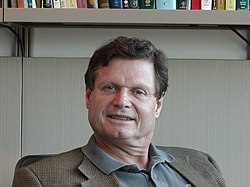
Peter Nordlander in 2014
Peter Nordlander completed a doctorate in theoretical physics at Chalmers University of Technology. Following postdoctoral research at Thomas J. Watson Research Center, Bell Labs, and Rutgers University, Nordlander began teaching at Rice University in 1989.[1] He is currently the Wiess Chair and Professor of Physics and Astronomy, Professor of Chemistry, Professor of Electrical and Computer Engineering, and Professor of Materials Science and Nanoengineering.[2]
He has been a Visiting Professor at University of Paris, the Institute of Physics at the Chinese Academy of Sciences, Peking University, The Chinese University of Hong Kong, and Wuhan University. He has been a Hans Fischer Senior Fellow at the Technical University and Ludwig Maximilian Universities in Munich.
His research background is in theoretical condensed matter physics and nanophysics. His current research is focused on the theoretical and computational modeling of Plasmonic and Nanophotonic phenomena. He served as associate editor of ACS Nano from 2011–2023. He has published more than 400 refereed articles, given more than 500 invited presentations at international conferences and workshops, and has been cited more than 75,000 times with a Web of Science h-index above 135.[2]
Peter Nordlander has made several pioneering theoretical contributions to the field of plasmonics.[3] His theory of plasmon hybridization[4] has laid the foundation for a rigorous yet intuitive understanding of how plasmons on adjacent nanostructures interact and hybridize to form collective modes. His prediction that Fano resonances can result from interactions between sub- and superradiant plasmon modes,[5] has laid the foundation for the rational design of coherent plasmonic structures. His studies of quantum effects in plasmonic systems, establishing the limits of validity of classical electromagnetic descriptions and predicting new optical effects,[6] have laid the foundation for the novel field of quantum plasmonics.
Since 2011 Nordlander’s work has focused on prediction and applications of hot carrier production from nonradiative plasmon decay.[7] Such hot carrier generation in plasmonic nanoparticles can be exploited in a wide variety of plasmon-enhanced light harvesting applications such as photodetection and photocatalysis.[8] Direct hot carrier generation provides much better energy efficiencies for driving chemical reactions than conventional heating, since only the electrons, and not the lattice, are heated. While the initial demonstrations were limited to reactions involving reactants that would be adsorbed on plasmonic noble metal surfaces which are relatively inert, the introduction of the plasmonic Antenna-Reactor platform,[9] extended the applicability of plasmon enhanced photocatalysis to a full range of chemical reactions. The antenna-reactor concept is based on the fact that the strong plasmonic near field around an antenna can induce excitations and hot carriers in a nearby reactor particle. The antenna can thus be chosen based on its ability to capture light of a desired wavelength and the reactor material can be chosen based on its ability to bind reactants. Using this approach Peter Nordlander and Naomi Halas have demonstrated highly efficient Nitrous Oxide decomposition,[10] defluorination of fluorocarbons,[11] Ammonia decomposition,[12] Methane Dry Reforming,[13] Methane Steam Reforming,[14] and many other important reactions of societal relevance. In 2022 they reported an earth-abundant catalyst for efficient hydrogen production (ammonia cracking) using LEDs.[15]
Nordlander and Halas, along with several of their students, applied for a patent on the antenna-reactor effect,[16] and together with Trevor Best (now CEO) and Suman Khatiwada (now CTO), founded Syzygy Plasmonics,[17] a company that has built and commercialized light-driven chemical reactors based on antenna-reactor plasmonic photocatalysts. Syzygy’s RIGELTM reactor can generate hydrogen at a rate of 100’s of kg/day by means of methane reforming or ammonia cracking at temperatures hundreds of degrees lower than conventional thermocatalytic reactors. Syzygy’s current focus is on the generation of Sustainable Aviation Fuel (SAF). Using biogas from agriculture and Syzygy’s technology, they are constructing what will be the largest biogas-to-SAF facility in Uruguay and teaming with Honeywell for SAF production at this site.[18]
Nordlander was elected to fellowship of the American Physical Society in 2002 “for pioneering contributions to the chemical physics of atom-surface interactions, including the development of a many-body theoretical description of charge transfer processes in atom-surface scattering.”[19] He is also a fellow of SPIE, the American Association for the Advancement of Science and Optica.[20][21]
Nordlander was one of three recipients of the Willis E. Lamb Award in 2013,[22] “for pioneering theoretical contributions in the field of plasmonics”[23] alongside Shaul Mukamel and Susanne Yelin. Nordlander, Naomi Halas, and Tony Heinz won the 2014 Frank Isakson Prize for Optical Effects in Solids awarded by the American Physical Society.[24][25] Nordlander and Halas shared the Optica Society’s R. W. Wood Prize in 2015.[26]
Nordlander has been an ISI highly cited researcher since 2014.[27] Nordlander and Halas were awarded the ENI Energy Transition prize by the president of Italy in 2022.[28]
- “Prof. Peter Nordlander”. Rice University. Retrieved 29 October 2019.
- https://profiles.rice.edu/faculty/peter-j-nordlander. Retrieved 9 September 2025.
- https://nordlander.rice.edu/members/nordlander. Retrieved 9 September 2025.;
- E. M. Prodan, C. Radloff, N. J. Halas and P. Nordlander, “A Hybridization Model for the Plasmon Response of Complex Nanostructures, Science 302, 419-422 (2003). https://doi.org/10.1126/science.1089171
- F. Hao, Y. Sonnefraud, P. V. Dorpe, S.A. Maier, N. J. Halas, and P. Nordlander, “Symmetry breaking in plasmonic nanocavities: Subradiant LSPR sensing and a tunable Fano resonance”, Nano Lett. 8, 3983-3988 (2008). https://doi.org/10.1021/nl802509r
- J. Zuloaga, E. Prodan, and P. Nordlander, “Quantum description of the plasmon resonances of a nanoparticle dimer”, Nano Lett. 9, 887-891 (2009). https://doi.org/10.1021/nl803811g
- M. W. Knight, H. Sobhani, P. Nordlander, and N. J. Halas, “Photodetection with active optical antennas”, Science 332, 702-704 (2011). https://doi.org/10.1126/science.1203056
- M. Brongersma, N. J. Halas, and P. Nordlander, “Hot Electron Science and Technology”, Nature Nanotechnology 10, 25-34 (2015). https://doi.org/10.1038/nnano.2014.311
- D. F. Swearer, H. Zhao, L. Zhou, C. Zhang, H. Robatjazi, J. P. M. Martirez, C. M. Krauter, S. Yazdi, M. J. McClain, E. Ringe, E. A. Carter, P. Nordlander, and N. J. Halas, “Heterometallic Antenna-Reactor Complexes for Photocatalysis”, PNAS 113, 8916–8920 (2016). https://doi.org/10.1073/pnas.1609769113
- D. F. Swearer, H. Robatjazi, J. M. P. Martirez, M. Zhang, L. Zhou, E. A. Carter, P. Nordlander, and N. J. Halas, “Plasmonic Photocatalysis of Nitrous Oxide into N2 and O2 using Aluminum-Iridium Antenna-Reactor Nanoparticles”, ACS Nano 13, 8076-8086 (2019). https://doi.org/10.1021/acsnano.9b02924
- H. Robatjazi, J. L. Bao, L. Zhou, M. Zhang, P. Christopher, E. A. Carter, P. Nordlander, N. J. Halas, “Plasmon-driven carbon-fluorine (C(sp3)-F) bond activation: mechanistic insights into hot-carrier-mediated pathways”, Nature Catalysis 3, 564-573 (2020). https://doi.org/10.1038/s41929-020-0466-5
- L. Zhou, D. F. Swearer, C. Zhang, H. Robatjazi, H. Zhao, L. Henderson, L. Dong, P. Christopher, E. A. Carter, P. Nordlander, and N. J. Halas, “Quantifying Hot carrier and Thermal Contributions in Plasmonic Photocatalysis”, Science 362, 69–72 (2018). https://doi.org/10.1126/science.aat6967
- L. Zhou, J. M. P. Martirez, C. Zhang, D. F. Swearer, S. Tian, H. Robatjazi, L. Henderson, E. A. Carter, P. Nordlander, and N. J. Halas, “Light-driven methane dry reforming with single atomic site antenna-reactor plasmonic photocatalysts”, Nature Energy 5, 61-70 (2020). https://doi.org/10.1038/s41560-019-0517-9
- Y. Yuan, J. Zhou, A. Bayles, H. Robatjazi, P. Nordlander, N. J. Halas, “Steam methane reforming using a regenerable antenna-reactor plasmonic photocatalyst”, Nature Catalysis 7, 1339-1349 (2024). https://doi.org/10.1038/s41929-024-01248-8
- Y. Yuan, L. Zhou, J. L. Bao, J. Zhou, A. Bayles, L. Yuan, M. Lou, M. Lou, H. Robatjazi, E. A. Carter, P. Nordlander, and N. J. Halas, “Earth-abundant photocatalyst for H2 generation from NH3 with light-emitting diode illumination”, Science 378, 889-893 (2022). https://doi.org/10.1126/science.abn5636
- U. S. Patent nos. 11,958,043 and 12,109,558.
- https://www.plasmonics.tech/about . Retrieved 9 September 2025
- https://www.plasmonics.tech/projectdetails-1. Retrieved 9 September 2025
- “APS Fellow Archive”. Retrieved 29 October 2019.
- “Dr. Peter Nordlander”. SPIE. Retrieved 29 October 2019.
- Boyd, Jade (19 March 2015). “Halas, Nordlander awarded Optical Society’s R.W. Wood Prize”. Rice University. Retrieved 29 October 2019.
- “The 2013 Willis E. Lamb Award for Laser Science and Quantum Optics”. Winter Colloquium on the Physics of Quantum Electronics/Lamb Award. 9 January 2013. Retrieved 29 October 2019.
- “Peter Nordlander, Rice University”. Winter Colloquium on the Physics of Quantum Electronics/Lamb Award. 9 January 2013. Retrieved 29 October 2019.
- “Halas, Nordlander win American Physical Society’s Isakson Prize”. Houston Chronicle. 18 October 2013. Retrieved 29 October 2019.
- “2014 Frank Isakson Prize for Optical Effects in Solids Recipient”. American Physical Society. Retrieved 29 October 2019.
- Ruth, David; Boyd, Jade (19 March 2015). “Halas, Nordlander awarded Optical Society’s R.W. Wood Prize”. Rice University. Retrieved 29 October 2019.
- Williams, Mike (18 November 2016). “9 Rice faculty on prominent ‘highly cited’ list”. Rice University. Retrieved 29 October 2019.
- https://www.eni.com/en-IT/media/press-release/2022/08/eni-award-2022-winners-named.html.

