
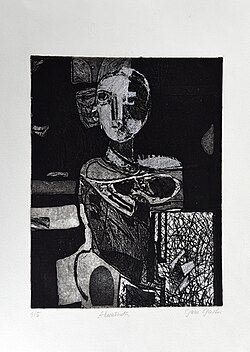
Gani Ismail Gashi (born 27 February 1944 in Mramor, Pristina, Kosovo) is a Kosovar painter and graphic artist, considered one of the pioneers of the concept of “verbal painting” in contemporary Albanian art. His artistic career began in the 1960s and spans over six decades, with hundreds of works exhibited in Kosovo, Germany, and other European countries. Gashi’s style combines modern approaches with repetitive rhythms and cubist or constructivist forms, giving his works a philosophical and universal dimension.
[1]
He is a member of the Academy of Sciences and Arts of Kosovo and has received numerous awards for his contributions to visual arts, including the title of Doctor Honoris Causa from the Académie Européenne des Arts in Paris in 2022. His works are often characterized by symbolism, minimal use of color, and explorations of identity, silence, and the fragmentation of collective memory.
[2]
Gashi began his professional artistic activity in the 1960s. Over six decades, he has created hundreds of works exhibited in Kosovo, Germany, and other European countries. He is known for pioneering the concept of “verbal painting” in contemporary Albanian art. His style incorporates modern techniques, repetitive rhythms, and cubist or constructivist forms, giving his works a philosophical and universal dimension. His works are characterized by symbolism, minimal use of color, and reflections on identity, silence, and the fragmentation of collective memory. Notable pieces include The Silent Portrait, Silhouettes, The Black Bird, and Fragmented Homeland.
-

From the Circle Between Reality and Abstract, (100×80) Graphics, Gani Gashi 1988.jpg
-

Vertical Texture in Monochrom (100×100) Graphics, Gani Gashi 1968
-

From the Cycle Poetics of Landscape (200×100), Graphics Gani Gashi 1968
_Graphics,_Gani_Gashi_1988.jpg)
_Graphics,_Gani_Gashi_1968.jpg)
,_Graphics_Gani_Gashi_1968.jpg)
Triptich is a large-scale abstract painting created in 2003 by Kosovar artist Gani Gashi. Measuring 210 × 300 cm and executed in acrylic on canvas, the work is composed of three interconnected panels in the traditional triptych format, reinterpreted through Gashi’s contemporary abstract visual language. It represents a pivotal moment in his artistic evolution, reflecting both spiritual inquiry and psychological depth during the early post-war period in Kosovo.
[4]
_Acrylic,_2003_Gani_Gashi.jpg)
The painting is structured into three distinct yet interrelated vertical panels that form a rhythmic visual dialogue. The composition features sweeping gestures, layered textures, and contrasts between luminous voids and dense chromatic masses. Through a restrained palette and deliberate fragmentation, Gashi evokes a metaphysical landscape charged with silence, tension, and introspection. Although non-figurative, Triptich references the historical function of triptych artworks in religious and sacred art. Gashi subverts this tradition by replacing iconography with abstraction, creating instead a secular altar of memory and emotion. Each panel can be interpreted as a chapter—birth, rupture, reconciliation—or as spatial and temporal dimensions interacting simultaneously. Created only four years after the end of the Kosovo War, Triptich embodies both a personal and collective search for meaning amid trauma and transformation. The central panel, traditionally the focal point of classical triptychs, offers no resolution; instead, it presents a contemplative void, reinforcing the artist’s interest in ambiguity, fragmentation, and existential questioning.
Circle is an acrylic painting on canvas, created from the spring of 2021 to April 2022, measuring 150 x 110 cm. The title of the artwork was chosen specifically for the artist’s solo exhibition opened in April 2022, inviting viewers to reflect on the symbolism behind the name.

The circle, as a geometric form, embodies perfection, equality, and human unity. In this composition, it serves as a clear metaphor for the cycle of life and the expansion of artistic influence through space. The outer circle invites a sense of balance, peace, and openness, while the interwoven smaller circles symbolize the personal and collective journeys of the human spirit.
The circular flow of forms generates an inner visual rhythm, described by critics as a “repetitive rhythm built upon elemental shapes.” The style of the work reflects notable influences from Cubism and Constructivism: the modern treatment of proportions, the chromatic palette, and the structural repetition of forms create a visual language in which every line, tone, and nuance carries a philosophical function.
As the artist himself expresses:
“Nothing repeats without a soul that repeats it.”
A metaphysical reflection on the essence of creation and collective memory.
2003–2004: Between Reality and Abstraction
[edit]
Between 2003 and 2004, Gani Gashi developed a highly introspective and symbolically charged body of work that represents a transitional moment in his career. During this period, he explored the psychological and existential dimensions of the human condition through a unique synthesis of abstraction and figuration. These works are characterized by dense textures, fractured surfaces, and muted earth tones, often depicting distorted or faceless human figures caught between identity and anonymity. This phase is best represented through several conceptual cycles, including The Poetry of the Landscape, Human Misery, and The Triptych (a large-scale work measuring 210 × 300 cm). The paintings evoke emotional turbulence and spiritual desolation, reflecting post-war trauma, inner conflict, and symbolic references to cultural loss and personal disintegration.
-

From the Cycle Time Mesenger (79×105),2003,Landscape Poetry (75×93)
-

From the Cycle Human Misery Gani Gashi 2003
-

From the Cycle Time Messenger (79×105), 2003
-

Travel Into Space (78×106) 2003
-

From the Cycle Landscape Poetry 2003 Gani Gashi
-

From the Cycle Between Reality and Abstraction, Gani Gashi 2003
-

Neigh (50×70 cm), 2003
-

Dream Relief (75×105) Gani Gashi 2004
-

Futuristic Dreams (75×104) 2004
,2003,Landscape_Poetry_(75x93).jpg)

,_2003.jpg)
_2003.jpg)


,_2003.jpg)
_Gani_Gashi_2004.jpg)
_2004.jpg)
Catalogs and bibliography
[edit]
- Gani Gashi GG Trade CO, Prishtina, GG Trade Co, 2003, Prishtina *Gani Gashi , Tirana, National Gallery of Arts in Tirana, 2004, Tirana *Gani Gashi , Prishtina, Gallery of the Ministry of Culture in Prishtina, 2004, Prishtina *Gani Gashi , Augsburg, Schröder Weinbar Gallery, Schlossermauer Augsburg, 2008, Germany *Gani Gashi , Exhibition Circle, National Gallery of Kosovo, Prishtina, 2022, OCLC 000101535 ISBN 978-9951-806-10-7
-

From the Cycle Between Reality and Abstraction, Gani Gashi 2003
-

Land Space 9xx115, Gani Gashi 2003
-

Blue Frame (70×100), Acrylic on Fabric, Gani Gashi, 2006
-

Snakes (100×70) Acrylic on Fabric, Gani Gashi, 2007
-

The Sounds of Silence (100×70) Acrylic on Fabric, Gani Gashi 2007
-

Game (105×75 cm)
-

Silhouettes, Silhouettes 100×64, Gani Gashi, 2010
-

White and Black (105×65 cm) ,Gani Gashi, 2008
-

Loja në hapësirë ,Das Spiel im Raum , Playing in Space, 2012
-

Old House Table (120×120) Acrylic on Fabric, Gani Gashi 2008
-

Delicacy 100×75, 2023
-

Oaus dem Zyklus Poetics of Landscape (200×100), Grafik Gani Gashi, 2025
-

Genesis of Whimsy Dance of Forms and Freedom (100×100) Acrylic on Fabric, Gani Gashi, 2025
-

Abstract Composition with Earth Tones and Blue Accents (115×75) Acrylic on Fabric Gani Gashi, April 2025

,_Acrylic_on_Fabric,_Gani_Gashi_2006.jpg)
_Acrylic_on_Fabric,_Gani_Gashi_2007.jpg)
_Acrylic_on_Fabric,_Gani_Gashi_2007.jpg)
,_Gani_Gashi_2010.jpg)

,_Gani_Gashi_2010.jpg)
.jpg)
_Acrylic_on_Fabric,_Gani_Gashi_2008.jpg)

,_Grafik_Gani_Gashi_1968.jpg)
_Acrylic_on_Fabric,_Gani_Gashi_20025.jpg)
_Acrylic_on_Fabric_Gani_Gashi,_April_2025.jpg)
Gani Gashi has held numerous solo exhibitions and has participated in dozens of group exhibitions both in Kosovo and abroad. Some of the most notable include:
Tirana Biennale of Contemporary Art (year not specified) Tiranë


==Awards and Recogniti
Gani Gashi has been recognized for his significant contribution to visual arts both in Kosovo and internationally. Some of the major awards and titles he has received include:
Legacy and Influence
[edit]
The works of Gani Gashi are considered an important part of Kosovo’s modern cultural heritage. His artistic approach has influenced the aesthetic development of many younger artists and contributed to the creation of an authentic visual language that reflects the post–war reality and the social transformations of the country.
A significant portion of his oeuvre is currently in the process of being archived and prepared for permanent exhibition as part of a dedicated museum space in Pristina, ensuring long-term preservation and public access to his artistic legacy.


