
From Wikipedia, the free encyclopedia
Content deleted Content added
| Line 167: | Line 167: | ||
|
{{bar box|title=Parliamentary seats{{efn|name=fn2}}|titlebar=#ddd|width=700px|barwidth=410px|bars= |
{{bar box|title=Parliamentary seats{{efn|name=fn2}}|titlebar=#ddd|width=700px|barwidth=410px|bars= |
||
|
{{bar percent|Liberal|{{party color|Scottish Liberal Party}}|56.9|41 seats}} |
{{bar percent|Liberal|{{party color|Scottish Liberal Party}}|56.9|41 seats}} |
||
|
{{bar percent| |
{{bar percent||{{party color| }}|.| seats}} |
||
|
{{bar percent| |
{{bar percent||{{party color| }}|.| seats}} |
||
|
{{bar percent|Crofter{{efn|name=fn5}}|{{party color|Crofters Party}}|2.7|2 seats}}}} |
{{bar percent|Crofter{{efn|name=fn5}}|{{party color|Crofters Party}}|2.7|2 seats}}}} |
||
Revision as of 09:49, 16 September 2025
|
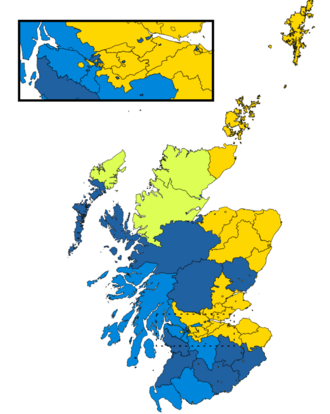
Results of the 1886 election in Scotland for the county and burgh seats
Liberal Conservative Liberal Unionist Crofters |

A general election was held in the United Kingdom over the period was held from 1 to 27 July 1886, and members were returned for all Scottish seats. Scotland was allocated 72 seats in total, with 70 territorial seats, comprising 32 burgh constituencies and 37 county constituencies.[e] There were also two university constituencies, Glasgow and Aberdeen Universities and Edinburgh and St Andrews Universities. As voters in university constituencies voted in addition to their territorial vote, the results are compiled separately.
The election was called following the defeat of the Government of Ireland Bill 1886, which led to a split in the Liberal party: Liberals who did not support Home Rule for Ireland formed the breakaway Liberal Unionist. The election in Scotland was effectively fought between two blocs, as the Conservatives did not put up candidates against sitting Liberal Unionist MPs, whilst the Liberals did not oppose sitting Crofters Party MPs even where they did not take the Liberal whip (several Crofters candidates elected in 1885 had been endorsed by Liberals prior to election, or had since become fully alligned with them).
Although the Liberals won a majority of the seats in Scotland, when combined with results from across the United Kingdom the election resulted in the defeat for William Ewart Gladstone‘s government. Although the Liberal Unionists did not formally join with the Conservatives, in practice the two groups acted together to control a parliamentary majority in the House of Commons.
Results
Seats summary
Burgh & County constituencies
University constituencies
The two university constituencies each elected an additional member to the house. In this election both seats were uncontested, with the sitting members being returned unopposed.
Votes summary
Notes
- ^ a b c Combined results for burgh, county and university seats
- ^ a b c The seat and vote count figures given here combines the Liberals and the Independent Liberals/Crofters, compared to their combined performance at the previous election.
- ^ a b c Total and percentage votes given here are for territorial constituencies only
- ^ a b c The seat and vote count figures given here combines the Conservatives and the Liberal Unionists, compared to Conservative performance only at the previous election.
- ^ One burgh seat, Dundee, was represented by two members of parliament.
- ^ a b This figures covers only those MPs who were not also official Liberal candidates.
References

