Beetles
Genus (and common name)
Species
Higher taxon
Notes (why it’s weird)
Images
Micromalthus M. debilis
Archostemata
Exclusively paedogenetic , male larvae eat their mothers, adults are sterile and only produced in heat so extreme that over 99% of larvae just die
A “ghost adult” Micromalthus
Antliarhis A. zamiae
Brentidae
Has an extremely long snout
Diagrammatic reconstruction of male and female of the species
Sikhotealinia S. zhiltzovae
Jurodidae
Only extant member of its family, may have ocelli (which no other known beetles have)
Ripiphoridae in general (wedge-shaped beetles)
Around 450 species in 30 genera
Tenebrionoidea
Reduced elytra but large wings, reduced mouthparts, parasitic lifestyle
Male of Ripiphorus diadasiae
Rhinorhipus R. tamborinensis
Elateriformia
Only member of its whole superfamily, split off from other beetles over 200 million years ago
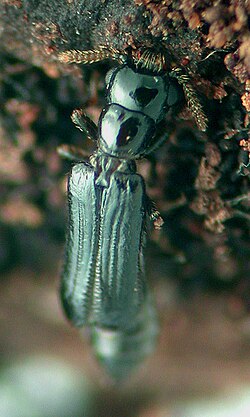
Specimen of Rhinorhipus with closeup of the head (right)
Jurasai About 10 species
Jurasaidae
Neotenic females but “normal” males
Mating pair of J. itajubense
Phloeodes P. diabolicus (not the only species, but the most unusual)
Zopherinae
Can withstand forces over 30,000 times its own body weight
Adult P. diabolicus
Platerodrilus Around 20 species
Duliticolini
Neotenic females likened to trilobites, more normal-looking males
Male and female trilobite beetles
Brigalowia B. setifera
Carabidae
Has a very wide and flat body, alongside extremely long setae[ 1]
Iberobaenia I. minuta , I. lencinai
Elateroidea
Only member of its family, neotenic[ 2]
Xenaroswelliana X. deltaquadrant
Carabidae
Only member of its subfamily, bears several odd characteristics (so strange it was named after aliens twice!)[ 3]
Muganryus M. susumui
Leiodidae
Eyeless and wingless[ 4]
Xenomorphon X. baranowskii
Lycidae
Only known beetle with wingless males (typically it’s the females which are wingless!)[ 5]
Ikaros I. apterus , I. paramo , I. polygonus
Staphylinini
Wingless with short elytra, one of the few non-brightly coloured members of Xanthopygina[ 6]
Austrospirachtha A. carrijoi
Aleocharinae
Enormous termite-shaped outgrowth of its abdomen (I.e. just look at it! )[ 7]
Malayopsebium M. coerulea
Psebiini
Very long hind legs, reduced elytra but normal-sized wings[ 8]
Leptodirus L. hochenwartii
Leptodirini
Slender thorax, dome-shaped elytra
Individual of Leptodirus
Phrixothrix P. hirtus
Phengodidae
One of the few animals with different colours of bioluminescence at once
A railroad worm with its “lights” on and off
Atractocerus Around 25 species
Lymexylidae
Extremely long body, tiny elytra and non-folding wings (basically a rove beetle but more so)
Atractocerus brasiliensis individual from Mexico
Acrocinus A. longimanus
Cerambycidae
Males have extremely long forelimbs
A male harlequin beetle specimen
Onychocerus O. albitarsis
Cerambycidae
The only known arthropod with venomous stingers on its antennae[ 9]
A wild scorpion beetle
Ptiliidae in general (featherwing beetles)
Around 600 species in 80 genera
Staphylinoidea
Very small (around 1 mm long on average, less than 0.3 mm in the smallest) with wings covered in long bristles, use a figure-8 flying style instead of the clap-and-fling flying of other tiny insects which allows them to fly much faster[ 10]
Specimen of Ptenidium pusillum
Meloetyphlus M. fuscatus
Meloidae
Blind, has a very robust head
M. fuscatus individual
Stenus Around 3000 species(!)
Steninae
Semiaquatic and can skate across the surface with secretions, has a harpoon-like labium used to catch springtails
A male Stenus of indeterminate species
Calodromus Around 20 species
Cyphagoginae
Has extremely long and modified hind legs
A male specimen of C. mellyi
Microzygops M. nigrofasciata
Conoderinae [ 11] Has large holoptic eyes
Lateral view of the holotype specimen
Stylogymnusa S. subantarctica
Aleocharinae
Vestigial eyes and elytra, unusual mouthparts[ 12]
Speothalpius S. grayi
Zuphiini
Elongate limbs, very long “neck” and head[ 13]
Confossa Three species
Hydroscaphidae
Elytra and abdomen covered in perforations, short elytra[ 14]
Dicranocara D. deschodti
Canthonini
Fused elytra, has two long horns[ 15]
Xenolycus X. costae
Calopterini
Partially neotenic, lacks mandibles[ 16]
Austroplatypus A. incompertus
Platypodinae
One of the only eusocial insects besides hymenopterans or termites
Female of A. incompertus
Mormolyce M. phyllodes
Lebiinae
Exceptionally broad and flat elytra, elongated head and limbs
A violin beetle specimen
Chiasognathus C. grantii
Lucanidae
Has exceptionally long and bent mandibles
Male and female specimens of Chiasognathus grantii from Chile
Cucujus C. clavipes
Cucujidae
Larvae have extreme cold tolerance (down to around -60°C, with some vitrifying and surviving -150°C! )[ 17]
An adult red flat bark beetle
Platypsyllus P. castoris
Platypsyllinae
Flattened, blind and wingless, resembles fleas more than beetles
A beaver beetle specimen
Cicindelidia C. hemorrhagica
Cicindelidae
Survives ground temperatures over 50°C in hot springs in Yellowstone National Park [ 18]
A different Cicindelidia species, C. floridiana
Cyphochilus Around 30 species
Melolonthini
Has an extremely white (brighter than any other material known) exoskeleton coating
Two Cyphochilus beetles
Thylodrias T. contractus
Dermestidae
Neotenic females, males have filamentous antennae instead of club-shaped ones
An adult female odd beetle
Chilamblyopinus C. piceus
Staphylininae
Resembles a silverfish in body shape[ 19]
Oculogryphus Four species
Ototretinae ?
Has ventrally holoptic eyes, secondarily lacks a light organ[ 20]
O. chenghoiyanae
Epomis Chlaenius )
Around 30 species
Chlaeniini
Eats amphibians several times their size (both as larvae and adults)!
Chlaenius dejeanii southern banded newt
Cerocranus C. extremus
Curculioninae
Has a very long and curved process on its thorax[ 21]



.png)


_(3232041856).jpg)

_sp_%E2%99%82_adult.jpg)

.jpg)


.jpg)