


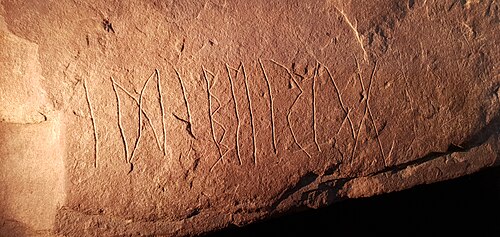
Runestone in Norway
The Svingerud Runestone (or Hole Runestone) is a sandstone slab, now in several fragments, featuring Elder Futhark inscriptions. It was found in a grave in Hole (west of Oslo), Norway. Radiocarbon dating indicates both the stone and the grave to date between 1 and 250 CE, during the Roman Iron Age, making it the oldest datable runestone known in the world, and potentially the oldest known runic inscription. The discovery is additionally notable for the content of its inscriptions.
Discovery and context
Archaeologists from the Museum of Cultural History, University of Oslo, discovered the fragments of Ringerike sandstone that were later reconstructed into the runestone in 2021-2023 during investigations of the Svingerud grave field close to the Norwegian farm of Hole, near Tyrifjorden. One of the pieces, Hole 2, was from a mound with grave goods radiocarbon dated to between 50 BCE and 275 CE. The other burials were dated to approximately the same time, with the grave containing Hole 1 likely being from before 150 CE. Such dates are consistent with graves of a similar style from elsewhere in Norway. Other fragments were found in other contexts in the grave field, with systematic sieving of soil in 2023 finding approximately 160 further pieces less than 2 cm in length.
Several fragments have elder fuþark runes carved on them, possibly with the tip of a needle or a knife, recording words of an early form of the Proto-Norse language (a northern development of Proto-Germanic).
in a block of reddish-brown Ringerike sandstone measuring 31×32 cm (12.2 in by 12.6 in)
Runologist Kristel Zilmer, Professor of Written Culture and Iconography at the Museum of Cultural History, worked on interpreting the inscriptions on the rune stone throughout 2022. Zilmer said, “Having such a runic find fall into our lap is a unique experience and the dream of all runologists. For me, this is a highlight, because it is a unique find that differs from other preserved rune stones.
The stone is named after the site where it was found (Svingerud, a tiny settlement North of Oslo) and has generally been referred to as Svingerudsteinen (‘the Svingerud Stone’) to date.
Fragments and the reconstruction
The fragments have been shown to be part of the same slab of sandstone, referred to variously as the Hole, or Svingerud, runestone. Nonetheless, substantial parts of the runestone are still missing.
Of the known fragments, the largest are named Hole 1 and 2, while Hole 3 is assembled from four separate pieces.
Inscriptions
Language
The language of the inscriptions has been considered Proto-Norse, or Ancient Nordic, following the convention for runic writing around Scandinavia in the time period from the mid second to late 7th centuries CE. Consistent with this, the inscriptions of Hole 2 and 3 seem to show North Germanic linguistic features.
Hole 2
idiberug sequence

The Hole 2 fragment has several identifiable sequences of runes. Eight runes are more clear than the others on one side and form a left-to-right sequence. Transliterated into Latin script, they read either idiberug or possibly idiberun, given the similarity between the ᚷ (g) and ᚾ (n) runes. The b rune is unusual, having four pockets, but resembles others on the fragment.
Several interpretations are possible, as is common with early runic inscriptions, however it likely includes a proper name. One possibility is the female name idibergu. In this case, the first element *idi- could be an intensifier, stressing long lasting, and be related to names such as Iðunn and Iðmundr. The etymology of this is uncertain, however. The second part of the name could be related to Proto-Germanic: *-bergō and Old Norse: -bjǫrg (“help”, “protection”), or bera, possibly related to *beran- (“bear”). A name such as Idibergu would be paralleled by attested names such as {{langx|goh|Iduberga} and the southern Germanic Bera. Alternatively, idibernu could be interpreted as a dedication (possibly of the stone or inscription) “for/to Īdiberō”. A further possible reading includes a faintly scratched z as part of the end of the sequence to give idiberu[n]g[a]z. This could be a kin name, with the suffix *-ungaz (‘descendant’) being well attested in the early Germanic record.
Eight runes are more legible than its other inscriptions; transliterated into Roman letters they spell either idiberug or idiberun. According to Zilmer, “The text may refer to a woman called Idibera and the inscription could mean ‘For Idibera’. Other possibilities are that idiberug is the rendering of a name such as Idibergu, or perhaps the kin name Idiberung. And there are other possible interpretations – as common with early runic inscriptions.”
fuþ sequence
Another sequence on Hole 2 is composed of the three runes ᚠ (‘f’), ᚢ (‘u’) and ᚦ (‘þ’ or ‘th’). These are the first three runes of the elder fuþark, in its typical order. It is possible that this sequence is therefore a rendering of the fuþark and may reflect an early knowledge of the rune-row as a defined, ordered concept. Complete and almost complete elder fuþark inscriptions are known elsewhere, with the Kylver stone, typically dated to around 400 CE, being widely considered the oldest. These runes resemble those of the idiberug sequence and were possibly carved using a similar tool.
Hole 3
The Hole 3 fragments have a sequence of 16 or 17 runes with at least two sets of dots, acting as separator marks between some of them. Several of the runes are split across fragments and some are damaged. They read ek(s)g(or w)ulu:fahido:runo (ᛖᚲ(ᛋ)ᚷ(or: ᚹ)ᚢᛚᚢ:ᚠᚨᚺᛁᛞᛟ:ᚱᚢᚾᛟ), in which the s (ᛋ) is faint and possibly not a rune, and the following rune is either a g or w (ᚷ or ᚹ). This has been interpreted as follows:
-
(ᛋ)ᚷ(or: ᚹ)ᚢᛚᚢ:
Gul(l)u/Wu(l)lu (or: Skul(l)u/Swul(l)u)
ᚠᚨᚺᛁᛞᛟ:
fahidō
ᛖᚲ {(ᛋ)ᚷ(or: ᚹ)ᚢᛚᚢ}: {} ᚠᚨᚺᛁᛞᛟ: ᚱᚢᚾᛟ
Ek {Gul(l)u/Wu(l)lu (or: Skul(l)u/Swul(l)u)} {} fahidō rūnō
I, Gu(l)lu/Wul(l)u (or: Skul(l)u/Swul(l)u), wrote the runic inscription
The names Gul(l)u or Wul(l)u are more likely than Skul(l)u or Swul(l)u given the faintness of the s and the possibility that it is a separator instead, as is seen elsewhere in the sequence. Gulu could be derived from Proto Norse: *gulu (‘yellow; gold’). The same runes may instead represent the name Gullu (‘she who shouts/sings’), related to Proto-Germanic: *galan- (‘to shout’) or *gellan (‘to yell/sound’). If this reading is correct, it would notably be the earliest recording of a female writer. Alternatively, the name Wullu may mean “the wooly one” or be related to Proto-Germanic: *wulan (‘to swell up, boil, seethe’).
The verb fahido is a form of *faihijan (‘to paint, decorate, write’). The inscription was scratched using a thin tool, making the meaning of “wrote” most fitting. It may also suggest, however, that the writer was aware of a custom at the time of decorating or colouring runic sequences. The formula used in the sequence is seen elsewhere in runic inscriptions, such as the Einang stone, which reads “Ek Go]dagastiz rūnō faihidō” (‘I, Godagastiz, wrote (or painted) the runic inscription’). In both inscriptions, runo (‘rune’) is in the singular, referring to the entire inscription. On the Svingerud stone, however, monophthongisation before the h is seen (fahido, rather than the Einang stone’s faihido). This spelling is also seen on the Rö runestone (dated to c. 60-375/400 CE). As the change is a regular development in Proto Norse, it may suggest that the Svingerud stone inscription was made after others that lack the innovation. Alternatively, the Svingerud stone could be older but the sound change took time to spread, and the monophthongisation had not been adopted in areas such as Einang by the time their inscriptions were carved.
Other
The fragments contain several other sequences of runes that are harder to interpret and make suggestions more speculative. These include an inscription with many consonants but few vowels that could reflect abbreviations or a record of different rune shapes. In other cases, it is unclear if certain carvings are intended to be runes, or which runes they are intended to be.
Function
As the largest fragment, Hole 1, lacks an inscription, it has been suggested to have been the base of an upright standing stone.
Hole 2 and 3 were likely removed from Hole 1 on purpose, after which Hole 2 was deposited in the grave in which it was discovered.
Exhibition
The University of Oslo placed the stone on public exhibition from January 2023 until late February 2023.
See also
- Einang stone, another ancient runestone from Norway which has previously been called one of the oldest
- Meldorf fibula, a metal fibula found in Schleswig-Holstein that features rune-like writing, dated to around 50 AD
- Negau helmet, one helmet, known as Negau-B and dated to 300–350 BC, features the oldest known writing in a Germanic language
- Vimose comb, another candidate for the earliest known runic inscription, a wooden comb found deposited in a bog in Denmark and dated to about 150 AD
Notes
Bibliography
- Olsen, Jan M. (17 January 2023). “Norway archaeologists find ‘world’s oldest runestone’“. AP News. Retrieved 28 September 2025.
- “The world’s oldest rune stone – Historical Museum”. Historisk Museum. Retrieved 28 September 2025.
- Gulliksen, Øivind (17 January 2023). “Found the world’s oldest rune stone – Museum of Cultural History”. Kulturhistorisk museum. Retrieved 28 September 2025.
- Schulte, Michael (2024). “Nochmals zum Runenwort urnordisch rūnō-: Ein Beitrag zur Periodisierung des Urnordischen”. Beiträge zur Geschichte der deutschen Sprache und Literatur (in German). 146 (2): 237–258. doi:10.1515/bgsl-2024-2001.
- Solheim, Steinar; Zilmer, Kristel; Zawalska, Judyta; Vasshus, Krister Sande Kristoffersen; Sand-Eriksen, Anette; Kimball, Justin J.L.; Havstein, John Asbjørn Munch (2025). “Inscribed Sandstone Fragments of Hole, Norway: Radiocarbon Dates Provide Insight into Rune-Stone Traditions”. Antiquity: 1–18. doi:10.15184/aqy.2024.225.
- Zilmer, K.; Vasshus, K.S.K. (2023). “Runic fragments from the Svingerud grave field in Norway: earliest datable evidence of runic writing on stone”. NOWELE: North-Western European Language Evolution. 76: 233–303. doi:10.1075/nowele.00080.zil.
- “World’s oldest runestone found in Norway, archaeologists say”. The Guardian. 17 January 2023. Retrieved 28 September 2025.



