


Separatist movement in Casamance, Senegal

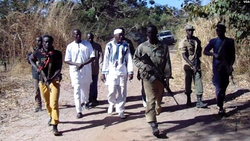
The Movement of Democratic Forces of Casamance (French: Mouvement des forces démocratiques de Casamance; MFDC) is the main separatist movement in the Casamance region of Senegal.
The modern MFDC was founded in 1982 under the leadership of Father Augustin Diamacoune Senghor. It is named after a political organization that was founded during French rule of Senegal in 1949 by Emile Badiane and Ibou Diallo before being integrated into the Senegalese Democratic Bloc in 1954. The MFDC’s armed wing was formed in 1985 and is called Atika (Diola for “warrior”[NOTE TO SELF: Cite “Casamance Conflict” by Carlo Panara here]).
The MFDC has fought against the Government of Senegal in the Casamance conflict. Despite various peace agreements, several MFDC factions have continued their fighting.
Casamance Region
The MFDC operates in the Casamance region of southern Senegal, which is south of the border with The Gambia. It was the last part of Senegal to get conquered by Europeans in 1903.[NOTE TO SELF: Cite Brittanica] Casamance is where the Jola, an ethnic minority making up about 4% of Senegal, are primarily concentrated.[NOTE TO SELF: Cite “Senegal” Minority Rights Group article here] The region is widely viewed by secessionists as having been neglected by the Senegalese government. Many believe northern Senegalese elites have exploited resources from the rivers and forests of Casamance, and state policies like the cutting of funding for boarding schools in the 1970s further upset those in the region.[NOTE TO SELF: CITE “The Mouvement des Forces Démocratiques de Casamance: The Illusion of Separatism in Senegal?” by Foucher here]
Casamance is predominantly Muslim, but many locals have retained traditional Jola religious beliefs. The modern MFDC’s leadership consists of both Muslims and Christians, and some members of the MFDC are considered Awasena, meaning they follow Jola religious traditions. The MFDC’s armed wing, Atika, has been known to take sacred oaths as part of their initiation, which plays off of traditional Jola rites.[NOTE TO SELF: Cite “Ripe or Rotting: Civil Society in the Casamance Conflict” by Clark here] However, nobody in public leadership positions are known to be Awasena.[NOTE TO SELF: Cite “Religious Roots of the Casamance Conflict and Finding a Path Towards its Resolution” by Baum here]
History
Original MFDC
The initial MFDC was initially founded in 1949 by schoolteachers Emile Badiane and Ibou Diallo as a regional political movement. Both were locals of the Casamance region, with Badiane being from a village close to Bignona and Diallo being from Sedhiou.[NOTE TO SELF: Cite “Ambiguous Echoes of the Colonial Partition: Alternative Futures from the Casamançais Past in Senegal” by Deets here] They sought to “rectify our local politics and militate as an intellectual community to raise, study, and solve the various local problems in a general framework, without, however, impeding or creating obstacles to issues of interest to Senegal as a whole or another region of the Colony in its own sphere”.[NOTE TO SELF: Cite citation 47 in “HIDDEN DEBATES OVER THE STATUS OF THE CASAMANCE DURING THE DECOLONIZATION PROCESS IN SENEGAL: REGIONALISM, TERRITORIALISM, AND FEDERALISM AT A CROSSROADS, 1946–62” by Dalberto here]
The original MFDC allied with Léopold Sédar Senghor‘s Senegalese Democratic Bloc (BDS), and in March 1952 elections, five of eight elected in Casamance were members of the MFDC.[NOTE TO SELF: Cite “HIDDEN DEBATES OVER THE STATUS OF THE CASAMANCE DURING THE DECOLONIZATION PROCESS IN SENEGAL: REGIONALISM, TERRITORIALISM, AND FEDERALISM AT A CROSSROADS, 1946–62” by Dalberto here] However, ensuing tensions between the MFDC and BDS resulting from MFDC conseillers feeling they were deprived of prestigious positions resulted in the MFDC deciding at a November 1953 convention in Marsassoum to remain autonomous but out of loyalty to Senghor, collaborate with the BDS on only crucial issues until the 1957 elections.[NOTE TO SELF: Cite “HIDDEN DEBATES OVER THE STATUS OF THE CASAMANCE DURING THE DECOLONIZATION PROCESS IN SENEGAL: REGIONALISM, TERRITORIALISM, AND FEDERALISM AT A CROSSROADS, 1946–62” by Dalberto here]
At a June 1954 MFDC convention in Bignona, MFDC leaders agreed to rejoin the BDS, marking the end of the MFDC as an independent organization. In response to this decision, a minority of young MFDC supporters left to create the Mouvement Autonome de Casamance (MAC), but the MAC dissolved in September 1957.[NOTE TO SELF: Cite “HIDDEN DEBATES OVER THE STATUS OF THE CASAMANCE DURING THE DECOLONIZATION PROCESS IN SENEGAL: REGIONALISM, TERRITORIALISM, AND FEDERALISM AT A CROSSROADS, 1946–62” by Dalberto here]
Modern MFDC
On December 26, 1982, the newly-formed, modern MFDC organized its first pro-independence demonstration, in which they replaced Senegalese flags in Casamance’s capital city of Ziguinchor with white flags. The MFDC’s new leader Augustin Diamacoune Senghor was amongst 32 people arrested and sentenced to prison for involvement in demonstrations.[NOTE TO SELF: Cite “Casamance Conflict” by Carlo Panara here]
In what MFDC members call “Red Sunday”, on December 18, 1983, an MFDC demonstration was met with violence, and MFDC sources claim that 200 demonstrators were killed.[NOTE TO SELF: Cite “Casamance Conflict” by Carlo Panara here]
In 1985, Atika, the MFDC’s armed wing, was formed. In 1990, Atika fully mobilized under the leadership of Sidy Badji. Their first military campaign was a surprise attack on a border post in Séléty by the Senegal-Gambia border.[NOTE TO SELF: Cite “Border Politics in Africa” by Nugent here] Since then, Atika has seen internal splits and the emergence of different factional leaders. Sidy Badji, Leopold Sagna, Salif Sadio, and César Atoute Badiate have been notable leaders of Atika factions, and Augustin Diamacoune Senghor, until his death in 2007, and Mamadou Nkrumah Sané have been the primary political leaders of the MFDC.
[1991 ceasefire]
[1993 ceasefire]
[1999 ceasefire]
[2004 ceasefire]
[2014 ceasefire]
Recent Developments
Members of the MFDC have taken a vocal stance against the Niafarang Project, a proposed mineral sands mine in the Zinguinchor region of Casamance. 2014 interviews with MFDC representatives showed they saw the mine as a exploitation of Casamance’s resources, with a representative saying, “It’s pillage, theft”, and that, “All of Casamance will suffer”.[NOTE TO SELF: Cite “‘This Mine is for the Entire Casamance Coastline’: The Politics of Scale and the Future of the Extractive Frontier in Casamance, Senegal” by Fent here]
The movement was rumored to have involved itself militarily in the 2016–2017 Gambian constitutional crisis and the subsequent ECOWAS military intervention in the Gambia on Yahya Jammeh‘s side.[2][3]
On 25 February 2025, Guinea-Bissau’s President Umaro Sissoco Embaló announced an agreement between the Senegalese government led by prime minister Ousmane Sonko and the MFDC to end the conflict between them following talks hosted and mediated by Guinea-Bissau.[4] Similar to a previous deal in 2022, the agreement was signed between the Senegalese government and the MFDC’s Badiate faction, with latter again agreeing to disarm.[5] In contrast, the MFDC’s Sadio faction did not agree to the deal.[6]
Internal Divisions
The MFDC has experienced significant internal divisions, especially within Atika. Following Sidy Badji’s signing of the May 31, 1991 ceasefire, Badji’s followers observed the ceasefire and became known as the Front Nord, but other members of Atika known as the Front Sud disobeyed the ceasefire and notably killed a Casamance Member of Parliament and a rural councillor.[NOTE TO SELF: Cite “Casamance Conflict” by Carlo Panara here]
Leopold Sagna initially led the Front Sud, but he was dismissed from his role in 1993 and replaced by Salif Sadio after attempting to meet with President Abdou Diouf.[NOTE TO SELF: Cite “‘THE FLAG STILL STANDS!’ THE POLITICAL RECONVERSION OF THE INTERNALLY EXILED INDEPENDENTISTS OF CASAMANCE” by Leyendecker and Miscoiu footnote 17] In 1997, Sadio attempted to take over Sidy Baji’s Front Nord camps at the north bank of the Casamance River.[NOTE TO SELF: Cite “‘THE FLAG STILL STANDS!’ THE POLITICAL RECONVERSION OF THE INTERNALLY EXILED INDEPENDENTISTS OF CASAMANCE” by Leyendecker and Miscoiu] In 2000, Sadio had Sagna killed, causing Atika and the political wing of the MFDC to further distance themselves from each other, with Diamacoune calling for a manhunt of Sadio.[NOTE TO SELF: Cite “‘THE FLAG STILL STANDS!’ THE POLITICAL RECONVERSION OF THE INTERNALLY EXILED INDEPENDENTISTS OF CASAMANCE” by Leyendecker and Miscoiu]
In March 2001, division within the political leadership of the MFDC occurred as well, with Diamacoune signing a peace agreement that Mamadou Nkrumah Sané did not approve of.[NOTE TO SELF: Cite “‘THE FLAG STILL STANDS!’ THE POLITICAL RECONVERSION OF THE INTERNALLY EXILED INDEPENDENTISTS OF CASAMANCE” by Leyendecker and Miscoiu] Diamacoune passed away on January 13, 2007.
In a 2018 interview, Nkrumah Sané, now the Secretary-General of the MFDC, said that he no longer recognizes Salif Sadio’s division of Atika as part of the MFDC.[NOTE TO SELF: Cite “‘THE FLAG STILL STANDS!’ THE POLITICAL RECONVERSION OF THE INTERNALLY EXILED INDEPENDENTISTS OF CASAMANCE” by Leyendecker and Miscoiu footnote 37]
As of 2021, Salif Sadio and César Atoute Badiate lead two major factions of Atika. The faction under Sadio, a Muslim Jola, has moved from southern Casamance to the north by the Gambia border, while César Atoute Badiate, a Christian Jola, leads the faction in the south by the Guinea-Bissau border.[NOTE TO SELF: Cite “Anti-Mine Action and Liberal Peace in Casamance, Senegal” by Tomas]
Foreign Relations
Guinea-Bissau
Members of the MFDC were directly involved in the Guinea-Bissau Civil War. One June 7, 1998, a coup erupted in Guinea-Bissau after a dispute over alleged arms sales from the Guinean armed forces to the MFDC. A report following a parliamentary investigation was set to be released on June 8 and absolve President João Bernardo Vieira from blame and incriminate his Chief of Staff, Ansumane Mané. Before the report was released, Mané launched a coup d’état backed militarily by local military personnel and an unknown number of MFDC troops.[NOTE TO SELF: CITE Vigh 2006 referenced in “Conflictual Motion and Political Inertia: On Rebellions and Revolutions in Bissau and Beyond” by Vigh]
Members of Atika are known to use religious rituals to ensure their safety. Some of their rituals are of Jola origin, but others come from the Manjaco, Mancagne, Bainounk, and Balanta people whose rituals were used during the Guinea-Bissau War of Independence.[NOTE TO SELF: Cite “Religious Roots of the Casamance Conflict and Finding a Path Towards its Resolution” by Baum]
On May 3, 2013, the MFDC detained twelve humanitarian demining workers from South African firm MECHEM.[NOTE TO SELF: Cite “Anti-Mine Action and Liberal Peace in Casamance, Senegal” by Tomas] Senegalese President Macky Sall sought the help of Guinea-Bissau’s President Serifo Nhamadjo, who sent a diplomatic mission of army officers to César Atoute Badiate. On May 27, with more help from Guinean non-governmental organization Djemberem di cumpo combersa (DDCC), three women were freed. The other nine workers were not freed until July 12 following Barack Obama‘s visit to Dakar.[NOTE TO SELF: Cite “Anti-Mine Action and Liberal Peace in Casamance, Senegal” by Tomas here]
Various negotiations involving the MFDC have taken place in Guinea-Bissau including a ceasefire signed on May 31, 1991 in Cacheu by Sidy Badji, the 2013 negotiations regarding the removal of land mines in Casmanace, and 2022 and 2025 talks resulting in agreements between the Senegalese government and Badiate’s MFDC faction.
The Gambia
Former Gambian President Yahya Jammeh, an ethnic Jola, has hosted various meetings aimed at peace in Casamance, but is also believed to have links with and to have supplied arms to the MFDC’s Front Nord.[NOTE TO SELF: Cite “Briefing: Senegal: Wade and the Casamance Dossier” by Evans footnote 55 here] In June 2001, Jammeh attempted to unify MFDC forces around Front Nord moderates, but this was unsuccessful.[NOTE TO SELF: CITE “The Mouvement des Forces Démocratiques de Casamance: The Illusion of Separatism in Senegal?” by Foucher here]
Additionally, the Senegalese government accused Mauritanian authorities of supplying Atika with weapons through the Mauritanian embassy in The Gambia, contributing to Senegal and Mauritania breaking diplomatic relations with each other from 1989 to 1992.[NOTE TO SELF: Cite “Casamance Conflict” by Carlo Panara here]
International Mediation
In 1993, the Senegalese government and the MFDC agreed to appoint a French arbitrator to evaluate the MFDC’s claim that Casamance had been an autonomous territory under French colonial rule and therefore had a right to independence at decolonization. Jacques Charpy, a former colonial administrator in northern Casamance, ultimately concluded that Casamance had never been governed as an autonomous unit, but the MFDC did not accept this conclusion.[NOTE TO SELF: Cite “Casamance Conflict” by Carlo Panara here]
On March 20, 2013, Geneva Call, a Swiss-based non-governmental organization supported negotiations between the Senegalese national Anti-Mine Action Centre (CNAMS) and 25 representatives from César Atoute Badiate’s wing of the MFDC in São Domingos, Guinea-Bissau to discuss the removal of land mines. Although the MFDC understood the need for de-mining, they argued that de-mining was dependent on a greater peace process.[NOTE TO SELF: Cite “Anti-Mine Action and Liberal Peace in Casamance, Senegal” by Tomas] On June 7, 2013, following the detainment of twelve demining workers, Geneva Call sent its President to aid subsequent talks, but Atoute Badiate argued that demining is not allowed during wartime. Following this, Geneva Call suspended their Casamance work.[NOTE TO SELF: Cite “Anti-Mine Action and Liberal Peace in Casamance, Senegal” by Tomas]
Flag
.svg)
Since 2013 photos indicate that the MFDC – or, at least one of its armed branches – uses a new flag, designed with a different geometrical arrangement of the elements of the flag adopted in 1983. The flag is horizontally divided green-yellow with a red triangle placed along the hoist, charged with a white star tilted to the upper hoist.[7][8][9]
See also
References
Bibliography
- Minahan, James (2002). Encyclopedia of the Stateless Nations: Ethnic and National Groups Around the World. Greenwood Publishing Group.



