

== later reply ==
== later reply ==
Thank you for that reference, I was able to get that book. They make the same mistake as explained in my [https://www.solidstep.com/light/paper1/Latest-light-paper-Sep2025.html article] (they don’t correctly determine the Total Energy of the light after expansion). This simple thought problem illustrates what they’re missing:
Thank you for that reference, I was able to that book. the . they don’t the of the after expansion. simple thought problem illustrates:
”’Q:”’ A light source emits light for exactly 2 seconds. While the light is traveling through space, the universe expands with a scale factor of 3. How long will it take to receive the light after the expansion?
”’Q:”’ A light source emits light for exactly 2 seconds. While the light is traveling through space, the universe expands with a scale factor of 3. How long will it take to receive the light after the expansion?
”’A:”’ The number of seconds it will take to receive the light is six, because the light is stretched out not only in space but also in time (because the speed of light is a constant). So although the energy of each “particle” (photon) is lower, there are more seconds of light (more photons) after expansion than there were before, so the total energy of the light doesn’t change. (see [https://www.solidstep.com/light/paper1/Latest-light-paper-Sep2025.html article] which includes an example textbook study problem)
”’A:”’ The number of seconds it will take to receive the light is six, because the light is stretched out not only in space but also in time (because the speed of light is a constant). So although the energy of each “particle” (photon) is lower, there are more seconds of light (more photons) after expansion than there were before, so the total energy of the light doesn’t change. (see [https://www.solidstep.com/light/paper1/Latest-light-paper-Sep2025.html article] which includes an example textbook study problem)
All of the other sciences that deal with light, such as optical engineering, computer switching, medical applications, etc, have moved way beyond the early confusion surrounding the Photon (the per-second energy of light). It is only physicists (but not the giants of inflationary cosmology) who cling to the false belief that photons really are just like particles, when in reality the Photon is a mathematical construct for 1 second’s worth of light (as this thought experiment illustrates). So if the frequency of a traveling light wave changes it does not mean the total light energy has changed, and the Photon was originally only meant to be used in the case where the frequency is NOT changing. (see [https://www.solidstep.com/light/paper1/Latest-light-paper-Sep2025.html article] which explains that if the frequency of a traveling light wave changes, it simply means the Power of the light has changed (the per-second energy), not the Total Energy)
All of the other sciences that deal with light, such as optical engineering, computer switching, medical applications, etc, have moved way beyond the early confusion surrounding the Photon (the per-second energy of light). It is only physicists (but not the giants of inflationary cosmology) who cling to the false belief that photons are just like particles, when in reality the Photon is a mathematical construct for 1 second’s worth of light (as this thought experiment illustrates). So if the frequency of a traveling light wave changes it does not mean the total light energy has changed, and the Photon was originally only meant to be used in the case where the frequency is NOT changing. (see [https://www.solidstep.com/light/paper1/Latest-light-paper-Sep2025.html article] which explains that if the frequency of a traveling light wave changes, it simply means the Power of the light has changed (the per-second energy), not the Total Energy)
|-
|-
|-
|-
|}
|}
”’OR:”’
Thank you for that reference, I was able to access that book. I can understand why you wouldn’t want to change the Wikipedia page since it’s taught by cosmology textbooks. But it’s not correct, and they don’t explain their reasoning except to imply that the number of photons after expansion is the same as the number before expansion. But that is false, as this simple thought problem illustrates:
”’OR:”’
Thank you for that reference, I was able to access that book. I can understand why you wanted to include it in the Wikipedia page since it’s taught by cosmology textbooks, but it’s not correct. Their math is OK for a single photon, but they don’t explain their reasoning in extending it to the energy density of all the radiation, except to imply that the number of photons after expansion is the same as the number before expansion. But that is false, as this simple thought problem illustrates:
== msg to authors ==
== msg to authors ==
Effect of Expansion on Light
[edit]
I’m thinking about changing the Expansion of the Universe page to correct the misconception among some physicists that “E=hf” means light loses energy when the universe expands. In reality the “hf” term is only the Power of the light (the per-second energy), not the Total Energy. So while light does lose Power in the expansion of the universe, it does not lose energy. The giants of inflationary cosmology back me up on this. See my short paper with references to Prof Guth (MIT) and Prof Susskind (Stanford) and which includes an example textbook study problem for this:
Physicists Confused by their Own Mathematical Constructs
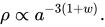
I wanted to run this past you first before changing it though, since you made a lot of edits to that page. Basically this means that light’s energy density drops in the same proportion as matter (). So I was going to fix the section about energy density, and remove the part about

What do you think? Does my paper (and Prof Guth and Prof Susskind) convince you? Or do you still think that light loses energy in the expansion of the universe?
– Jerry Huth (talk) 03:21, 12 October 2025 (UTC)
the reply from Aseyhe
[edit]
- The scaling is correct. The usual derivation uses general relativity. You can also derive it just using thermodynamic principles. Note that none of the derivations (that I know of) involve E=hf. In any event, this scaling is in accordance with established physics, and if you were to change it, you would be going against established physics — which is not the purpose of this site. Aseyhe (talk) 17:17, 12 October 2025 (UTC)
- Ok, thanks for looking at this. Do you have a textbook reference for this statement on that page: “For ultrarelativistic particles (“radiation”), the energy density drops more sharply, as “? Or do you know what kind of textbook would have it, what subject matter or section it would be in, etc? (I live near this university library: https://library.du.edu/)
- Thanks,
- Jerry Huth (talk) 20:50, 12 October 2025 (UTC)
- For example, Dodelson & Schmidt (2nd ed.) section 2.3. I’d guess most cosmology textbooks should have it though.


Thank you for that reference, I was able to access that book. I can understand why you wanted to include it on the Wikipedia page since it’s taught by cosmology textbooks, but it’s not correct. Their math is OK for a single photon, but they don’t explain their reasoning in extending it to the energy density of all the radiation, except to imply that the number of photons after expansion is the same as the number before expansion. But that is false, as this simple thought problem illustrates:
Q: A light source emits light for exactly 2 seconds. While the light is traveling through space, the universe expands with a scale factor of 3. How long will it take to receive the light after the expansion?
|
If you want to think about it Scroll Scroll Scroll Scroll Scroll A: The number of seconds it will take to receive the light is six, because the light is stretched out not only in space but also in time (because the speed of light is a constant). So although the energy of each “particle” (photon) is lower, there are more seconds of light (more photons) after expansion than there were before, so the total energy of the light doesn’t change. (see article which includes an example textbook study problem) All of the other sciences that deal with light, such as optical engineering, computer switching, medical applications, etc, have moved way beyond the early confusion surrounding the Photon (the per-second energy of light). It is only the physicists (but not the giants of inflationary cosmology) who cling to the false belief that photons are really just like particles, when in reality the Photon is a mathematical construct for 1 second’s worth of light (as this thought experiment illustrates). So if the frequency of a traveling light wave changes it does not mean the total light energy has changed, and the Photon was originally only meant to be used in the case where the frequency is NOT changing. (see article which explains that if the frequency of a traveling light wave changes, it simply means the Power of the light has changed (the per-second energy), not the Total Energy) |
Subject: Important Thought Problem missing from the Modern Cosmology textbook
Hello Dr Dodelson and Dr Schmidt,
I wanted to alert you to a serious issue in your textbook “Modern Cosmology”. This very important thought problem / exercise is not included in the textbook:
Question: A light source emits light for exactly 2 seconds. While the light is traveling through space, the universe expands with a scale factor of 3. How long will it take to receive the light after the expansion?
Answer: see https://en.wikipedia.org/wiki/User:Jerry_Huth/LightProblem1
This thought problem helps explain why the following equation about the energy density of radiation is not correct:

(on page 37 in the 2nd edition)
To calculate the energy density of light, you first have to correctly calculate the Total Energy of the light (see example exercise included in this article, which also includes references to the giants of inflationary cosmology who agree with me about this).
Ripple effects of this mistake include that equation 2.61 is incorrect:

Please let me know if you have any questions or would like to discuss it. Are you convinced about this? i.e. do you think you will change this in the next edition of your textbook?
Thank you,
Thank you for that reference, I was able to get that book. All of their math is fine up to where they show that the momentum and energy of a photon decreases as the frequency goes down. But then they make the final leap (without evidence) and say that the energy density of radiation goes down by an extra scale factor, which is false (and the giants of inflationary cosmology agree with me on this – see references in article). The textbook authors don’t “show their work” on that final leap, i.e. they don’t even attempt to calculate the total energy of the light. So they make the same mistake as explained in the article. Here’s a simple thought problem that illustrates what they’re missing:
Did you intend those equations to apply to the Total Energy Density of the radiation? If so then they are incorrect, for instance the author of the Wikipedia article about Expansion of the Universe points to your textbook to support this statement:
The Photoelectric Fiction
There are other places where confusion about the Photon has led physicists to incorrect conclusions. For instance the classic textbook problem about the Photoelectric Effect (where the student calculates the speed of an ejected electron) is a total fiction/oversimplification. It could only be true if the electron absorbed exactly 1 second’s worth of light before being ejected (because the Photon is the per-second energy of light). Obviously that is an oversimplification, and as the following video I found on YouTube shows, once the experiment reaches steady state it takes many seconds for the electrons to absorb enough energy to be ejected (and there are multiple plateaus): https://www.youtube.com/watch?v=oYnp0WZDhYQ&t=270s
(at time 4:30)
(BTW I like this YouTuber’s enthusiasm for this experiment, but I don’t agree with his explanation of the underlying physical processes (it is the classic explanation, which is a gross oversimplification))

