


THOMAS E. POWERS
T. E. Powers (cartoonist)
{{short description|American cartoonist
{{other people||Thomas Powers (disambiguation)
{{Use mdy dates|date=February 2026
|
T. E. Powers |
|
|---|---|
| Born |
Thomas Edward Powers (1870-07-04)July 4, 1870 |
| Died | August 14, 1939(1939-08-14) (aged 69) |
| Occupations | Comic-strip artist, editorial cartoonist, caricaturist, animation supervisor, landscape painter |
| Years active | 1889–1937 |
| Spouse(s) | Louise Hyde Powers (m.1895–1939; his death) |
| Children | None |
https://archive.org/details/movingpicturewor27newy/page/250/mode/2up
https://archive.org/details/motography151elec/page/106/mode/1up?view=theater&q=Powers
Thomas Edward Powers (most often identified and professionally credited as T. E. Powers, but also Tom Powers, Tom E. Powers, and TEP; July 4, 1870 – August 18, 1939) was an American comic-strip artist, editorial cartoonist, and caricaturist whose drawings were published in newspapers throughout the United States between 1889 and 1937. The Wisconsin native, who was reported to be President Theodore Roosevelt’s favorite “political cartoonist”,[1] spent the final four decades of his career employed by the New York Journal, the flagship of William Randolph Hearst’s vast newspaper chain.[2][3] Power’s drawings were also widely used in commercial advertisements in the early 1900s, and between 1916 and the 1921, an assortment of his comic-strip characters were adapted for use in animated shorts . Those cartoons were presented in both domestic and foreign cinemas as part of Hearst-Vitagraph newsreels and in other releases by Hearst’s International Film Service. Given the scope and influence of Powers’ work on American journalism, politics, and popular culture, he ranks among the leading satirical artists of the early twentieth century.[4]
https://chroniclingamerica.loc.gov/lccn/sn84026749/1918-06-30/ed-1/seq-37/
Early life and initial jobs
Thomas Powers was born in 1870 in Milwaukee, Wisconsin.[2] In his youth he moved with his family to Kansas City, Missouri, where he completed his secondary education and where he obtained his first jobs.[1] Tom demonstrated at an early age a natural talent for drawing cartoons, an ability that got him in trouble at school for decorating classroom blackboards with unflattering portraits of his teachers.[4] His mischievous artwork also cost him his first paid position as a clerk in a local grocery, being fired there for sketching caricatures of his boss on sheets of the store’s wrapping paper.[5] Tom was next employed by a Kansas City lithographer, although he soon left that job as well. Over 50 years later, in its 1939 obituary for Powers, the New York Herald Tribune quotes the cartoonist’s comments about his stint with that printing company and why he left his position there, comments that he originally shared in an interview with the news magazine Editor & Publisher in 1906:
“When I was about seventeen years of age [c.1887] I went to work for a lithographer who estimated that I was well worth $2 a week. I also received a goodly supply of advice on the subject of saving money. But, in spite of all he said, I squandered my money, with carelessness, recklessness and negligence…My employer said that I would never be able to draw. I was offended and resigned….”[4]
By 1889, after Powers had finally managed to save sufficient funds working in yet another position in Kansas City, the self-taught artist left Missouri and relocated to Chicago.[6] There he enrolled in formal, part-time art classes and also secured a job as an illustrator and cartoonist.[5] While attending school at night, “T. E.” worked days for the Chicago Daily News under the direction of Victor Lawson, who hired him after seeing some of his pen-and-ink drawings.[3]
Move from Chicago to New York City, 1894
In Chicago, Powers did additional artwork for another newspaper, the Chicago Herald, before accepting a “lucrative offer” in 1894 from newspaper editor Arthur Brisbane to move to Manhattan to join the staff of the widely popular New York World.[5][1] That newspaper was owned by Joseph Pulitzer, recognized at the time as “the foremost newspaper publisher in the world.”[7] That lofty status, however, began to be seriously threatened in November 1895, when William Randolph Hearst acquired the New York Journal, which would become the flagship of a network of newspapers he intended to establish across the United States.[8][9][a] Under Hearst’s new management that year, the Journal experienced a remarkable increase in daily readership, rising from 30,000 to 100,000 in just a single month and then, after a year, to over 430,000.[10][11] In order to sustain such growth and eclipse Pulitzer’s success in the two publishers’ fierce circulation war, Hearst implemented a plan to bring together at the Journal the finest editors and illustrators in American journalism.[12][13] In 1896 he lured Brisbane away from the World; and the following year Brisbane, now chief editor and noted columnist at the Journal, coaxed Powers to leave The World as well and to join a stellar group of cartoonists being assembled by Hearst, a group that included such artists as Homer Davenport, Richard Outcault, Frederick Opper, and Jimmy Swinnerton.[12]
Powers and the Hearst newspaper empire
After T. E. Powers joined Hearst’s newspaper in 1896, Joseph Pulitzer soon convinced him to return to the World under a new, more generous contract.[12] Like Hearst, Pulitzer knew that “Nothing attracted readers and distinguished a newspaper from its competitors like a brilliant cartoonist.”[12] Hearst, in turn, countered with an even more attractive offer for Powers to come back to the Journal. A court trial then ensued over this employment tug-of-war; and while those proceedings continued, Powers was prohibited from doing work for either publisher. Nevertheless, until the litigation’s resolution, both Pulitzer and Hearst were required to pay the cartoonist the full salaries that each of the publishers had stipulated in their contract offers to him.[14] That trial condition, paying Powers two salaries “for doing nothing”, made T. E. “the envy of newspaperdom”.[14] Ultimately, Hearst prevailed in court and retained the services of the 27-year-old artist.[14] Powers from that point forward spent the remainder of his long career working for what became Hearst’s vast newspaper empire. Yet, despite the cartoonist’s legally approved transfer to the Journal, Pulitzer still owned the exclusive rights to all of his drawings that had been published in the World from 1894 to 1896. Reprintings of Power’s comic strips and single panel cartoons from that period would therefore reappear for several years to come in Pulitzer’s newspapers.[15]
Until Power’s retirement from the Hearst Corporation in 1935, his drawings over nearly four decades would be seen by millions upon millions of readers of Hearst-owned newspapers and through Hearst’s syndication network of client newspapers. That network, with hundreds of other newspapers and publications paying fees for the rights to republish news articles, opinion columns, editorial cartoons, comic strips, and other content produced by Hearst’s employees, added millions of additional readers. At its height in the 1920s and early 1930s, the Hearst Corporation owned 28 newspapers in every major American city, and those papers, combined, had a daily circulation of nearly 13 million readers.[16] The addition of the network-affiliated newspapers increased the total readership to nearly 20 million Americans who received all or much of their daily news and other print information from Hearst sources.[16][17]
Comic strips and single-panels
[[File:The Rapid Transit Problem, and Some Solutions (Powers cartoon).gif|thumb|200px|right|Example of comic strips

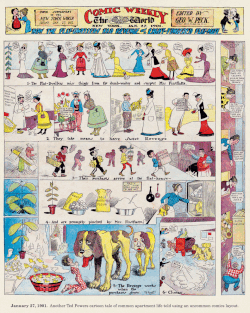
Powers soon became one of William Hearst’s favorite staff artists as T. E.’s comic strips and single-panel cartoons gained a large loyal following for Hearst’s newspapers and for the steadily rising number of client newspapers in syndication under the Hearst Corporation.[18] By 1916, Hearst-Vitagraph advertisements in trade journals were announcing that “Five hundred newspapers today are using the great Tom Powers cartoons.”[19] The commercial and critical success of Powers’ pen-and-ink creations were perhaps due to how relatable their themes were to many readers. His drawings regularly portrayed and lampooned the everyday challenges facing the inhabitants of New York City and in other cities where residents coped with the rigors of parenthood set in urban environments, dealing with troublesome neighbors, balancing tight family budgets, commuting woes, keeping up with changing fashion trends, as well as with a host of other local social, economic, and political, issues. Some of the cartoon titles of Powers’ comic strips and panels are “How’d You’d Like to be Charlie?”, “Our Moving Pictures”, “Home, Sweet Home”, “Mike and Mike”, “Mr. Nobody Holme”, “Mrs. Trubble”, “Never Again,” “The Down-and-Out Club”, “Sam the Drummer”, “Married Life From the Inside”, “Charlie and George”, and “The League of Husbands”.[1][18][b]
Joy and Gloom
https://archive.org/details/movingpicturewor11newy/page/423/mode/1up
https://www.loc.gov/item/00694016/
To enhance the theme of his pen-and-ink drawings and to underscore the emotional tone of their intended messages, Powers began adding to his cartoon panels two very simply drawn elf-like characters: an ever-smiling, round-headed female figure in stylized ballerina attire he named “Joy”; the other, a male figure he called “Gloom”, who wears a small cone-shaped hat, sports long black whiskers, and usually bears a constant scowl or is shown celebrating whenever the main subject of the cartoon is sad or fails in a task.[1][18] Often, Joy and Gloom appear together in Powers’ cartoons; at other times, separately, occupying spaces in the foreground of his comic strips or cavorting in the bottom corners of panels. Each character also occasionally mobilize and lead their respective groups of equally small followers or allies in Powers’ drawings representing other emotions. Joy and Gloom and their cartoon allies quickly became widely recognized essentially as trademarks of Powers’ artwork. Their presence extended too beyond his comic strips and were “generally employed”, as described by The New York Times, “as pictorial footnotes to his editorial cartoons.”[3].
The first appearance of Joy and Gloom in a published drawing by Powers remains undetermined, although the two little characters began to be seen with increasing frequency in his newspaper strips and panels in 1910. By 1912, Joy and Gloom had become so popular that the Chicago publishers Reilly and Britton sought to capitalize on their broad appeal by marketing a 72-page compilation of Powers’ cartoons titled Joys and Glooms: A Book of Drawings by T. E. Powers. In the foreword, readers are greeted with the following upbeat message:
“May this book cause the Joys to banish the Glooms from among those who turn these pages . . . Beat the drum; and troops of Joy will scatter the regiments of Misery, Anguish, Revenge, Worry, Jealousy and Envy. Optimism will pluck handfuls out of the beard of Old Grouch. Good Cheer will send Jinx Hoodoo on the run. Don’t be a Gloom. Be a Joy. It is so easy.[20]


Selections of Powers’ cartoon panels in Joys and Glooms portray with both slapstick action and wry humor situations a wide range of subjects, such as women’s suffrage, con men, superstitions, marriage, sports, and health issues. One highlight in the book is Powers’ multi-panel illustration of Ernest Thayer’s 1888 mock-heroic poem “Casey at the Bat”. In the final panel of Powers’ depiction of that poem, the “mighty” baseball player Casey sits dejectedly on the team bench after striking out and losing the game. Above his head is a small raincloud while in the panel’s foreground a troop of seven Glooms marches triumphantly in celebration of his failure.[21]
“Preservation funded by The David and Lucile Packard Foundation
Joys and Glooms (1921) International Newsreel Corp.. Based on the comic strip by T.E. Powers. Animation: John C. Terry. 35mm, approx. 3 min.”
Political caricatures and editorial cartoons
[[File:W.W. Denslow (by T.E. Powers).jpg|thumb|160px|left|Caricature of fellow artist W. W. Denslow by Powers, 1900]]
Powers’ cartoons were admired by his colleagues not only for their humor but also for their uncomplicated style.[18] In its obituary for the artist in August 1939, The Sun newspaper in Baltimore alludes to the deceptive simplicity of his drawings and reveals the cartoon that was Powers’ personal favorite:
Using a relatively simple line-drawing technique, which looked easy to duplicate but was not, Mr. Powers had a gift for caricature. His own favorite cartoon was one he drew of President Calvin Coolidge sawing wood. Mr. Coolidge liked the drawing and his request for the original, on White House stationery, was one of the cartoonist’s most cherished mementos…While conceding that few caricatures were flattering, Mr. Powers once observed that he had encountered few men who objected to being caricatured. “In fact,” he said, “most of them seem to like it.”[18]
Powers’ exaggerated, highy stylized depictions of people were also often applied to illustrate newspaper coverage of political events and presentations of human-interest stories. In 1901, for instance, in the New York World, his pen-and-ink work complemented press reports about Edward M. Shepard’s unsuccessful second run for the mayorship of New York City. Powers’ drawing of Shepard (left) in October that year captured the Tammany Hall candidate as he sat “evading questions put to him by reporters” at a campaign gathering.[22]
James Hazen Hyde
https://www.newyorkhistoryblog.com/2013/01/james-hazen-hyde-a-gilded-age-scandal.html

Support for Theodore Roosevelt and “progressive thought”, 1901-1909
Despite William Hearst’s later political disagreements with Theodore Roosevelt, he and his newspapers generally supported “Teddy’s” progressive causes during the Republican’s presidential term of office between 1901 and 1909.[23] T. E. Powers, who was reported to be Roosevelt’s favorite newspaper cartoonist, did his part in promoting progressive issues in the early twentieth century.[1] During that period, Powers regularly produced editorial cartoons that championed Roosevelt’s progressive efforts to enact and enforce anti-trust legislation, federal food and drug safety inspections, and to advance other progressive policies.Cite error: A <ref> tag is missing the closing </ref> (see the help page). His editorial drawings also frequently showcased the investigations of many reform-minded reporters or “muckrakers”, who sought to uncover both corporate and government corruption in the United States and to encourage their prosecution.[24] Overall, Powers’ drawings actively promoted the political and economic interests of the Hearst newspaper chain and reflected the personal opinions of its owner, William Hearst, on a variety of issues affecting the direction of United States domestic and foreign policies.[25]
“The Hearst crusade technique, which advocated “moral and progressive thought in the community,” appeared daily. Editorials and pronouncements, coupled with political cartoons by such talented artists as Frederick Opper, Winsor McCay, and T. E. Powers, crusaded for such important local and national issues as municipal subways, public school reforms, a fair and judicial enforcement of laws by city and state officials, food safety and public health issues, women’s suffrage, child labor laws, an aggressive foreign policy by the United States, and the expansion and modernization of the nation’s naval fleet.[26]
Powers sued for libel, 1907
For often mocking and disparaging prominent political officials and wealthy industrialists in cartoons and opinion columns, Powers and other staff of Hearst’s newspapers were periodically threatened with litigation or drawn into court trials. One high-profile example for Powers was the 1907 lawsuit filed by Chicago’s Republican mayoral candidate Frederick Busse, who included the cartoonist and editor Arthur Brisbane in his $150,000 libel case ($5,060,000 today) against the Hearst Corporation.[27][c] In his action, Busse alleged that Hearst and “his mudslinging hirelings”,[28] including his “cartoonist from New York”,[27] had maliciously damaged his reputation by portraying him as a maniacal “gunfighter” and as a “distorted, piglike creature”.[27][29] The Republican also charged that Hearst and his employees outside the state of Illinois, in their support for incumbant Chicago Mayor Edward F. Dunne., had “taken charge of the Democratic newspaper campaign” against Busse during the city’s mayoral election of 1907.[27]
The March 31, 1907 issue of the Chicago Tribune reports on the hunt for Brisbane and Powers by a “big, and burly, and brusque” Cook County deputy sheriff. The officer was dispatched by his superiors to find the journalists and serve each of them a court summons and to read aloud to them the formal charges against them for libeling Frederick Busse.[30] The deputy searched downtown Chicago all day for Brisbane and Powers, who were visiting the city to observe firsthand the final days of the mayoral campaign before the April 2 election. The officer finally located the two men that evening staying in a hotel. He delivered the summons first to Brisbane, who, according to the Tribune, responded to the deputy, “These libel suits don’t amount to anything. I don’t worry about them…Busse’ll [sic] never get a dollar o’ that.”[30] Then, shortly before midnight, the officer “knocking loudly” on the door of Powers’ room woke up the cartoonist and his wife Louise.[30] The Tribune in the same cited issue also states that Powers took the court order, waived a reading of its charges, and simply “went back to bed”.[30] Such reported nonchalance about being served with yet another lawsuit suggests that both Brisbane and Powers continued to be confident that the combination of First Amendment safeguards and William Hearst’s deep pockets would protect them once again from judicial convictions. Just three days after those summons were served, Busse won Chicago’s election, defeating Dunne.[31] One post-election update regarding the progress of Busse’s lawsuit appears in the June 25, 1907 issue of the Tribune. That news item
in the months after the election are absent in searches of newspapers in Chicago and elsewhere. Perhaps the case was settled out of court or became lost among the myriad of other suits and countersuits related to the campaign, including a $2,500,000 ($84,370,000 today) libel case and other suits that Hearst himself filed against the Chicago Tribune.[32]
“The Political Round-Up”, 1913
“T.E. Powers also did political illustrations for the Political Round-Up column in Hearst’s Magazine, July – Dec 1913.” Lambiek comicpedia
https://archive.org/details/williamrandolphh00benp/page/61/mode/2up?q=Powers
https://archive.org/details/williamrandolphh0000litt/page/180/mode/2up?q=Powers
economic interests and military power globally, establish tighter health and safety standards for food production and distribution in the United States.

https://strippersguide.blogspot.com/2006/09/ep-1939-te-powers-obituary.html
Mr. Powers first attracted the attention of Theodore Roosevelt when he pictured the President threatening tall, silk-hatted figures labeled “The Trusts” with the then famous “big stick.” His satirical thrusts at “grafting politicians” or others whose right to public office he challenged, however, usually were tempered with broad humor. Powers’ 1901 caricature of New York City’s police chief William Stephen Devery being “perfumed” at a beauty parlor to mask the stench of the official’s widespread reputation for bribery and extortion.
“This T.E. Powers editorial cartoon appeared during the 1912 Presidential campaign. It features William Howard Taft, Theodore Roosevelt, and Woodrow Wilson, all grasping for the Presidential ring. Wilson ultimately won the race, with Roosevelt playing the role of spoiler. I love the secondary characters in the cartoon, on the merry-go-round and in the background. Plus, there are two of Powers’ wonderful little Joys figures dancing in the foreground”
https://www.comicartfans.com/GalleryPiece.asp?Piece=1869678
Powers’ drawings used in advertising
Some of the characters that Powers developed for his comic strips and featured in his editorial cartoons were adopted for commercial advertising by an array of manufacturers in the United States. In 1910, for example, the Kinney Brothers Tobacco Company of New York included in Tobacco insert card, 1910, from the “Mutt and Jeff” series (T88), issued with Sweet Caporal Cigarettes by. The comic strip was created by Bud Fisher, and the backs of the cards state they were illustrated by Bud Fisher, T.E. Powers, R.L. Goldberg, Tad (Dorgan), and Gus Mager.
https://www.metmuseum.org/art/collection/search/785127?sortBy=Relevance&ft=Thomas+E.+Powers&offset=0&rpp=40&pos=8
used in Carbons
Animated shorts, 1916—1921
T. E. Powers’ comic-strip characters and their storylines extended beyond newspaper and magazine pages. Beginning in 1916, his orginal pen-and-ink creations were adapted and brought to “life” in animated shorts presented semi-weekly to theater audiences as added content in Hearst newsreels. The cartoons included in those newsreels were developed by an animation studio under the Hearst Corporation’s recently established International Film Service. The American film-industry publication Motion Picture News in its January 15, 1916 issue announces, “Cartoonist Powers to Draw for Hearst-Vitagraph”. In the article the periodical provides examples of what cartoon characters theatergoers could expect to see in each newsreel:
TOM POWERS, the cartoonist, is presented as one of the main features of the Hearst-Vitagraph News Pictorial. “Joys” and “Glooms,” which have appeared in the Hearst newspapers, will scamper across the screen as a part of the Hearst-Vitagraph semi-weekly news film. “Mrs. Trubbel” will continue to stir up domestic discord, but in thousands of theatres, in addition to the columns of the Hearst papers. “Powers’ Phables” will bring in motion on the screen the weaknesses of human nature. “Never Again!” the “Down and Out Club” and “Charlie and George” will be other features to be seen in motion from the pen of Powers.[33]
The actual animation of Powers’ characters for Hearst newsreel, as well as the works of other comic-strip creators, was done by artists hired from Barré Studio, an early leader in animation in the United States.

Titles of some of the cartoons:Mister Nobody
T. E. Powers, the famous cartoonist, shows the triumph of “glooms,” over “joys” in “Her Busted Romance,” a series of animated drawings (1916)
https://archive.org/details/movingpicturewor27newy/page/1006/mode/2up?q=Powers
Feet Is Feet.^A phable by T. E. Powers. In which the joys triumph in a heavy engagement with the glooms.
https://archive.org/details/movingpicturewor27newy/page/1010/mode/2up?q=Powers (1916)
POWERS — “A Hot Time In Iceland” (Comedy Cartoon)
https://archive.org/details/movingpicturewor27newy/page/828/mode/2up?q=Powers (1916)
Cartoon — A comic animated cartoon by T. E. Powers, America’s foremost comic artist, in which Mr. Powers depicts the experience of a gentleman ordered to indulge in “Gentle Exercises” by his medical adviser, “Old Doc Gloom.”
“World War I proved the death-knell for IFS. Hearst had been pursuing an aggressive pro-German position for decades under the assumption that German immigrants were the core of his newspaper consistency. As a result, International News Service lost its credibility. The spiraling debt this created forced Hearst to cut out his least-profitable business, and that was IFS. The entire staff was laid off on July 6, 1918, a date referred to in animation history as “Black Monday”. But Hearst still cared about his animated properties, so he licensed them to John C. Terry’s studio. When that studio folded a year later, he licensed his former competitor, Bray Productions, to make the IFS cartoons. The deal lasted from 1919 to 1921, when the IFS-Bray agreement broke off; with the final few cartoons released in early 1921.
“By 1914, Barré and Nolan felt confident enough to start their own studio, totally independent of Edison and dedicated 100% to animation. This Barré-Nolan Studio was probably the first of its kind (although Bray Productions also had a good claim to the title). The main title produced by the new studio was a series of inserts for the mostly live-action Animated Grouch Chaser series, distributed by Edison.
“International Film Service (IFS) was an American animation studio created to exploit the popularity of the comic strips controlled by William Randolph Hearst. In 1916, William Randolph Hearst, multi-millionaire and newspaper magnate, started a rival animation studio called International Film Service and hired most of Barré’s animators, including Bill Nolan, by paying them more money than Barré could provide. Barré was reduced to being a contractor for IFS, animating the series Phables. After seven cartoons, he quit.
Donald Crafton; Before Mickey: The Animated Film, 1898-1928; University of Chicago Press; ISBN 0-226-11667-0 (2nd edition, paperback, 1993)
Denis Gifford; American Animated Films: The Silent Era, 1897-1929; McFarland & Company; ISBN 0-89950-460-4 (library binding, 1990)
Leonard Maltin; Of Mice and Magic: A History of American Animated Cartoons; Penguin Books; ISBN 0-452-25993-2 (1980, 1987)
[[File:Some cartoonists of the Lambs. T. E. Powers, R. L. Goldberg, Hy. Mayer, Richard Outcault, C.A. Briggs, George McManus.jpg|thumb|300px|right|Powers (far left) with some other prominent cartoonists in 1915 (continuing from left): R. L. Goldberg, Hy Mayer, Richard Outcault, C. A. Briggs, and George McManus
[[File:Some cartoonists of the Lambs. T. E. Powers, R. L. Goldberg, Hy. Mayer, Richard Outcault, C.A. Briggs, George McManus.jpg|thumb|300px|right|Powers (far left) with some other prominent
Between 1916 and 1921, Powers is credited with consulting on the production of at least 18 silent animated cartoons, which IFS also marketed in those years as “living comic strips”. “animated satires” based on his characters. In January 1916, the International Film Service released the silent animated cartoon Mr. Nobody Holme Buys a Jitney. Those shorts were regular features in Hearst-Vitagraph newsreels, which were distributed semi-weekly and presented in thousands of theaters across the United States.[34]
https://archive.org/details/motography151elec/page/106/mode/1up?view=theater&q=Powers
Hearst-Vitagraph semi-weekly news film
https://www.imdb.com/name/nm0694632/?ref_=fn_nm_nm_1
https://www.loc.gov/item/00694018/
Later, in the early 1920s, another series of cartoons based on T. E. Powers’ popular comic-strip characters Joy and Gloom were distributed to theaters. Drawn by John Coleman Terry in consultation with Powers, one example of those animated comedies is preserved in the UCLA Film and Television Archive and is available for viewing on the streaming service Youtube.[35]
[?] International Newsreel Corporation or International News Reel Corporation? production. / From a comic strip by T.E. Powers. Animation by John C. Terry (John Coleman Terry). / Standard 35mm spherical 1.33:1 format.
Final years of career to retirement, 1922-1937
[[File:Tom Powers (Cravath).jpg|thumb|200px|right|Promotion of Powers by the Rochester Journal, one of many newspapers in Hearst’s syndicated publishing empire, 1928
Use 1935 cartoon about making tax returns public
“In 1926 Joy and Gloom Toys introduced a line of toys designed by T. E. Powers, cartoonist for Hearst Newspaper. Joy and Gloom starred in two 1916 films. As far we can determine, the line did not continue past these four toys.”
https://babel.hathitrust.org/cgi/pt?id=nyp.33433021018118&seq=385&q1
https://babel.hathitrust.org/cgi/pt?id=nyp.33433021018118&seq=206&q1=Gloom
Playthings, promoted as “A Business Monthly for Toy Men” (New York: McCready Publishing Company, 1926). Retrieved via HathiTrust
https://babel.hathitrust.org/cgi/pt?id=nyp.33433021018118&seq=
Personal life
Powers married only once, in 1895, to Louise Hyde, a native of Stafford, Connecticut.[36][d] Subsequent federal census records and the cartoonist’s obituaries indicate that the couple had no children, and that during their 44-year marriage the Powers resided at various locations in New York as well as in Connecticut. While they resided in New York City for many years, Tom and Louise by 1910 had moved to Norwalk, Connecticut, to a farm situated approximately 50 miles northeast of downtown Manhattan.[37] There Powers continued to produce his drawings and send them to the city for printing and release.[37] The rural atmosphere of Connecticut provided the popular cartoonist with welcomed distractions and relief from his relentless publication schedules. The New York Herald Tribune later quoted Powers’ comments about the personal enjoyment he derived from living in Norwalk, along with his awareness that he was providi veteran farmers in the area had watching him “work the soil”:
My favorite recreation is farming. It’s the best kind of sport in the world and is real fun, not only for myself but for the neighbors as well. They seem greatly amused. I don’t know why but that’s the status of the situation.[4]
The couple maintained their farm for another two decades, even after they later purchased another house in New York to serve as their primary residence, a property located on Long Island at 323 West Pine Street in Long Beach.[18] By the mid-1930s, however, after decades of producing thousands of drawings for publications, Powers began to curtail his work substantially due to failing health.[18] He finally retired in 1937 to the Long Beach residence], also he continued to produce occasional cartoons for publication until September the following year.
Landscape artist
[[File:ArmoryShow poster.jpg|thumb|180px|Armory Show poster
Cartoons and caricatures were not Powers only interests artistically. He was also an accomplished oil painter, particularly of landscapes and maritime-related scenes. Over the years his works were displayed in both national and international exhibitions, including the prestigious International Exhibition of Modern Art in New York City in 1913.[38] Also known as the “Armory Show“, that event opened “informally” on February 15 on Lexington Avenue, between Twenty-fifth and Twenty-sixth streets, and showcased the 1,500 contemporary works of notable American painters and sculptors as well as 400 example European masters in those media.[39][40] The New York Times in its coverage of the extensive exhibition lists “T. E. Powers” among the painters selected by the “committee of domestic art” to present their works. A few of the other American artists represented at the Armory Show were Max Weber, Kathleen McEnery, Albert P. Ryder, Philip Hale, Leon Dabo, and George Bellows.[39]
Two of T.E.’s landscapes were displayed and are identified in the exhibition’s catalog as works number
Association of American Painters and Sculptors
https://www.aaa.si.edu/collections/items/detail/catalogue-international-exhibition-modern-art-new-york-481
Death
By early 1939, Powers had quit drawing entirely and spent his days confined to a wheelchair when not in bed.[18] Then on the morning of August 14, 1939—after battling what Powers’ obituaries describe as a “two-year illness”—he died at home in his sleep.[1][18] Obituaries also report that his butler and caretaker, Nicholas Russell, found the retired artist dead in bed.[4] After a brief memorial service, Powers’ body was cremated at the New York and New Jersey Crematory in Union City, New Jersey.[41] He was survived by his wife Louise, two brothers, and his sister. Louise remained in New York City until her death in the Bronx on December 27, 1944.[36][42]
Preservation of Powers’ work
Powers produced more than 15,000 drawings for publication during his long career.[2][1] Many of those works survive in printed form from numerous period newspapers and journals preserved physically in library archives or in digital form in online references.[1]
Smithsonian American Art Museum
https://www.sil.si.edu/DigitalCollections/art-design/artandartistfiles/vf_details.cfm?id=94054
https://www.metmuseum.org/art/collection/search/785134
Some of his original pen-and-ink drawings also survive in public and private collections throughout the United States. For example, 14 of his India ink political cartoons are part of the Caroline and Erwin Swann Collection of Caricature & Cartoon that is preserved in the Prints and Photographs Division of the Library of Congress in Washington, D.C. One of those drawings, titled “Banquet Scene”, depicts, as described in that collection, “Men and animals gather at banquet tables in a hall labeled ‘Down & Outs.’ They are political losers associated with incompetence, corruption, scandal, and electoral defeat, about to feast on crow.”
Other archived examples of Powers’ pen-and-ink works either in newspaper issues and in other publications are held in repositories across the United States. In New York, at the Syracuse University, selections of his editorial cartoons and comic strips form part of the “General Cartoon Collection” preserved in the campus library.[43] Full copies of Powers’ 1912 volume Joys & Glooms: A Book of Drawings are also readily available in both digitized formats and in hard-copy editions in library collections.[20] That 72-page publication features an array of the cartoonist’s most popular characters, showcasing foremost his little “mood” figures Joy and Gloom.[20]
https://www.loc.gov/item/00694015/
Cartoons preserved at UCLA
https://www.cinema.ucla.edu/events/2004-07-22/ucla-festival-preservation-2004
Gallery of selected comic strips and editorial panels
https://www.loc.gov/resource/cph.3b31967/
https://www.loc.gov/resource/cph.3b31972/
Notes
- ^ The New York American (originally the New York Journal, renamed American in 1901) was a morning paper; the New York Evening Journal, an afternoon paper. Both newspapers were published by Hearst from 1895 until 1937, when the American and Evening Journal merged.
- ^ The cited cartoon titles, as well as many others created by Powers, can be seen by searching “T. E. Powers” between the years 1900 to the 1930s in the Library of Congress online database Chronicling America, which is referenced herein.
- ^ T. E. Powers’ fellow cartoonist T. S. Sullivant, also working for Hearst since 1904, was included as well in Frederick Busse’s libel lawsuit, but Sullivant did not accompany Brisbane and Powers on their trip to Chicago to observe personally the conclusion of the city’s 1907 mayoral campaign. Later that year, however, Sullivant left Hearst’s employment, although that move was unrelated to the Busse lawsuit. Newspaper coverage of the case sometimes confused Sullivant and Powers due to the two cartoonists using the initials of their first and middle names with their surnames in professional credits as well in most personal identifications. For information about T. S. Sullivant and his artwork, see Groth, Conrad (ed), A Cockeyed Menagerie: The Drawings of T. S. Sullivant (Seattle, WA: Fantagraphics Books, 2000), 360 pp.
- ^ The spelling of Louise’s name varies in some records, at times being cited “Louisa”, such as in the United States Census of 1900 for Manhattan, New York.
References
- ^ a b c d e f g h i “T. E. Powers Dies; Noted Cartoonist Had Been Ill 2 Years”, The Evening Star (Washington, D.C.), August 14, 1939, A-10. Retrieved via Chronicling America: Historic American Newspapers, Library of Congress (LC), Washington, D.C., January 22, 2026. Cite error: The named reference “EveStar39” was defined multiple times with different content (see the help page).
- ^ a b c “T. E. Powers, Cartoonist, Dies at 69”, Hartford Courant (Hartford, Connecticut), August 15, 1939, p. B1. Retrieved via ProQuest Historical Newspapers (Ann Arbor, Michigan); subscription access through The University of North Carolina at Chapel Hill Library, January 14, 2026.
- ^ a b c “Thomas E. Powers. Long a Cartoonist…Dies at 69”, obituary, The New York Times, August 15, 1939, p.26. Retrieved via ProQuest, January 14, 2026.
- ^ a b c d e “T. E. Powers, 69, Retired Hearst Cartoonist, Dies…”, obituary, New York Herald Tribune, August 15, 1939, p. 12. Retrieved via ProQuest, January 14, 2026.
- ^ a b c “Tom Powers: Cartoonist”, The Moving Picture World (New York, N.Y.), January 8, 1916, p. 251. Retrieved via Internet Archive, January, 2026.
- ^ “Powers Pens Fun Films”, Motography, January 15, 1916, p. 106. Internet Archive, January 18, 2026.
- ^ Procter, Ben. William Randolph Hearst: The Early Years, 1863-1910 (Oxford, UK: 0xford University Press, 1998), p. 85.
- ^ Pringle, Henry F., Theodore Roosevelt: A Biography (New York: Harcourt, Brace & World, 1956), p. 121. Internet Archive, January 26, 2026.
- ^ “New York Journal Collection”, LC, accessed online January 22, 2026.
- ^ Zimmerman, Jonathan (2018)), “William Randolph Hearst For President”, online article in Lapham’s Quarterly, January 22, 2018.
- ^ Littlefield, Roy Everett (1980) William Randolph Hearst, His Role in American Progressivism (Lanham, Maryland: University Press of America, 1980), p. 11.
- ^ a b c d Whyte, Kenneth (2006). The Uncrowned King: The Sensational Rise of William Randolph Hearst (Knopf Canada, 2009), p. 156.
- ^ Hoff, Syd. Editorial Political Cartooning. New York: Stravon Educational Press, 1976, p. 100.
- ^ a b c Swanberg, William Andrew. Citizen Hearst: A Biography of William Randolph Hearst (New York, NY: Scribner, 1961), p. 82.
- ^ Various drawings by Powers republished in Pulitzer’s newspapers after 1896 can be seen online in Chronicling America, LC. Three examples of reprints accessible online in the newspaper database of the Library of Congress are the following issues of the New York World (Evening Edition): “Home, Sweet Home”, May 24, 1904, p. 10; “The Policy Holder’s Dream”, October 3, 1905, p. 1; “Revised Tactics For Pool-Room War”, January 3, 1906, p. 5.
- ^ a b Crane, Burton (1951), “Hearst Built Corporate Empires in Newspapers, Magazines, Radio and Real Estate…”, The New York Times, August 15, 1951, p. 21. Proquest, January 23, 2026.
- ^ Evans, Harold (2000), “Baron’s Progress”, The New York Times, July 2, 2000, np. Retrieved online January 27, 2026.
- ^ a b c d e f g h i “Thomas E. Powers, Cartoonist, Dies…”, The Baltimore Sun (Baltimore, Maryland), August 15, 1939, p. 4. Retrieved via ProQuest, January 21, 2026.
- ^ “Hearst-Vitagraph” advertisement, Moving Picture World, January 1, 1916, unnumbered page. Retrieved via Internet Archive, January 24, 2026.
- ^ a b c Joys and Glooms: A Book of Drawings by T. E. Powers (Chicago: The Reilly & Britton Company, 1912); hereinafter cited Joys and Glooms. Internet Archive, January 24, 2026.
- ^ “CASEY AT THE BAT / ‘There is no Joy in Mudville'”, cartoon panel, Joys and Glooms, np. Internet Archive, January 31, 2026.
- ^ “Tammany’s Candidate Has Made Another Change”, New York World, October 12, 1901, p. 8. Retrieved via Chronicling America, LC, January 31, 2026.
- ^ Goluboff, Risa (2012), “Theodore Roosevelt and the Progressive Movement”, subtopic of the television documentary Slavery By Another Name: The Rise of Progressivism, Public Broadcasting Service (PBS), initially broadcast February 12, 2012. Accessed January 25, 2026.
- ^ Chalmers, David Mark (1964). The Social and Political Ideas of Muckrakers (New York: Citadel Press, 1964). pp. 105-108.
- ^ examples of cartoons
- ^ Procter, Ben H. (2007), William Randolph Hearst: Final Edition, 1911-1951 (New York: Oxford University Press, 2007), pp. 41-42. Internet Archive, January 24, 2026.
- ^ a b c d Busse Sues Hearst…Republican Candidate for Mayor Objects to Being Pictured as Gunfighter”, news item, Indianapolis Morning Star (Indianapolis Indiana), March 30, 1907, p. 1. Retrieved via ProQuest, January 18, 2022.
- ^ “Political”, Chicago Daily Tribune, March 30, 1907, p. 1. ProQuest Historical Newspapers, January 18, 2026.
- ^ “SIX LIBEL SUITS AGAINST HEARST…Editorial Writer Arthur Bisbane and Cartoonists Powers and Sullivant Co-defendants”, Chicago Tribune, March 30, 1907, p. 1. ProQuest, January 30, 2026.
- ^ a b c d “Hands Summons To Hearst Men”, Chicago Tribune, March 31, 1907, p. 3. ProQuest, January 28, 2026.
- ^ “BUSSE DEFEATS DUNNE: WINS IN CHICAGO…”, New York Tribune, April 3, 1907, p. 1. ProQuest, January 29, 2026.
- ^ “BITTER CAMPAIGN ENDS IN CHICAGO: W. R. Hearst’s Personality…”, The New York Times, March 31, 1907, p. 3. ProQuest, January 29, 2026.
- ^ [https://mediahistoryproject.org/reader.php?id=motionpicturenew131unse Check to see if this is a duplicated citation.
- ^ “Cartoonist Powers to Draw for Hearst-Vitagraph”, Motion Picture News (New York, N.Y.), January 15, 1916, p. 249. Retrieved via Internet Archive (San Francisco, CLifornia), September 23, 2022.
- ^ “JOYS AND GLOOMS (1921)”, video of T. E. Powers’ characters in animated short created by John C. Terry under the supervision of Powers. Copy preserved in the UCLA Film and Television Archive, Los Angeles, California; retrieved via YouTube, September 18, 2022.
- ^ a b “New York, New York City Municipal Deaths, 1795-1949”, database, Louise H. Powers, December 27, 1944, Certificate Number 27634. Retrieved via FamilySearch online archives, Salt Lake City, Utah, September 13, 2022.
- ^ a b “Thirteenth Census of the United States Census: 1910 Population”, database with images, Thomas E. Powers and Louise Powers, Norwalk, Fairfield County, Connecticut, May 3, 1910; Enumeration District (ED) 93, sheet 16A, U.S. Census Bureau, Department of Commerce and Labor; microfilm image of original census page, National Archives and Records Administration (NARA), Washington, D.C. Retrieved via FamilySearch, Salt Lake City, Utah, September 28, 2022.
- ^ https://www.aaa.si.edu/collections/items/detail/catalogue-international-exhibition-modern-art-new-york-481
- ^ a b “What Is Happening Of Importance In The World Of Art To-Day?”, The New York Times, February 2, 1913, p. SM14. Restrieved via ProQuest Historical Newspapers, January 27, 2026.
- ^ “Database of Modern Exhibitions (DoME)European Paintings and Drawings 1905-1915”. Universität Wien, Der Wissenschaftsfond, Wien, Österreich (Vienna, Austria). Retrieved January 25, 2026.
- ^ “T. E. Powers’s Body Cremated”, The New York Times, August 17, 1939, p. 27. Retrieved via ProQuest, September 12, 2022.
- ^ “POWERS, Louise H.”, The New York Times, obituaries, December 28, 1944, p. 19. Retrieved via ProQuest, September 14, 2022.
- ^ “General Cartoon Collection”, inclusive dates: 1870-1995, Special Collections Research Center, Syracuse University Library, Syracuse, New York. Retrieved May 17, 2025.
External links
{{DEFAULTSORT:Powers, Thomas E.}
[[:Category:1870 births
[[:Category:1939 deaths
[[:Category:19th-century American cartoonists
[[:Category:20th-century American cartoonists
Category:American caricaturists
[[:Category:American editorial cartoonists
[[:Category:Artists from Wisconsin
[[:Category:Artists from Milwaukee, Wisconsin
[[:Category:20th-century American male artists
[[:Category:American illustrators
[[:Category:American comic strip cartoonists
[[:Category:American humorists]
[[:Category:American satirists
[[:Category:American anti-corruption activists
[[:Category:Newsreels
[[:Category:American animators
END POWERS
Early life
Born in 1899 in Providence, Rhode Island, George Macready was the elder of two children of Grace C. (née Clark) and George Peabody Macready Sr., who worked as a superintendent at a local cotton mill.[1][2] Young George graduated from the Classical High School in Providence in 1917 and then enrolled at Brown University, where he majored in mathematics, was a member of Delta Phi fraternity, and earned a letter serving as the school’s football team manager.[3] While attending Brown, Macready on September 12, 1918 registered for military service during World War I, although the conflict ended before he was inducted. Later, prior to his graduation from the university in 1921, Macready was seriously injured in an automobile accident when the Ford Model T in which he was riding skidded off an icy road and hit a telephone pole. In the collision he was hurled through the windshield of the car and sustained a long gash to his right cheek, which was stitched up by a nearby veterinarian.[source] The injury left Macready with a permanent scar that gave him a distinctive appearance, one that would later influence the types of acting roles he was offered by casting directors in film and television productions. The scar, coupled with Macready’s deep voice and his precise diction, often made him an ideal, if not stereotypical, choice to portray authoritarian or villainous characters.[source]
After graduating from Brown, Macready initially employed at a bank in Providence before moving to New York City to work as a newspaper reporter. There he soon became involved in stage acting, a career He claimed to have been descended from the 19th-century Shakespearean actor William Macready.
Cornwall during this time was also returning periodically to perform on stage. One example was in March 1929, when The Washington Times in D.C. reported in its Hollywood updates that “the petite ficker-ite” was performing as “the heroine” in a rendition of the 1923 play Broadway at the Vine Street Theatre in Los Angeles, along with Franklin Pangborn, James Crane, and Isabel Withers.[4] Another example occurred the following year. The entertainment newspaper Variety announced in its January 29, 1930 issue that Cornwall had recently made her debut at the Dufwin Theatre in Oakland, California, starring in a revival of the 1923 Broadway production Give and Take.[5]
References
- ^ 1910 Census.
- ^ Monush, Barry (2003). Screen World Presents the Encyclopedia of Hollywood Film Actors: From the silent era to 1965. Hal Leonard Corporation. p. 456. ISBN 9781557835512. Retrieved July 25, 2019.
- ^ Cite error: The named reference
ciwas invoked but never defined (see the help page). - ^ Additional news item under heading “Lupe Velez Sought By Broadway”, The Washington Times (Washington, D.C.), March 15, 1929, p. 21, col. 3. Chronicling America, January 16, 2026.
- ^ “Dufwins Week Change”, Variety, January 29, 1930, p. 83, col. 4. Internet Archive, December 7, 2025; “GIVE AND TAKE” by Aaron Hoffman, The Billboard (Cincinnati, Ohio), January 27, 1923, p. 10, cols. 2-4. Internet Archive, December 21, 2025.
——— EXPANDED ANNE CORNWALL ENTRY ———
Born to Kill
In addition to being barred by various review boards and prompting revisions to the Production Code, the film became a central issue in a highly publicized murder that occurred outside Chicago in October 1947. That homicide involved a 12-year-old boy, Howard Lang, who used a switchblade and a block of concrete to kill a seven-year-old playmate.[1] During Lang’s trial, his lawyers argued that the boy had watched Born to Kill less than three weeks prior to the killing[2] and that the film’s violence triggered in their young client a form of temporary insanity.[3] Although the boy was found guilty and sentenced to 22 years confinement in the state penitentiary,[4] the Illinois Supreme Court later overturned his conviction, ruling that he was too young to understand his actions.[5] Lang was then retried and acquitted on those grounds.[6] The presiding judge in that second trial recommended the establishment of laws to censor violent films like Born to Kill and to hold theater managers criminally liable for showing them.[6]
—————
BORN TO KILL
In 1948, 12-year-old Howard Lang was convicted for using a switchblade and a piece of concrete to kill a seven-year-old boy outside Chicago the previous year.[1] Lang’s lawyers argued that he had watched Born to Kill less than three weeks prior to the homicide[2] and that the film’s violence triggered a form of temporary insanity.[3] The Illinois Supreme Court overturned Lang’s conviction, finding that he was too young to understand his actions.[7] He was then acquitted following a retrial, but the judge recommended laws to censor violent films and hold theater managers liable for exhibiting them.[8]
CORNWALL
Universal’s “recent stellar find”[9] also drew widespread interest from newspapers throughout the United States, even extending into the remote territory of Alaska. The film finally arrived in Juneau, the territorial capital, in June 1921, nearly a year after the drama’s initial release. The town’s newspaper, The Alaska Daily Empire, announced in its June 25 issue that the 50-minute film was to be presented at the local cinema:
…”The Girl in the Rain,” a Universal feature starring Anne Cornwall…is to be seen at the Palace Theater tonight and Sunday matinee…the story takes on special interest because it introduced a new star in the person of Anne Cornwall, a former musical comedy favorite who is comparatively new to the screen.[10]
CUT FROM PRIOR TO BLOCK QUOTE UNDER STAGE EXPERIENCE:
the “tiny little mite of a girl”[11]
Cut and paste from intro
as cross-referenced from her available filmographies and in reports in references in period newspapers and trade publications,
GEORGETOWN COLLECTION
https://findingaids.library.georgetown.edu/repositories/15/archival_objects/1271673
Not all reactions to the film were positive. J. G. Varnell, the owner of the Princess Theater in Piedmont, Alabama, submitted to Exhibitors Herald a terse, very dismissive review of the production: “Very poor. Nothing to it. Tame little story with a tame little actress.”[12]
Universal exhibited great confidence in the ability of the company’s “dainty piece of femininity” to fill theater seats.[13] In the June 19, 1920 issue of The Moving Picture Weekly, Universal’s promotional ad for The Girl in the Rain offers an explanation why audiences were inherently attracted to the studio’s small performer: “THERE is something very appealing in the personality of ANN [sic] CORNWALL, particularly when she plays the part of a young girl in dire distress”.
References
- ^ a b Murder Trial Begins For Chicago Boy Of 12″, Los Angeles Times, February 17, 1948, p. 2. Retrieved via ProQuest, October 2, 2023. Cite error: The named reference “LAT2” was defined multiple times with different content (see the help page).
- ^ a b “Bans Film From Court”, Boxoffice, April 6, 1948, p. 64. Retrieved via Internet Archive, October 2, 2023. Cite error: The named reference “BO3” was defined multiple times with different content (see the help page).
- ^ a b “‘Born to Kill’ Movie Cited In Mitigation For Boy Slayer Lang”, Chicago Daily Tribune, March 20, 1948, p. 3. Retrieved via ProQuest, September 29, 2020. Cite error: The named reference “CDT2” was defined multiple times with different content (see the help page).
- ^ Fitzpatrick, Rita (1948). “Lang Weeps Over 22 Year Murder Term”, Chicago Daily Tribune, April 21, 1948, p. 1. Retrieved via ProQuest, October 3, 2023.
- ^ “Illinois Supreme Court”, news item, The St. Petersburg Times (Florida), January 20, 1949, p. 1.
- ^ a b “LANG ACQUITTED BY JUDGE IN 2D MURDER TRIAL: State Plans New Move to Confine Him”, Chicago Daily Tribune, April 27, 1949. p. 7.
- ^ “Illinois Supreme Court”, news item, The St. Petersburg Times (Florida), January 20, 1949, p. 1.
- ^ “LANG ACQUITTED BY JUDGE IN 2D MURDER TRIAL: State Plans New Move to Confine Him”, Chicago Daily Tribune, April 27, 1949. p. 7.
- ^ Cite error: The named reference
MPWeekly20was invoked but never defined (see the help page). - ^ “Story of Old Virginy at the Palace Tonight”, The Alaska Daily Empire (Juneau), June 25, 1921, p. 3. Retrieved via Chronicling America, Library of Congress, Washington, D.C., November 25, 2025.
- ^ Handy, Truman B. (1920). “How Young is Anne?”, Motion Picture Classic (Brooklyn, New York), October 1920, pp. 23, 71. Internet Archive, November 18, 2025.
- ^ “Universal”/, “The Girl in the Rain”, Exhibitors Herald, February 12, 1921, p. 86, col. 3. Internet Archive, December 16, 2025.
- ^ “How It All Started”, Universal Weekly (New York, N.Y.), January 23, 1926, p. 13. Internet Archive, December 3, 2025.



