


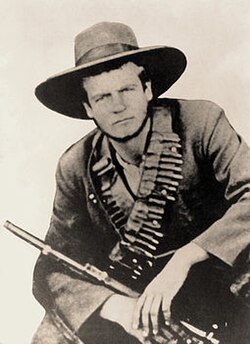
Deneys Reitz (3 April 1882 – 19 October 1944), was a South African soldier, author, adventurer and statesman. Best known as the author of Commando (1929), which detailed his experience in the Second Boer War, he also fought against the Maritz rebellion, and in the First World War in Africa and Europe. In the 1920s he began a decades-long political career included multiple ministerial portfolios, culminated in the office of Deputy Prime Minister under Jan Smuts. A lawyer by trade, his eponymous firm Deneys Reitz Inc went on to become one of South Africa’s leading firms. Reitz died in office in 1944 as South African High Commissioner to the United Kingdom.
The son of Orange Free State President Francis William Reitz, Reitz fought as a Boer commando for the duration of the Second Boer War, including as a bittereinder under General Jan Smuts in the Cape Colony. After the war, he refused to sign an oath of allegiance to Britain, and followed his father into exile. After a difficult period in French Madagascar, Reitz returned to South Africa at the urging of Smuts, settling in Heilbron as a lawyer. Under Smuts’ tutelage he accepted the new Union of South Africa and reconciled himself to its membership of the British Empire. At the start of the First World War, he took up arms to lead local pro-government forces in the suppression of the Maritz rebellion. Reitz then served with the South African Army in the South West Africa and East African campaigns, before joining the British Army in order to fight on the Western Front. Wounded twice in the trenches, he was mentioned in dispatches and finished the war in command of the 1st Royal Scots Fusiliers. On returning to South Africa he commenced a political career, holding various portfolios in both the South African Party Government of 1921-1924 and in the United Party Government from 1933-1942. As Minister for Lands he helped lay the groundwork for establishing the Kruger National Park, and later served as one of its first Trustees. Outside of politics, he published Commando (1929), Trekking On (1933) and No Outspan (1943), and undertook expeditions to the Kalahari, Kaokoveld, the Belgian Congo and Angola. His political career culminated in serving as Deputy Prime Minister under Smuts, in which capacity he represented South Africa at the Dominions war conference of 1939. Reitz was appointed South African High Commissioner to the United Kingdom in 1942, and would die in office in 1944.
Early life and education
[edit]
Deneys Reitz was born in 1882 in Bloemfontein to Francis William Reitz, and Blanka Thesen (1854–1887), as the middle child of five sons. His father came from a Cape Dutch family who had seen in South Africa since 1791, while his mother was Norweigan.[1] Reitz spoke both Afrikaans and English at home, and also learnt Dutch, English French and German.[2] Reitz described his childhood as:
[…] a Tom-Saywerlike existence such as falls to the lot of few boys nowadays. We learned to ride, shoot, and swim almost as soon as we could walk, and there was a string of hard Basuto ponies in the stables, on which were were often away for weeks at a time, riding over the game-covered plains by day, and sleeping under the stars at night, hunting, fishing and camping to our heart’s content, and clattering home again when we had had our fill.[3]
Reitz Snr. became State President of the Orange Free State in 1885, and in this capacity toured Europe in 1894, which Reitz accompanied, meeting the Queen Wilhelmina of the Netherlands, the French President, King Leopold II and Sir George Grey.[4] In the Free State, through his father Reitz also met key personalities of the time, including Paul Kruger, Piet Joubert and Cecil Rhodes, who Reitz remembered cracking jokes with him and his brothers.[5]
In 1895 Reitz’s father fell ill and the family left the Free State for the Cape Colony, living at Claremont.[6] After recovering, his father he took office as the State Secretary of the South African Republic in 1898, moving Reitz back to Bloemfontein.[7]
Reitz was educated at Wynberg Boys’ High School in Cape Town in the and Grey College in Bloemfontein.[8]
Reitz fought for the entire duration of the Boer War, and participated in almost all of its key events, including the Siege of Ladysmith, Spion Kop, the fall of Pretoria, retreat eastwards to Waterval Onder, and the bittereinder guerrilla campaign.[9] At the end of the war he accompanied Jan Smuts to peace negotiations which culminated in the at Treaty of Vereeniging. He served under most of the key Boer generals, including Smuts, de la Ray, Botha and Joubert.[9] Reitz documented his experience in the book Commando, originally written in Afrikaans in 1904 and published in English in 1929.[10] Compared to the original manuscript, the published text has a few amendment to remove or temper unflattering references to British leaders, in line with the South African Party’s policy of reconciling Dutch- and English-speaking people into a single South African identity.[11] The book for many years been regarded as one of the best narratives of war and adventure in the English language.[12] In its day it earned Reitz some celebrity, with George Bernard Shaw and the Prince of Wales requesting meetings with Reitz to discuss the book, while King George V told Reitz he had a copy at his bedside.[13] Commando remains one of the key primary sources for the Boer War and is frequently cited by historians, particularly in the English language; in many cases comments attributed to ‘a Boer’ are actually Reitz’s.[14]
Outbreak of war and invasion of Natal
[edit]

As the storm-clouds of war gathered, the 17 year old Reitz sought to join up, but the Field-Cornet’s office said he was too young to fight and refused to enlist him.[15] He met with his father and the President of the Transvaal, Paul Kruger, receiving personal authorisation from the later to join Boer forces.[15] Kruger took him straight to the room of the Commandant-General Piet Joubert, who personally handed Reitz a new Mauser carbine and a bandolier of ammunition.[15] After bidding farewell to their father and receiving the blessing of the President, Reitz and one of his brothers then entrained with Boer forces “by virtue of having thrown our belongings through a carriage window and climbing aboard”.[16]
On October 11th, 1899, the ultimatum Reitz’s father had signed expired, and the Boer republics declared war on the British Empire. During the initial phase of the War, Reitz fought in a corporalship led by Isaac Malherbe in the Pretoria Commando.[17] He first saw action at the Battle of Talana Hill near Dundee, where he was disappointed to realise the British Army wore modern khaki rather than their traditional scarlet uniforms.[18]
Reitz then joined in the Siege of Ladysmith, before being called back to Pretoria to give evidence is legal case. Reitz visited his father, with whom he first met Winston Churchill, then a Prisoner of War. Reitz reported that when Churchill protested his imprisonment on the grounds that he was a non-combatant journalist, the State Secretary said he has invalidated this status by carrying a revolver. When Churchill claimed that in the Sudan all journalists had carried a side arm for protection, Reitz’s father took a dim view of the implication that the Boers might harm an unarmed non-combatant.[19]
On his return to Ladysmith Reitz he fought in the engagement at Surprise Hill (Vaalkop) and the Battle of Wagon Hill.[20][21] Reitz was given leave to return to Pretoria, but on arrival his father urged him to return to the front as he had received word of an impending British blow at the Tugela.[22] Reitz fought in the bloody Boer victory at Spionkop, and subsequently against the successful British crossing of the river in the Battle of the Tugela Heights.[23] This victory allowed to the British relieve Ladysmith, and Reitz retreated to a new defensive line across the Biggarsberg, under General Botha.[24] Hearing word of Field Marshall Roberts breakthrough and march on Bloemfontein, Reitz and three of his brothers decided to defend their own country, and left for the Orange Free State, via Pretoria and Johannesburg.[25]
Retreat and turn to guerrilla warfare
[edit]
Reitz arrived in the Free state after Roberts had captured Bloemfontein.[25] He joined a new unit, the ‘Afrikander Cavalry Corps’ or ACC, and engaged in a long and drawn-out fighting retreat in the face of relentless British advance.[25] After a making brief stand at the Vet River, the Boer forces suffered a sharp defeat and Reitz was separated from the ACC. He fell in with a band of stragglers retreating towards Kroonstad, where an address from President Steyn inspired him to return to confront the advancing British once more.[25] Reitz reunited with his brothers Arnt and Hjalmar along with the survivors of the ACC, and then was sent to join a force of scouts, under Captain Daniel Theron, to screen the British forces, now in occupation of Kroonstad.[25]
Unable to withstand the British in set-piece warfare, the Boer retreat continued to Johannesburg.[26] Although many burghers considered the war lost, Reitz and his brothers were determined to fight on and rode on to Pretoria in search of their father and the Transvaal Government, but found it abandoned.[26] Leaving Pretoria the day before the British arrived, Reitz encountered Jan Smuts, a member of the Government in his capacity as State Attorney.[26] Smuts announced his intention to fight on as a guerilla bittereinder, and directed Reitz to Machadodorp, where his father and President Kruger has established a new provisional capital.[26] After receiving his father’s encouragement to fight on, Reitz fell in with the German Corps then led by Austrian Baron Anton von Goldeck.[26] With this new unit Reitz rode back west, skirmishing with British forces near Pretoria before finding General Botha near Bronkhorstspruit.[27] Botha was concentrating commandos still in the field into a new force, and the new arrivals included the remnants of the Pretoria Commando, which Reitz rejoined, leaving his brother Hjalmar with the German Corps.[27]
Under Botha’s command Reitz fought at one of the last set-piece battles of the war, the Diamond Hill, witnessing the earthquake that struck during the fighting.[27] Forced to reatreat, the Boers were pushed east once more, descending from the Highveld along the Pretoria-Delagoa Bay railway, into the low country.[27] A Basuto pony which Reitz had had with him since the before the war was killed by a collision with one of the trains.[27] At length Reitz reached the Crocodile River on the Portuguese border where Botha’s forces took the decision to fight on as bittereinder commandos on the open veld:
General Botha now got everything ready. Surplus guns were destroyed or thrown into the Crocodile River, and the sick and wounded were sent over the Portuguese border, while such stores as had been accumulated were distributed among the men or else burnt. Then, on a morning early in September he led the way into the uncharted bush to begin a new phase of the war.[27]
Guerilla war in the Transvaal and Free State
[edit]
Reitz broke out from British encirclement by riding north, through the area that later became the Kruger National Park, passing through Lydenburg before reaching Warm Baths where General Beyers has established a temporary base of operations. Beyers’ force joined with a commando led by de la Rey and under this joint commando Reitz fought at Nooitgedacht where the Boers captured a British camp from General Clements. This allowed the Boers to re-equip, as Reitz reports:
Here we remained for several days, during which time my brother and I enjoyed high living, after the straight diet of meat and maize on which we had subsisted for so long. We were refitted from head to heel, we carried a Lee-Metford rifle apiece, in lieu of our discarded Mausers, and above all we were well found in horseflesh.
Reitz ranged widely over the Transvaal and Free State, fighting regular skirmishes with pursuing British forces. He reports how the commandos lived off the land, shooting game for biltong, relying on feral horses for re-mounts and at times reduced to scavenging bullets fallen from the bandoliers of British soldiers on the march. After losing many horses to African horse sickness, the units began to disperse. In an abandoned farmhouse Reitz found a newspaper which mentioned a Boer commando raiding in the Cape Colony, and decided to set out on foot to join them, with a band of like minded bittereinders. After fashioning a wagon from the spare parts of a burnt out British convoy, Reitz’s party encountered a laager in the charge of de la Rey. De la Rey had with him the ‘prophet’ Siener van Rensburg and was firmly under his sway, although Reitz himself expressed skepticism of Rensburg’s supernatural powers. During his time with de la Rey, Reitz received his only serious wound of the war, a broken leg; self inflected in an attempt to smash firewood with a heavy stone. At length the commando was joined by the remnants of the German Corps, who provided Reitz with a new horse, and agreed to join him on his quest into the Cape Colony.
After various adventures the Germans wished to remain in the Boer territories, so Reitz continued with a single companion, Jacobus Bosman. They came across a commando led by General Hertzog, and were joined by a troop calling themselves the ‘Rijk Section’ who also wished to join the raid into the Cape Colony.
Smuts’ raid into the Cape Colony
[edit]
After several scrapes evading the British blockhouse system, Reitz and the ‘Rijk Section’ eventually joined up with Smuts’ force near Zastron, and crossed the Orange River into the Cape Colony. Smuts appointed Reitz and the ‘Rijk Section’ to serve as his scouts.
Smuts’ force faced immense difficulties, almost immediately falling under attack from Basotho warriors, before being harried by British columns. Driven into the difficult upland country of the Stormberg by their pursuers, they suffered from severely from the winter climate, losing men and horses to the cold and wet. Reitz reports that he was reduced to wearing a sack for clothing, and footwraps fashioned from a blanket. The commando received some support from local Dutch-speaking farmers, who provided some food and shelter. A British military embargo meant they had little clothing to spare, but a friendly farmer’s wife did furnish Reitz with a pair of elasticated Jodhpur boots to replace his footwraps.
After successfully evading interception on the escarpment, the commando descended into lower country, and managed to stop a mail train. Still harried by encircling British forces, the commando was denied the shelter of farmhouses and left adrift on the open veld. Reitz writes:
The night that followed was the most terrible of all. Our guide lost his way; we went floundering ankle-deep in mud and water, our poor weakened horses stumbling and slipping at every turn; the rain beat down on us, and the cold was awful. Towards midnight it began to sleet. The grain-bag which I wore froze solid on my body, like a coat of mail, and I believe that if we had not kept moving every one of us would have died.
We had known two years of war, but we came nearer to despair that night than I care to remember. Hour after hour we groped our way, with men groaning who had never before uttered a word of complaint, as the cold searched their ill-protected bodies. We lost fourteen men that night, and I do not know whether they survived, but we never again had word of them.
Battle of Elands River
[edit]
On 17 September 1901, Smuts’ commando encountered the 17th Lancers in the vicinity of Tarkastad. Smuts realised that the Lancers’ camp was their one opportunity to re-equip themselves with horses, food and clothing. Reitz himself only had two bullets left. A fierce fight, subsequently to be known as the Battle of Elands River, took place, with the Lancers being caught in a cross-fire and suffering heavy casualties. Reitz played a key role in the attack, outflanking and silencing the gun of the Royal Garrison Artillery. Stunned by the onslaught, the remaining Lancers put up a white flag. Reitz encountered Captain Sandeman, the Lancers’ commander, and his lieutenant Lord Vivian among the wounded.[28]
In his book Commando, Reitz recounts how Lord Vivian pointed out his bivouac tent and told him it would be worth his while to take a look at it. Soon, Reitz, who that morning had been wearing a grain-bag, riding a foundered horse, and carrying an old Gewehr 1888 rifle with only two rounds of ammunition left, was dressed in a cavalry tunic and riding breeches, with a superb mount, a Lee-Metford sporting rifle, and full bandoliers.[29] Reitz reports that he met Lord Vivian again in London in 1935, on excellent terms, and again in 1939 whilst in Britain on an official trip as Deputy Prime Minister of South Africa.[30][31]
Thomas Pakenham, in his introduction to the 1983 Jonathan Ball edition of Commando, reports a more elaborate story. In this touching account, Vivian overcomes Reitz’s reluctance to take Vivian’s possessions, and presents Reitz’s original rifle to him in London in 1943.[32] As Vivian died in 1940 this is impossible, although Pakenham may have simply got the year wrong, as Reitz did meet Lord Vivian again during his 1939 trip.[33][34]
Across the Karoo and Swartberg
[edit]
Following the victory at Elands river the commando was now well-equipped. Reitz, wearing Lord Vivian’s Lancers uniform as a trophy, fought with Smuts’ forces as they evaded the ever encircling British columns. Unbeknownst to the Boers, Lord Kitchener had given orders for Boers found wearing British uniforms to be shot, and Reitz came close to being captured several times. In Commando he reports witnessing an incident when Boers, confronted by a British force actually claimed to be the 17th Lancers, and reported that Kitchener later cited his exact incident in his justification of the execution order.
Reitz and his comrades were given ready food and shelter by Cape Dutch families as well as foisting themselves on less willing English-speaking farmers. From these visits he learnt of the uniform order and discovered that several of his bittereinder comrades had been executed for impersonating British soldiers.
Smuts forces moved generally westward, crossing the Karoo desert and Swartberg mountains, before heading into Namakwaland with the intent of capturing a town to use as a base of operations. Reitz reports that some of Smuts’ forces raided deep enough into the Cape Colony to come in sight of Table Mountain.
Capture of Concordia and Siege of Okiep
[edit]
Reitz fought in the capture of Springbok, personally doing using stick of dynamite as improvised grenades to attack the surrounding blockhouse forts. After the commando captured neighbouring Concordia, Smuts dispatched Reitz on a mission to demand the surrender of Okiep, Northern Cape, the largest of the three mining towns in the area. Okiep was held by men of the 5th Royal Warwickshire Regiment, who mocked the demand: “Surrender! Surrender be damned; we’re Brummagem boys, we’re waiting for ye!”. An officer also abused Reitz, as he reports in Commando:
As we sat on our horses, an infuriated officer rushed up from the next block-house, and violently abused us. He was an officer, but no gentleman, for he blustered and swore, and at the point of his revolver ordered us to put up our hands, while he went through our pockets. […] He was the most disagreeable, in fact the only disagreeable, Englishman whom I met in the war, for, with this one exception, I had no unpleasant word from officer or private in all the time that we were out against them.
Unable to take the town, the Commando settled into a loose siege, controlling the surrounding countryside. The siege was still ongoing when word came from British lines of a truce with an invitation for Jan Smuts to attend a peace conference.
Smuts selected Reitz to accompany him along with P.S. Krige, and they passed through British lines to Port Nolloth. Originally having mistakenly designated himself as Smuts’ batman, Reitz was billeted along with British enlisted troops. When the British realised he was the son of President Reitz and served as Smuts de facto chief of staff, they ‘promoted’ him to officer status, affording him a grander level of hospitality. After reaching the Cape they stayed aboard HMS Monarch before travelling to Kronstadt for the peace negotiations.
Treaty of Vereenigen
[edit]
Reitz formed part of the negotiating delegation from his commando, given passage to meet the delegates from the other commandos still in the field. He reports that:
Nothing could have proved more clearly how nearly the Boer cause was spent than these starving, ragged men clad in skins or sacking, their bodies covered in sores, from lack of salt or food, and their appearance was a great shock to us, who came from the better-conditioned forces in the Cape.[35]
Reitz’s father was among the signatories of the surrender, but only in his official capacity; he refused to sign himself and was given two weeks to settle his affairs in Pretoria before leaving the country. Deneys felt that he had to stand by his father and so also refused to sign.[36]
Exile and Return to South Africa
[edit]
Reitz shipped into exile with his father and one/two of this brothers. They initially travelled to Europe, where exiled Boers were considered a welcome novelty. Whilst his father chose to go to America, Reitz and his brother preferred an adventurous life in Madagascar.
A well-meaning but misinterpreted missive from [some important french french guy] meant that the French officialdom in Madagascar expected a a large band of boers to arrive, led by senior generals. Reitz was worried about being an embarrassing disappointment. Instead the frnehc forces were amused by the mishap and considered the small band of Boers and amusing novelty.
Reitz was sent into the interior on a exploring mission, and fell in with Manie Maritz, who was serving as an land purchase agent of the eccentric French millionaire Jacques Lebaudy.[37] Reitz befriended several Madagascans and had difficulty navigating these friendships and Maritz’s racist views. Reitz attempted to establish an ox transport exercise and Maritz helped him tame semi-wild oxen.[38] After “quote about awful conditions” the transport enterprise failed when Reitz’ customers failed to pay and he was hit by a large tax bill. At this time a letter came from Mrs Smuts urging him to return to South Africa. With his health failing from repeated bouts of fever, he decided to quit Madagascar and travel to his father in Texas in order to get his blessing to return to South Afirca now that it was British run.
Return to South Africa
[edit]
He got on a steamer but with his health in a perilous state and facing abuse from his crewmates, he decided to return straight to South Africa, via Delagoa Bay. Here he found that he could not land unless he had a passport – which being a de facto stateless exile he did not – or a sum of £25. Eventually a fellow South African took pity on him and gave him the money. Reitz took the train to Pretoria, and in a perilously weak state collapsed there in a public park. Members of the public came to his succour and took him to the house of Jan Smuts.
He was taken in and nbrused back to health for years. Trained as a lawer.
New life in Heilbronn
[edit]
lawyering
Maritz Rebellion and First World War
[edit]
gg
one
East African Campaign
[edit]
Two
Royal Scots Fusiliers
In Government 1921-24
[edit]
One two three
Out of Government 1924-1933
[edit]
United Party (Hertzog 4)
[edit]
United Party (Smuts 3
[edit]
Deputy Prime Minister
[edit]
etc
London.
Went to Glasgow and there are pictures.
During this time he lived at Bedwell End in Essendon, Hertfordshire.[39]
The town of Deneysville in the Free State is named after Reitz.[40] The town was founded in 1936 next to a dam on the Vaal River Reitz had built during his tenure as Minister for Lands and Irrigation.[40]
His eponymous law firm, Deneys Reitz Inc., went on to to become one of the leading firms in South Africa, before it merged with Norton Rose Fulbright in 2011.[41] In November 2025 it was announced that the South African arm of the firm would split into a separate business from March 31 2026.[41]
Reitz was mentioned in dispatches in the First World War and twice offered the Distinguished Service Order.[11] The first time had to refused due to his family’s opposition to his fighting in the British Army, and the second time due to South African legislation prohibiting the acceptance of foreign titles.[11]
Reitz helped to establish the Kruger National Park and develop it for tourists as one of its first trustees. A plaque near Balule on the Olifants River commemorates his involvement.[42]
Other parks – elephant reserve in the Cape. I swear there was one for Springboks too. and the hippo lake on the east coast in zululand.
Kruger – and others.
Commando.
In 1920 Reitz he married Leila Agnes Buissiné Wright (Cape Town, 13 December 1887 – Cape Town, 29 December 1959). She was a social reformer, an outspoken advocate of women’s rights and suffrage for women, and the first woman member of the Assembly (representative for Parktown in Johannesburg, 1933–1944). They had two sons:
- Jan “John” Deneys Reitz (5 December 1920 – 14 February 2003). He married Helen Winifred Hotson on 3 November 1945, and had issue. As a boy he lost a hand and an eye in an explosives accident.[43]
- Claude Michael Deneys Reitz (2 March 1923 – 2 September 1952). Known as Michael, he took a BA at University of Cambridge, and served as Lieutenant in the South African Air Force. He died in a aircraft collision near Barberton, and his commemorated alongside his parents at Mariepskop.[44]
In 1935 Reitz bought a farm near to Mariepskop, along with some land on the hill. He had intended to retire there, but died suddenly from a cerebral embolism in 1944 whilst serving as the South African High Commissioner in Britain.[45][46] He described the area as:
[…] a piece of land more beautiful, in my eyes, than anything in the country. It has a crystal clear mountain torrent of its own, it has flower-carpeted forests and from the rim one looks down a mighty gorge and almost the whole of the Low Country lies stretched beyond.[47]
Reitz funeral memorial is located south of Mariepskop, approximately 10 km (6.2 mi) east of the Blyde River Canyon in Mpumalanga, alongside those of his wife and younger son Michael.[48]
- ^ Reitz, Deneys (1999). Emslie, Trevor (ed.). Adrift on the Open Veld. Cape Town: Stormberg. pp. 561–562. ISBN 978-0-6202-4380-3.
- ^ Meredith, Martin (2017). Afrikaner Odyssey: The Life and Times of the Reitz Family (Kindle edition ed.). Johannesburg: Jonathan Ball. p. 44.
- ^ Reitz, Deneys (1999). Emslie, Trevor (ed.). Adrift on the Open Veld. Cape Town: Stormberg. p. 1. ISBN 978-0-6202-4380-3.
- ^ Reitz, Deneys (1999). Emslie, Trevor (ed.). Adrift on the Open Veld. Cape Town: Stormberg. pp. 1–2. ISBN 978-0-6202-4380-3.
- ^ Reitz, Deneys (1999). Emslie, Trevor (ed.). Adrift on the Open Veld. Cape Town: Stormberg. p. 2. ISBN 978-0-6202-4380-3.
- ^ Reitz, Deneys (1999). Emslie, Trevor (ed.). Adrift on the Open Veld. Cape Town: Stormberg. p. 3. ISBN 978-0-6202-4380-3.
- ^ Moll, ‘Reitz, Francis William’, 598.
- ^ “A classic in context: a historian on literary commando”. Business Day. 2024-07-16. Retrieved 2025-12-08.
- ^ a b Reitz, Deneys; Emslie, Trevor (1999). Adrift on the open veld: the Anglo-Boer War and its aftermath, 1899-1943. Cape Town, South Africa: Stormberg. ISBN 978-0-620-24380-3.
- ^ Reitz, Deneys (1929). Commando. London: Faber and Faber.
- ^ a b c Yuill, David. “Deneys Reitz: “South African First, Dutchman Second” – A Case Study of the Evolution of South African Identity in South Africa in the First Half of the Twentieth Century”. Digital Access to Scholarship at Harvard. Harvard University. p. 163. Retrieved 24 November 2025. Cite error: Unknown parameter “p.” in
<ref>tag; supported parameters are dir, follow, group, name (see the help page). - ^ A Theory Of Civilization
- ^ Reitz, Deneys (1999). Emslie, Trevor (ed.). Adrift on the Open Veld. Cape Town: Stormberg. pp. 706, 740. ISBN 978-0-6202-4380-3.
- ^ Pakenham, Thomas (1992). The Boer War (1st Avon Books trade printing Dec. 1992 ed.). New York: Avon. p. 556. ISBN 978-0-380-72001-9.
- ^ a b c Reitz, Deneys (1999). Emslie, Trevor (ed.). Adrift on the Open Veld. Cape Town: Stormberg. p. 6. ISBN 978-0-6202-4380-3.
- ^ Reitz, Deneys (1999). Emslie, Trevor (ed.). Adrift on the Open Veld. Cape Town: Stormberg. p. 8. ISBN 978-0-6202-4380-3.
- ^ Reitz, Deneys (1999). Emslie, Trevor (ed.). Adrift on the Open Veld. Cape Town: Stormberg. p. 12. ISBN 978-0-6202-4380-3.
- ^ Reitz, Deneys (1999). Emslie, Trevor (ed.). Adrift on the Open Veld. Cape Town: Stormberg. p. 19. ISBN 978-0-6202-4380-3.
- ^ Reitz, Deneys (1999). Emslie, Trevor (ed.). Adrift on the Open Veld. Cape Town: Stormberg. p. 34. ISBN 978-0-6202-4380-3.
- ^ erica (2013-07-15). “Rifle Brigade Monument at Surprise Hill | Battlefields Route”. Retrieved 2025-12-20.
- ^ Reitz, Deneys (1999). Emslie, Trevor (ed.). Adrift on the Open Veld. Cape Town: Stormberg. p. 47. ISBN 978-0-6202-4380-3.
- ^ Reitz, Deneys (1999). Emslie, Trevor (ed.). Adrift on the Open Veld. Cape Town: Stormberg. p. 52. ISBN 978-0-6202-4380-3.
- ^ Reitz, Deneys (1999). Emslie, Trevor (ed.). Adrift on the Open Veld. Cape Town: Stormberg. pp. 56–68. ISBN 978-0-6202-4380-3.
- ^ Reitz, Deneys (1999). Emslie, Trevor (ed.). Adrift on the Open Veld. Cape Town: Stormberg. p. 71. ISBN 978-0-6202-4380-3.
- ^ a b c d e Reitz, Deneys (1999). “A Campaign in the Free State”. In Emslie, Trevor (ed.). Adrift on the Open Veld. Cape Town: Stormberg. ISBN 978-0-6202-4380-3.
- ^ a b c d e Reitz, Deneys (1999). “The British Invade the Transvaal”. In Emslie, Trevor (ed.). Adrift on the Open Veld. Cape Town: Stormberg. ISBN 978-0-6202-4380-3.
- ^ a b c d e f Reitz, Deneys (1999). “Farther Afield”. In Emslie, Trevor (ed.). Adrift on the Open Veld. Cape Town: Stormberg. ISBN 978-0-6202-4380-3.
- ^ Reitz, Deneys; JC Smuts (2008). Commando: A Boer Journal of the Boer War. CruGuru. p. 336. ISBN 978-1-920265-68-7.
- ^ Commando. Deneys Reitz. London 1929. No ISBN
- ^ No Outspan. Deneys Reitz. Faber and Faber, London, 1943. No ISBN.
- ^ Reitz, Deneys (1999). Emslie, Trevor (ed.). Adrift on the Open Veld. Cape Town: Stormberg. p. 802. ISBN 978-0-6202-4380-3.
- ^ Shearing, Taffy; David Shearing (2000). General Smuts and his long ride. Sedgefield: Anglo-Boer War Commemoration Cape Commando Series No 3. p. 248. ISBN 0-620-26750-X.
- ^ Smith, RW (June 2004). “Modderfontein 17 September 1901”. Military History Journal. 13 (1). Johannesburg: South African Military History Society. SA. Retrieved 30 April 2009.
- ^ Reitz, Deneys (1999). Emslie, Trevor (ed.). Adrift on the Open Veld. Cape Town: Stormberg. p. 802. ISBN 978-0-6202-4380-3.
- ^ Reitz, Deneys (1999). Emslie, Trevor (ed.). Adrift on the Open Veld. Cape Town: Stormberg. pp. 268–269. ISBN 978-0-6202-4380-3.
- ^ Reitz, Deneys (1999). Emslie, Trevor (ed.). Adrift on the Open Veld. Cape Town: Stormberg. p. 271. ISBN 978-0-6202-4380-3.
- ^ Deneys, Reitz (1999). Adrift on the Open Veld (Fourth ed.). Stormberg Publishers. pp. 298–299. ISBN 0-620-24380-5.
- ^ Deneys, Reitz (1999). Adrift on the Open Veld (Fourth ed.). Stormberg Publishers. p. 302. ISBN 0-620-24380-5.
- ^ “No. 37150”. The London Gazette. 26 June 1945. p. 3361.
- ^ a b Raper, R.E. Dictionary of Southern African Place Names. Human Science Research Council of South Africa.
- ^ a b “Norton Rose Fulbright and South Africa arm to split”. www.globallegalpost.com. Retrieved 2025-12-17.
- ^ “Kruger National Park: The Past Colour Bar, South Africa”. southafrica.co.za. Retrieved 2025-12-17.
- ^ Reitz, Deneys (1999). Emslie, Trevor (ed.). Adrift on the Open Veld. Cape Town: Stormberg. p. 742. ISBN 978-0-6202-4380-3.
- ^ “In Memory Of Reitz, Claude Michael Deneys”. South Africa War Graves Project. Retrieved 27 November 2025.
- ^ Rowe, Christine. “Heritage Management Of Archaeological, Historical and Industrial Resources on the Blyde River Canyon Nature Reserve”. UPSpace Institutional Repository. University of Pretoria. p. 43. Retrieved 23 November 2025.
- ^ Yuill, David. “Deneys Reitz: “South African First, Dutchman Second” – A Case Study of the Evolution of South African Identity in South Africa in the First Half of the Twentieth Century”. Digital Access to Scholarship at Harvard. Harvard University. p. 2. Retrieved 24 November 2025.
- ^ Reitz, Deneys (1999). Emslie, Trevor (ed.). Adrift on the Open Veld. Cape Town: Stormberg. p. 737. ISBN 978-0-6202-4380-3.
- ^ “Mpumalanga, PILGRIM’S REST district, Mariepskop, Glenlyden 424 KT, Deneys Reitz Memorial”. eGGSA graves. Retrieved 27 November 2025.



