
== History ==
== History ==
Toronto municipal ward boundaries were significantly modified in 2018, passing through three models (44-ward, 47-ward, and 25-ward). Ultimately, for the purposes of administering the 2018 election, the 25-ward structure was used and later upheld by the Supreme Court of Canada in 2021.
Toronto municipal ward boundaries were significantly modified in 2018, passing through three models (44-ward, 47-ward, and 25-ward). Ultimately, for the purposes of administering the 2018 election, the 25-ward structure was used and later upheld by the Supreme Court of Canada in 2021.
From 2014 to 2017, the City of Toronto engaged in a ward boundary review<ref>{{Cite web |title=City of Toronto Ward Boundary Review |url=https://www.toronto.ca/city-government/accountability-operations-customer-service/city-administration/city-managers-office/ward-boundaries-for-toronto/}}</ref> evaluating the City’s previous [https://www.toronto.ca/city-government/data-research-maps/neighbourhoods-communities/ward-profiles/44-ward-model/ 44-ward model].
From 2014 to 2017, the City of Toronto engaged in a ward boundary review<ref>{{Cite web |title=City of Toronto Ward Boundary Review |url=https://www.toronto.ca/city-government/accountability-operations-customer-service/city-administration/city-managers-office/ward-boundaries-for-toronto/}}</ref> evaluating the City’s previous https://www.toronto.ca/city-government/data-research-maps/neighbourhoods-communities/ward-profiles/44-ward-model/
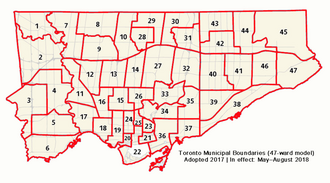
Based on this, and in preparation for the 2018 municipal election, the City of Toronto added 3 new wards to create a [https://www.toronto.ca/city-government/data-research-maps/neighbourhoods-communities/ward-profiles/47-ward-model/ 47-ward]. This model was in effect at the opening of the 2018 municipal election.
Based on this, and in preparation for the 2018 municipal election, Toronto added new wards to create a https://www.toronto.ca/city-government/data-research-maps/neighbourhoods-communities/ward-profiles/47-ward-model/ This model was in effect at the opening of the 2018 municipal election.
The 2018 Toronto municipal election ran from May 1, 2018 to October 22, 2018, and while underway<ref>{{Cite web |title=How would Ontario’s plan to change Toronto politics work? An explainer |url=https://www.cbc.ca/news/politics/explainer-toronto-city-council-cut-1.4765227}}</ref> the provincial government introduced the Better Local Government Act, 2018, S.O. 2018, c. 11 – Bill 5. The act was assented to on August 14, 2018.<ref name=”:0“>{{Cite web |title=Better Local Government Act, 2018, S.O. 2018, c. 11 – Bill 5 |url=https://www.ontario.ca/laws/statute/s18011}}</ref>
The 2018 Toronto municipal election ran from May 1 to October 22, 2018, and while underway<ref>{{Cite web |title=How would Ontario’s plan to change Toronto politics work? An explainer |url=https://www.cbc.ca/news/politics/explainer-toronto-city-council-cut-1.4765227}}</ref> the provincial government introduced the Better Local Government Act, 2018. The act was assented to on August 14, 2018.<ref name=””>{{Cite web |title=Better Local Government Act, 2018, S.O. 2018, c. 11 – Bill 5 |url=https://www.ontario.ca/laws/statute/s18011}}</ref>
The immediate effect of this act was to eliminate all previous ward models, and replace them with a [https://www.toronto.ca/city-government/data-research-maps/neighbourhoods-communities/ward-profiles/ 25-ward model] designed to align with the [[Electoral district (Canada)|provincial and federal ridings]] boundaries in effect at that time.<ref>{{Cite news |last=Bronskill |first=Jim |date=2021-03-10 |title=City of Toronto tells Supreme Court that Doug Ford’s government disrupted democracy by slashing council during election |language=en-CA |work=The Globe and Mail |url=https://www.theglobeandmail.com/canada/toronto/article-city-of-toronto-tells-supreme-court-that-doug-fords-government/ |url-status=live |access-date=2021-11-19 |archive-url=https://web.archive.org/web/20211119081150/https://www.theglobeandmail.com/canada/toronto/article-city-of-toronto-tells-supreme-court-that-doug-fords-government/ |archive-date=2021-11-19}}</ref>
The act all previous ward models and them with a 25-ward designed to align with provincial and federal boundaries.<ref>{{Cite news |last=Bronskill |first=Jim |date=2021-03-10 |title=City of Toronto tells Supreme Court that Doug Ford’s government disrupted democracy by slashing council during election |url=https://www.theglobeandmail.com/canada/toronto/article-city-of-toronto-tells-supreme-court-that-doug-fords-government/ |archive-url=https://web.archive.org/web/20211119081150/https://www.theglobeandmail.com/canada/toronto/article-city-of-toronto-tells-supreme-court-that-doug-fords-government/ |archive-date=2021-11-19}}</ref>
The timing of the boundary change was controversial, and the [[Toronto (City) v Ontario (Attorney General)|City of Toronto sued the province]] contesting the provisions’ constitutionality. In the absence of an injunction, and with the pending threat of the province invoking the [[Section 33 of the Canadian Charter of Rights and Freedoms|notwithstanding clause]]<ref>{{Cite web |title=Premier Doug Ford to use notwithstanding clause to cut size of Toronto city council |url=https://www.cbc.ca/news/canada/toronto/judge-ruling-city-council-bill-election-1.4816664}}</ref> which would defeat any constitutional challenge, the election continued under the 25-ward model.<ref>{{Cite web |title=With Toronto city council slashed to 25 wards, attention turns to governing – Toronto {{!}} Globalnews.ca |url=https://globalnews.ca/news/4583063/toronto-city-council-25-wards-governance/ |access-date=2025-10-26 |website=Global News |language=en-US}}</ref>
The timing of the boundary change was controversial, and the City of Toronto sued the province contesting the constitutionality.<ref>{{Cite web |title=Premier Doug Ford to use notwithstanding clause to cut size of Toronto city council |url=https://www.cbc.ca/news/canada/toronto/judge-ruling-city-council-bill-election-1.4816664}}</ref> , the election continued under the 25-ward model.<ref>{{Cite web |title=With Toronto city council slashed to 25 wards, attention turns to governing |url=https://globalnews.ca/news/4583063/toronto-city-council-25-wards-governance/}}</ref>
The nomination period originally scheduled to close on July 27, 2018 was extended to September 14, 2018.<ref>{{Cite web |title=Abrupt closure of city council nominations adding more confusion for candidates |url=https://www.cbc.ca/news/canada/toronto/abrupt-closure-of-city-council-nominations-adding-more-confusion-for-candidates-1.4818724}}</ref> This allowed new candidates to run, and existing candidates to either withdraw or to reassign their candidacy to a different constituency.<ref>{{Cite web |last=Toronto |first=Web Staff-CTV News |date=2018-10-19 |title=Ward by ward: A look at candidates running in a new 25-ward system |url=https://www.ctvnews.ca/toronto/article/ward-by-ward-a-look-at-candidates-running-in-a-new-25-ward-system/ |access-date=2025-10-26 |website=CTVNews |language=en}}</ref>
The nomination period originally scheduled to close on July 27, 2018 was extended to September 14, 2018.<ref>{{Cite web |title=Abrupt closure of city council nominations adding more confusion for candidates |url=https://www.cbc.ca/news/canada/toronto/abrupt-closure-of-city-council-nominations-adding-more-confusion-for-candidates-1.4818724}}</ref> This allowed new candidates to run and existing candidates to either withdraw or reassign their candidacy.<ref>{{Cite |title=Ward by ward: A look at candidates running in a new 25-ward system |url=https://www.ctvnews.ca/toronto/article/ward-by-ward-a-look-at-candidates-running-in-a-new-25-ward-system/ |date=-10-}}</ref>
== Official ward materials (2018 47-ward model) ==
== Official ward materials (2018 47-ward model) ==
Phase 1 of Toronto’s 2018 municipal election, conducted under the 47-ward model
|
Toronto Municipal Boundaries 2018 (47-ward) |
|
|
|

The 2018 Toronto municipal election operated in two distinct phases. Phase 1 (47-ward model was approved on appeal by the Ontario Municipal Board[1] and was in effect from the beginning of the election through to August 14th, 2018.
The province of Ontario ordered a change midway through the election cycle initiating a second phase (25-ward model) which ran from august through to election day. Phase 1 candidacy and campaign finance remain a matter of official public record, however it is the the results of phase 2 that decided the final composition of the 2018 -2022 Toronto City Council.
Councillor and school trustee races which relied on ward boundaries as a condition were substantially affected. Mayoral races which covered the city as a whole were administrated differently in terms of polling methods, but were otherwise less affected.
Toronto municipal ward boundaries were significantly modified in 2018, passing through three models (44-ward, 47-ward, and 25-ward). Ultimately, for the purposes of administering the 2018 election, the 25-ward structure was used and later upheld by the Supreme Court of Canada in 2021.
From 2014 to 2017, the City of Toronto engaged in a ward boundary review[2] evaluating the City’s previous 44-ward model.[3]
Based on this review, and in preparation for the 2018 municipal election, Toronto added three new wards to create a 47-ward model.[4] This model was in effect at the opening of the 2018 municipal election.
The 2018 Toronto municipal election ran from May 1 to October 22, 2018, and while it was underway[5] the provincial government introduced the Better Local Government Act, 2018. The act was assented to on August 14, 2018.[6]
The act immediately eliminated all previous ward models and replaced them with a 25-ward structure designed to align with provincial and federal riding boundaries.[7]
The timing of the boundary change was controversial, and the City of Toronto sued the province contesting the act’s constitutionality.[8] Without an injunction, and facing the possible use of the notwithstanding clause, the election continued under the new 25-ward model.[9]
The nomination period, which was originally scheduled to close on July 27, 2018, was extended to September 14, 2018.[10] This allowed new candidates to run and existing candidates to either withdraw or reassign their candidacy.[11]
In a judgment rendered on October 1, 2021,[12] the Supreme Court of Canada upheld the constitutionality of the provisions,[13] and the 25-ward model remained in effect for the 2022 Toronto municipal election.
Official ward materials (2018 47-ward model)
[edit]

