
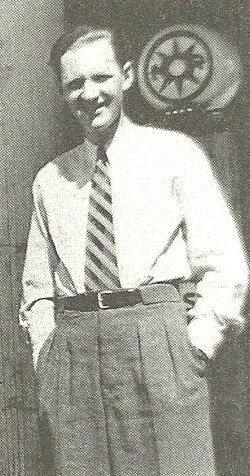
Norwegian resistance member
|
Kai Holst |
|
|---|---|

Photo of Holst taken on 22 June 1945, a few days before his death |
|
| Born |
Kai Christian Middelthon Holst 24 February 1913 |
| Died | 27 June 1945 (aged 32)[1] |
| Cause of death | Pistol bullet to head, officially suicide[3][4] but many friends and colleagues suspected murder.[4][5][6][7][8][9] |
| Body discovered | Top of stairway, apartment house, Gärdet |
| Resting place | Vestre Gravlund, Oslo |
| Nationality | Norwegian |
| Education | Secondary school, vocational school[2] |
| Occupation(s) | Seaman, fur farmer[2] |
| Known for | Resistance fighter and suspicious circumstances regarding his death |
| Spouse | Margarete Corneliussen[10][11] |
| Parent(s) | Christian and Inga Holst (born Rasmussen)[2] |
Kai Christian Middelthon Holst (1913–1945) was a Norwegian sailor and fur farmer. During World War II, he participated in the resistance movement against the German occupation of Norway. When the leadership of Milorg (a Norwegian military resistance organization) was dismantled by the German occupation forces in the autumn of 1942, he was given a central role in the organization. He was then involved in the reconstruction of the Central Leadership (SL) in Milorg together with Jens Christian Hauge (1915–2006).
Holst fled German-occupied Norway in the summer of 1943 due to the threat from the German security police, the Gestapo. He was a refugee in neutral Sweden, and supported the resistance there, until the German occupation of Norway ended with the liberation in May 1945.
Holst is known for his efforts in the Norwegian resistance on the home front, and for the circumstances surrounding his death in Stockholm. He was found shot in the head in an apartment building. The case was so widely reported in the press that three prominent former members of the Milorg leadership issued a statement in Norwegian newspapers in July 1945.
Swedish and Norwegian authorities stated suicide as the cause of death. However, Holst’s family, many of his friends and colleagues in the resistance movement believe that he was murdered, among them Jens Christian Hauge and Gunnar Sønsteby. In the post-war period, the case has been discussed at irregular intervals in newspapers, books, radio and television in Norway and Sweden.
Background
Kai Holst was born on 24 February 1913,[note 1] and was from Lillehammer. He was the son of wholesaler Christian Holst ( 1872–1919)[5] and Inga Holst, née Rasmussen (1880–1956), both originally from Stavanger. After primary school, Holst attended secondary school and a trade school in Lillehammer. A couple of years after his confirmation, he went to sea. In the years 1930–1933, he sailed on the South American Line’s MV Brageland, then for the Ditlev-Simonsen shipping company on the MV Daghill. He then went ashore and began working at a fox farm in Mesnali east of Lillehammer. Holst contracted tuberculosis (a common disease at the time, which claimed thousands of lives in Norway annually), and just before World War II he had a major operation related to bilateral pulmonary tuberculosis.[6]
From December 1944 he was married to Margarete Corneliussen (1914–1990), daughter of deputy manager of Tiedemanns Tobaksfabrik and member of the Federation of Norwegian Industries executive board Ragnar Corneliussen (1887–1938) and Monna Morgenstierne Roll (1891–1976).[7] His wife’s sister Else Corneliussen (1916–1951) was married in London in 1944 to Captain, later Major General Ole Otto Paus (1910–2003), who was then head of the army department in the group for offensive intelligence in the Norwegian military intelligence service in the Norwegian exile government in London. Upon his return to Norway in 1945, Paus was considered the Army’s leader in military intelligence, and was among three candidates to become head of the intelligence service in the much-discussed appointment of Vilhelm Evang in 1947–1948.[8] Kai Holst never met Paus, but after Holst’s death, Paus was active in trying to clarify the circumstances surrounding the death, drawing on his background as an intelligence officer.[9] Else and Ole Otto Paus were the parents of the folk singer Ole Paus (1947–2023), who also became involved in Holst’s case.[10]
Resistance work

During the German occupation of Norway (1940–1945), Kai Holst, despite his weakened health, joined the illegal resistance early on. According to his widow Margarete Holst, this happened as early as the autumn of 1940.[11] In 1941, he was recruited by his brother-in-law, the career officer Lieutenant Lars Trygve Heyerdahl-Larsen (1912–1944),[12] to the Norwegian military resistance organization Milorg. There he soon received important tasks,[13] and became known as perhaps the most action-oriented man in the Central Leadership Secretariat (SL).[note 2][14] Holst was a keen “illegalist”, aware of the risk of exposure. He always carried a gun and poison pills so that he could kill himself and not expose the organization if he was caught.[13]
Kai Holst was one of the most handsome and energetic illegalists S.L. had. He had had tuberculosis, and now had only one lung left. – It’s not that bad with me, he said. He always volunteered to take the most dangerous jobs. He later married in Sweden. His tragic death in Stockholm shortly after the capitulation is still a mystery to all his friends. He was found shot in a stairwell, as is well known.
— Norwegian resistance fighter and Supreme Court lawyer Wilhelm Münter Rolfsen[15]
From 1942 Holst worked as a courier for the resistance movement. He had close contact with well-known resistance fighters such as Ole Borge (1916–1995), known as “Big O”,[note 3] and Jens Christian Hauge, known as “Big I”.[16] According to historian Professor Tore Pryser, Holst was central to Hauge’s introduction to resistance work: “In many ways it was actually Holst who trained the inexperienced Hauge.”[17] Together with Ole Borge, he established Edderkoppen, Milorg’s covert and export service, with apartments where resistance fighters went under cover before being “exported” (helped to escape) to Sweden.[18][19]
When chemist Jomar Brun (1904–1993), a key figure in the production of Norwegian heavy water, and his wife had to flee to Sweden in 1942, it was Holst who, through Milorg’s liaison officer Salve Staubo (1900–1989), organized a covert apartment for the couple in Oslo.[13] It was also Holst who, through Staubo, recruited Milorg’s legendary weapons chief Bror With.[20]
Kai Holst was a very nice guy, and we got along well. He struggled a bit with his health, but it never hindered his work. Among other things, he had good connections to the communists, and he was very central when large parts of Milorg’s management had to flee the country in 1942. […] We had a lot of contact, and we helped each other with contacts, information and material.
— Gunnar Sønsteby about Holst
Although he never held a formal leadership position in Milorg,[12] Holst played an important role in the practical work of the organization.[12] During the operation on 22 July 1942 to free two resistance fighters who had been arrested, Jens Ropstad and Rolf Karlson, Holst, according to Gunnar Sønsteby (1918–2012), was involved as a conversationalist with his large network of contacts. Holst recommended the communist resistance fighter Asbjørn Sunde (1909–1985) for the operation, which was successful.[21] Holst played a particularly important role for Milorg in the autumn of 1942,[note 4] when several of the leaders were arrested or had to flee to Sweden.[12] Holst attended the meeting at the turn of 1942–1943, when Milorg was reorganized with Jens Christian Hauge as inspector general.[13][22]
After Michael Hansson, Arthur Hansson and Helge Motzfeldt had left [meaning that the three had to flee to Sweden], Kai Holst was actually the only vertical link between the Council and all other bodies within Milorg’s Central Management. There were no cross-border contacts between the Central Management bodies, so that everything depended on Holst during the necessary reorganization. He had daily conferences with Council member Carl Semb.
Kai Holst was given the responsibility of being the SL’s liaison officer for the four Norwegian agents from the Special Operations Executive (SOE) who participated in the so-called Operation Bittern in the autumn of 1942. The operation was intended to provide Milorg with training and support for the liquidation (murder, also referred to as premeditated murder) of dangerous individuals, such as informers for the Germans. However, the operation created bad blood between Milorg and SOE, due to a lack of British understanding of Norwegian conditions. Poor discipline among two of the four agents sent from Britain also gave a negative impression, especially the long-time criminal Johannes S. Andersen, known as Gulosten.[23]

For six months (the first half of 1943), Kai Holst worked for, and shared a flat with, Jens Christian Hauge, at Munkedamsveien 75 in Ruseløkka in Oslo.[13][16][note 5][note 6][24] Holst’s girlfriend and later wife, Margarete Corneliussen, looked after the two men and was herself deeply involved in resistance work.[25] In his report on his work during the war, Jens Christian Hauge gave a very good testimonial to “Kaka”, as Kai Holst was called, and particularly highlighted him among his co-workers.[note 7]
The SL people were all good to work with and all very helpful. I must especially mention Kaka [code name for Kai Holst] who was a great illegalist, always willing to help, full of resourcefulness and good humor.
— Jens Christian Hauge, from Report on my work during the occupation[26]
Despite his poor health, Holst worked hard and took on a number of dangerous assignments. Among other things, he had meetings with people who might have been working for the German security service.[note 8] Together with Hauge and the Hansson brothers (Arthur Mørch Hansson, and Michael S. Hansson), Holst worked to eliminate dangerous Norwegian and German agents and organized teams for this purpose.[27][28][20][note 9][note 10]
The employment service
Behind the seemingly innocent name National Labor Effort, commonly known as the Labor Service, lay a plan by the German occupiers and their Norwegian helpers to recruit Norwegian youth for socially useful work. These youth would then eventually be sent to the Eastern Front to participate in the German war of aggression against the Soviet Union.
Both through their own skepticism and through secret contacts among the German occupiers, the Milorg leadership became aware of these plans and sabotage of the Labor Service was therefore given high priority. The action against the Labor Service was also the first major break with Milorg’s previously passive line, a change that Kai Holst had been active in bringing about.[30]
Before the liquidation at Løvenskiolds gate 17 in 1943, where the Norwegian fellow runners Finn Roald Andersen and Charles Anderson were liquidated, it was Kai Holst who carried out significant parts of the preparatory work. He copied drawings of the farm, obtained weapons and contacted Asbjørn Sunde, who took on the task of liquidating it.[29]
In addition to being a liaison between the Milorg leadership and the district organizations, Holst was a contact person for groups independent of Milorg. These included SOE agent Gunnar Sønsteby,[31] the intelligence organization XU,[note 11] Asbjørn Bryhn‘s action group 2A,[14] and the communist Osvald Group (also known as the Sunde group after its leader Asbjørn Sunde).[13][14][16]
Holst played an important role in the Osvald Group’s firebombing of the Labor Service office in Pilestredet on 20 April 1943,[32][33] to which Milorg’s council reluctantly agreed.[34][35] The aim of the action was to destroy archives of young Norwegian men who had been drafted for labor service for the Nazis.[13][note 12] Due to poor security, the collaboration with the communists in the Osvald Group led to Holst being nearly captured by the German security police, the Gestapo.[36]
Escape and work in Sweden

Due to the risk of arrest by the Gestapo, Kai Holst had to flee to Sweden in the summer of 1943.[16][note 13][note 14] After first hiding on a fox farm in Mesnali, he was followed by a border guide (a member of the resistance movement who assisted refugees) across the border into neutral Sweden at Svinesund on 5 August. He was arrested on the Swedish side, and explained that he had to flee because he had had a radio illegally, had listened to news from London and spread it. He did not say anything about his work at Milorg.[37] After questioning by the Swedish authorities in Strömstad (the regional fiscal office), he was sent as a Norwegian refugee to the refugee reception centre at Kjesäter, and after further questioning there he was allowed to travel to Stockholm.[37]
In Stockholm, Holst was employed at the Norwegian legation‘s Military Office No. 4 (Mi4),[37][note 15] with offices at Skeppargatan 32[38] in Östermalm. Holst was given an important position under Hans Ringvold (1917–1999).[39] He worked with supplies for the Home Forces in Norway, and one of his tasks was to organize courier operations (secret messages and equipment) to and from Norway.[40] In the autumn of 1943, Holst, together with Sverre Ellingsen (1907–1994), a liaison officer for the Special Operations Executive (SOE), was also involved in planning the kidnapping and liquidation of the torturer and informer Henry Oliver Rinnan (1915–1947). The attack on Rinnan, led by Ole Halvorsen, failed, and led to one of the agents – Johnny Pevik – being captured by the Germans and executed.[41]
Some of Holst’s work for the resistance movement in Norway was illegal in neutral Sweden. At least once (in the spring of 1944) he was arrested by Swedish police in Charlottenberg, but was quickly released.[43] The arrest was linked to Holst’s failed attempt to organize a courier route across Magnor with the help of a locally known Swede and a Norwegian. After World War II it was revealed that the two were working for the German military intelligence service Abwehr.[43] Holst was good at organizing and obtaining equipment, and he had many contacts.[44] One of them was the Soviet ambassador Alexandra Kollontai, from whom he received several pistols.[43]
Active or passive resistance?
To understand Kai Holst’s position as a so-called activist in the Norwegian resistance movement, it is useful to know the disagreement about active or passive resistance work. The Norwegian government-in-exile in London stood for a line where Milorg should be built up for possible use at the end of the war, and not carry out sabotage actions before then.
Part of the resistance movement in Norway, however, supported various armed actions. The most activist were the Norwegian communists (after Germany’s invasion of the Soviet Union in June 1941), but also within bourgeois resistance groups (such as 2A) there was enthusiasm for sabotage and other things.[42]
In November 1944, Holst was involved in an illegal arms trafficking case, and received a warning from the Swedish Security Police.[43] During the same period, Holst was also mentioned by the Security Police in connection with an espionage case involving the Norwegian intelligence officer Finn Jacobsen (1898–1966). However, Holst could not be questioned as he had diplomatic status at the time.[45]
Finn Jacobsen worked for the British foreign intelligence service Secret Intelligence Service (SIS, known to many as MI6) and collaborated with Holst to provide the British with information about Norway. This happened on the side of the Norwegian legation, which SIS did not fully trust.[46] Holst (who was also an agent for SIS) and Jacobsen had a common lead officer at SIS, John Thomas Whistondale (1910–1993).[47] Holst was an activist and probably sympathized with the action-oriented groups in the resistance movement, such as 2A and the Osvald Group, and the so-called Idrettskontoret (later the Sambandskontoret[48]) at the legation.[43]
On December 19, 1944, Kai Holst and Margarete Corneliussen married in Stockholm.[49]
Peace and death
Raid on Lillehammer
After the German capitulation in May 1945, Kai Holst worked on dismantling the various warehouses and supply bases that Norwegian resistance forces had had on Swedish soil. In this work, he traveled back and forth between Sweden and Norway.[17] On 23 June 1945, Holst arrived in Hamar together with resistance fighter Erik Myhre (1900–1983) by car from Stockholm. From the early morning of 26 June, he was involved as an informant in raids and arrests carried out by British and Norwegian forces,[note 16] in prison camps with German military forces at Lillehammer. The purpose of the raids was to find German war criminals who had been hiding in the camps, under the guise of being ordinary soldiers.[17] It was a method that German war criminals and Gestapo employees tried in a number of Wehrmacht camps after the liberation.[note 17]
That same day he abruptly returned to Stockholm. Holst was driven by taxi from Hamar by Paul Romstad (1906–1968), a local resistance fighter and workshop owner from Hedmark.[50] On the morning of 27 June 1945, Kai Holst was found dead at the top of the staircase in an apartment building at Rindögatan 42 in Gärdet.[51] Holst’s body, shot in the right temple, lay in a pool of blood at the top of the staircase, in front of the elevator door. Holst was found by the concierge’s wife, who a few hours earlier had found Holst’s backpack and suitcase outside the entrance to the building.[51] The body was found with around 1,200 Swedish kronor and 1,700 Norwegian kronor on it. This was a significant sum at the time (equivalent to more than 60,000 Swedish kronor in 2015),[52] which seems to rule out robbery (murder to steal from the deceased).[51]
Kai Christian Middelthon Holst was buried at Vestre gravlund in Oslo. The grave is marked with a simple headstone with his name, date of birth and death engraved on it.[53]
Swedish police investigation

According to the Stockholm police, Holst had called and been let in by a resident of the apartment building on Rindögaten, but without going to the apartment as he was already inside the stairwell.[54][55] The police officer who first arrived at the body reported that the gun (a Spanish Llama Colt 9mm[56]) was in Holst’s right hand,[57] with his finger on the trigger.[51] However, the gun was removed by the first police officer on the scene before the criminal police arrived.[51] There is no photograph or sketch of the body before it was removed, only photographs from the autopsy.[58]
The Swedish Criminal Police concluded within hours of the same day that the cause of death was suicide,[59][60][note 18] and the case was transferred to the police, which usually handled such cases. However, upon further investigation, the Swedish Criminal Police discovered that a witness statement claimed that Kai Holst was not alone with the taxi driver in the car when he drove the taxi to Rindögatan. The case had therefore to be sent back to the Criminal Police, and investigated as a possible murder.[61]
Forensic scientists tested the gun found in Holst’s hand. They found it to be identical to the gun that had fired the bullet that killed Holst. It was found in the hallway where Holst died, by the caretaker’s wife, the day after the body was found.[62] There was no fingerprint from Holst on the gun.[63] Of the 28 residents of the block where Holst was found, only 3 were questioned by the police.[64]
In addition to the lack of interrogations, there were a number of other shortcomings in the investigation. There was no detailed description of the crime scene, and information routinely obtained in murder investigations was not recorded.[65] The shortcomings of the investigation seem striking. The person who led it, Police Commissioner (Chief Constable) Nils Fahlander (1902–1985) of the Criminal Police, was experienced, and in 1941 had participated in a Swedish delegation that visited the German Gestapo leader Reinhard Heydrich in Berlin. Fahlander worked in the Swedish Security Police during World War II, with responsibility for Western Allied agents, and was known for being particularly zealous in the persecution of Norwegian resistance fighters. A few years after the war, he published a book about criminal investigation, Kriminalpolititjänst.[66][67]
“The Holst Case”
Announcement of Kai Holst’s death
“Kai Holst.
Due to the sensation that has arisen about Kai Holst’s death, we will, after the Swedish and Norwegian police have conducted a thorough investigation, give the following account:
Kai Holst entered the work of building up the home forces very early. He was connected to the Central Management, where his work was of invaluable importance. His strong and fine character, his courage, clear intelligence and winning nature made him exceptionally well suited for this work. In 1943 he was ordered to leave the country, after he had been strongly sought by the Gestapo.
In Sweden he was immediately employed at the Norwegian legation in Stockholm, where he continued his outstanding work in support of the home forces.
When peace came, it was natural that he was given a responsible position in connection with the liquidation of the large apparatus that had been built up in Sweden.
Throughout the freedom struggle, Kai Holst gave his all. He worked day and night without thinking about himself, and without taking into account that he had undergone a serious illness that he had probably overcome, but which had given him a severe physical handicap. If he nevertheless managed the intense work pressure for several years, it is due to the satisfaction he felt by giving his utmost.
Kai Holst has been followed from day to day, and in the very last period from hour to hour, and on this basis it can be stated that no evidence has been found for the assumption that there was murder. Nor has anything been found to indicate that he – even a few minutes before his death – had plans to take his own life, and no motive for such an act can be seen to have been present. On the contrary, all his dispositions show that he expected to live on. This also agrees with the impression those of his acquaintances who spoke with him recently got – also during his last journey from Norway back to Sweden.
In the last weeks and days during and after the capitulation, Kai Holst’s work pressure reached such a level of intensity that it exceeded what a human being could handle. He exhausted himself in the fight for the liberation of the country.Olaf Helset. Carl Semb. Michael S. Hansson.
Oslo, July 19, 1945″[68]
Suicide or murder?
Holst’s family, and many of his friends and colleagues in the resistance movement (including Hans Ringvold and Erik Myhre), rejected the claim of suicide and believed that Holst had been murdered.[60][69][note 19][note 20][note 21] Among the theories colleagues and friends put forward about possible murder, the common denominator was the liquidation of foreign intelligence services, German, Swedish, Soviet or American.[60] However, the former head of Milorg, Jens Christian Hauge, was silent about Kai Holst’s death, which many of his friends and colleagues found striking.[70]
The Holst case was so widely reported in the press that a report was published in a number of newspapers, including Aftenposten, in July 1945.[68] The form of the report and who signed it are striking, according to the Swedish journalist and author Göran Elgemyr. First comes a laudatory biography, then it is stated that there were no signs of suicidal thoughts or threats against Holst, before culminating in the conclusion that he “worn himself out in the fight for the liberation of the country”. Elgemyr claims that the purpose of the report was to put a lid on further discussion about the background to Kai Holst’s death.[71]
Kai Holst’s death also contributed to increased concerns about the security situation that Norwegian authorities already had after the German capitulation in May 1945. There were fears that die-hard Nazis would go into hiding and carry out armed revenge attacks. Due to collaboration with the occupation authorities, over 2,000 of a total of 5,500 police officers were suspended pending the legal purge in Norway after World War II.[60]
Investigations and threats
Erik Myhre had been with Holst for the last week of his life. After Holst’s death, he investigated Holst’s movements during the trip to Lillehammer. Together with Erling Mørch Hansson, he had planned to travel to Stockholm to conduct further research.[72] Myhre and Hansson cancelled the trip when Myhre was informed by British Major W.D. McRoberts that it was dangerous for them to travel to Stockholm and that they would not survive such a trip.[72][note 22]
Holst’s family conducted their own investigations into his death.[10] Holst’s sister, Else Heyerdahl-Larsen, contacted the Norwegian authorities, but was warned not to investigate the matter further as it could be dangerous.[note 23] The wife of then major, later major general, Ole Otto Paus was the sister of Holst’s spouse, and Paus saw the documents from the investigation in Oslo in 1945 when he tried to find out about the case.[73] The fact that Holst had booked sleeping car tickets for his wife and himself until the day after he was found dead was particularly disturbing to Paus.[10] Two years later, the same documents had disappeared when Paus wanted to look at them again.[10]
When he was a defense attaché in Sweden, then-Lieutenant Colonel Paus was informed in connection with an intelligence mission in 1954 that a man with a common name like “Andersson” or similar had killed Holst. Ole Otto Paus passed this information on to his superiors.[74] Ole Otto Paus was then warned by a high-ranking Norwegian police officer, the lawyer and deputy chief of Norwegian police Olav Svendsen, former head of the Judicial Office[75] (a Norwegian intelligence organization in Stockholm), against conducting further investigations into Holst’s death.[10][note 24] The same police officer threatened Holst’s widow and sister to drop the case,[10] Svendsen was then deputy chief of police in Norway.[76]
Paus was also advised by the Chief of the Defence Staff, Lieutenant General Ole Berg (former head of MI II and MI IV)[note 25] to drop the case, and was told that it was “life-threatening” to pursue it.[10][note 26] Berg had been Paus’s department head in the General Staff before World War II, and they knew each other well.[note 27] Reidar Hedemann (1912–1985), former assistant press attaché at the Norwegian legation in Stockholm, sent a top-secret letter to his former boss Jens Schive (1900–1962) in 1948, about Kai Holst’s death, with a letter to XU man Brynjulv Sjetne (1917–1976) attached. The two letters were critical of the leadership of the Swedish C-byrån, and suggested that members of the intelligence organisation were behind Holst’s murder.[77]
The 1980s and new research
Milorg’s liaison officer Salve Staubo wrote a report on his work during the war in 1977, and in a number of places he mentions his extensive collaboration with Kai Holst. Staubo was among those who were convinced that Holst had not committed suicide, but was murdered.[78]
He fell to an enemy bullet in Sweden not long after the liberation.
— [78], Milorg’s communication officer, Salve Staubo, on Kai Holst’s death in Stockholm in June 1945[78]
Towards the end of the 1980s, several of Holst’s former colleagues, associated with Norway’s Resistance Museum (NHM) in Oslo, began to take an interest in the case. The chairman of the board of the NHM, Supreme Court attorney Ole Borge, was among them, and at that time retired Lieutenant General Rolf Rynning Eriksen was the head of research at the museum. Rynning Eriksen was the one Holst contacted in 1942 to join Milorg; he was among Holst’s colleagues at the legation in Stockholm, and best man at Kai Holst’s wedding to Margarete Corneliussen. Borge encouraged retired Supreme Court judge Einar Løchen to investigate the death in Stockholm, but this did not lead to any real results.[79]
Norway’s Resistance Museum, led by Professor Magne Skodvin, reviewed the case the same year. He based his research on the findings of retired Supreme Court judge Einar Løchen on behalf of Ole Borge,[56] one of the Milorg veterans who believed that Holst had been liquidated.[note 28] Borge and Løchen believed that the communists were behind Holst’s liquidation,[80] as did XU agent Wiggo Ljøner.[81] Skodvin pointed out certain weaknesses in the police investigation, but concluded, based on the material, that the cause of death was suicide.[56]
In 1992, Sveriges Radio (SR) broadcast two programs related to the end of the war in Norway. The first was about the Swedish C-byrån’s retrieval of intelligence material and experts from the Wehrmacht headquarters in Norway, later known as Operation Claw, while the second program was about the death of Kai Holst. The programs were made by the journalist and author Göran Elgemyr. He presented a lot of new material, and the programs attracted attention and debate in both Sweden and Norway. In 1994, two books, a novel and a non-fiction book, were published about Kai Holst’s death. The author Espen Haavardsholm and historian Tore Pryser held a joint launch at Hotel Bristol, well covered by the media and with a number of veterans of the resistance present. Among the participants were Ole Borge and Ole Jacob Malm, Major General [[Reidar Torp}} from Norway’s Resistance Museum, historians Magne Skodvin and Olav Riste, while a panel consisting of art history professor Ingvar Bergström (during World War II at C-byrån in Gothenburg), historians Arnfinn Moland and Lars Borgersrud led the debate. The media coverage led to public debate on the case, and renewed efforts by Holst’s relatives to have his death investigated.[82]
In the 1990s, Holst’s family contacted lawyer Jan Heftye Blehr. He contacted the Institute of Forensic Medicine to obtain a new assessment of the autopsy report. Pathologist Olving stated that: “based on the autopsy findings, there is nothing to indicate that it could have been a suicide. However, there is also nothing to prevent it from being a murder.” [83] Based on Major General Paus’ statements, the Ministry of Justice and the Police became involved. Historian Trond Bergh was in Stockholm in 1995 and was able to see the Swedish Security Police’s material on the case. According to the then Minister of Justice Grete Faremo, no new information emerged. [84]
Some unanswered questions
Hauge about Holst
The head of Milorg, Jens Christian Hauge, worked closely with Holst during the war, and many have since asked him what he thinks and knows about the matter. Hauge has largely remained silent, but he gave a statement to NTB in the autumn of 1994, in which he claimed that he had no particular knowledge of Holst’s work after he had to flee Norway, or knowledge of Holst’s death.[85][86]
To biographer Olav Njølstad, Hauge expressed skepticism that the Americans had liquidated Holst. He considered suicide the most likely possibility, based on Holst’s possible concern about the deterioration of his health, due to renewed tuberculosis.[87]
However, according to a biography of Gunnar Sønsteby published in 2024, Hauge always believed that Kai Holst had been “taken out of the picture.” According to the biography, he did not say this publicly, so as not to undermine the authorities’ version of the case.[88]
Among the striking aspects of the case is that Holst’s file (according to historian Tore Pryser) has been removed from the Swedish Security Police archives.[89] Tore Pryser argued that given the level of detail that the Swedish Security Police went to in similar cases during World War II, a file must have existed: “Everything indicates that material about Holst has been shredded.”[81][90][91] However, some information about Holst at the Security Police is found in the file of three other individuals.[84] Witness accounts of his movements upon arrival in Stockholm, and who he was with on the night of his death, are also contradictory.[92][note 29]
Holst was found dead in the attic of a block of flats where the German legation had a secret flat, while a British SIS agent lived in the block next door.[55] The man who opened the door for Holst was Svante Holger Ahreson, an acquaintance of Holst. According to Ahreson’s statement to the police, he had only heard a murmur on the intercom, thought it was someone who had called in error, and went to bed when he heard nothing more.[54]
According to Ahreson’s daughter Eva, mentioned in Göran Elgemyr’s book, however, Holst had an agreement with her father to house Norwegian resistance fighters who were in danger. Holst was therefore in close contact with Ahreson and not a peripheral acquaintance.[93] Contrary to what he had explained to the police, Ahreson recognized Holst’s voice on the intercom. He waited for Holst to come in, which did not happen, but registered the elevator passing, heard voices and later a shot.[note 30][94]
According to the Swedish police, Holst was found with the gun in his right hand, which has been considered a sign of suicide. However, according to medical experts, it is highly unusual for a handgun to be left in the hand of a deceased person. The weapon’s powerful recoil, combined with the immediate muscle weakness of death, would cause the weapon to fall out of the hand of a would-be suicide.[95] However, Swedish police officer and forensic scientist Sonny Björk claimed that it is not unusual to find the weapon in the hand of a deceased person, and that this is the case in one in five cases.[note 31]
The fact that the body was found with the weapon in his right hand is also something that the family has reacted strongly to. According to them, Holst was left-handed.[note 32] In the Swedish police report on the case, the conclusion is only stated in one place, on the front page. The medical examiner who performed Holst’s autopsy wrote the following: “Suiciduum” (Latin for suicide).[96] The same medical examiner who did not decide in his autopsy report why Holst died (murder or suicide), signed the police report, but according to Swedish handwriting experts, the signature is forged.[97][note 33]
The threats and concealments the family, led by a very high-ranking officer, was faced with after the death and in all the years later when they tried to clarify why Holst had to pay with his life, can in any case mean nothing other than that the real reason for Holst’s death must have been known in the highest circles – and that the reason was of a very sensitive nature. People with a lot of power must have seen a different way.
— Gard Sveen, author and senior advisor to the Ministry of Defence
Holst’s boss in Stockholm in 1945, Wladimir Mørch Hansson, believed Holst’s life was under threat, and that the lack of Swedish help in solving the case was inexplicable.[note 34] Odd Feydt, active in the resistance group 2A, and in 1943 general manager of the Sambandskontoret (a Norwegian intelligence organization in Sweden), claimed that Holst was shadowed during his last journey from Lillehammer to Stockholm. Feydt considered that Holst’s death could be linked to collaboration between the Norwegian Rettskontoret and the Swedish intelligence organization C-byrån.[10]
The Swedish professor Ingvar Bergström, who had worked for the C-byrån in Gothenburg during the war,[note 35] believed in 1994 that Holst had been liquidated. He initially claimed that the liquidation was ordered by “high-ups in Milorg”. Bergström later changed his opinion, in consultation with the retired county governor and historian Per Nyström, to the point that it was the Swedes who did it, in collaboration with the Norwegians, but that the murder had been a misunderstanding.[note 36]
Kai Holst’s close colleague from the war years, Milorg leader Jens Christian Hauge, has been criticized for being reluctant to shed light on the case.[85][note 37][note 38] In connection with the press coverage of the case in 1994, Hauge issued a press release in which he stated that he had no special knowledge of the case and concluded with the following: “It would be a great relief for me and for all of Kai Holst’s surviving comrades if this painful case could be solved.”[86]
However, in a biography of Gunnar Sønsteby published in 2024, authors Petter Ringen Johannessen and Arnfinn Moland claim that both Hauge and Sønsteby were convinced that Holst was liquidated. Since it was not possible to find concrete evidence for this, Hauge believed it was wrong to go public with it, and according to the authors, Sønsteby was loyal to Hauge in this.[note 39]
The Lillehammer coup

In retrospect, it has been questioned whether Kai Holst’s death may have been related to the mission at Lillehammer, a theory put forward by, among others, historian Tore Pryser.[17][99] It is possible that Holst brought information from Lillehammer that could damage the Swedish-American operation – C-byrån from the Swedish side and the Office of Strategic Services (OSS) from the American side – which later became known as the Lillehammer coup and which the Americans called Operation Claw.[55][99] According to Odd Feydt, Holst was shadowed from the moment he crossed the border on his way back to Stockholm.[10] The information about the Lillehammer coup was classified in the years after World War II, and not all of it is still available. A report related to the case in the British National Archives was originally exempt from public access until 2020.[note 40] The protection of the document, entitled “Proposed use of German intelligence unit by Sweden”, has been extended at the request of the British Foreign Office, so that in 2025 it is still not public.[note 41]
Kai Holst never received any decoration from the Norwegian authorities for his war efforts, despite his commander Wladimir Mørch Hansson’s recommendation to the secretariat of the Home Forces Council in January 1946.[100] However, on 24 June 1950, Holst was posthumously honoured by George VI of Great Britain for “brave conduct”.[100] In retrospect, the reason why Great Britain chose to honour Holst has been questioned, given that he never officially worked for the British.[100] One hypothesis put forward by Professor Tore Pryser is that Holst, who in addition to his work for Milorg, was also in the British service for the intelligence organization SIS,[84] was killed by Swedish intelligence. The purpose of the murder, according to Pryser’s hypothesis, was to prevent Holst from reporting on the operation at Lillehammer to the British.[55][100] The British may then have become aware of this, according to Pryser, and he suggests that this may be the background to the award.[101]
Throughout World War II, Norway was defined as a British area of operations, and therefore a country that Britain was to occupy in order to disarm the German forces. In this sense, the Swedes and Americans had established themselves in an area that the British were to control. Worse, if the matter were to come to light, was that the German agents who were transported first to Sweden, then to Germany, were experts in intelligence against the Soviet Union. In 1945, the Soviet Union was still allied with the United States and Great Britain, and such an action would hardly have been viewed favorably by the Soviets if they had learned of it. The background to the Americans’ interest in the German intelligence specialists was the increasingly deteriorating relations between the Western Allies (the United States and Great Britain) and the Soviet Union, which eventually developed into the Cold War.[102][103][104][note 42]
Demand for investigation into Kai Holst’s death

In January 2025, Tore Pryser, Göran Elgemyr and Ulf Larsen submitted a request to the Ministry of Justice and Public Security for an interdisciplinary public investigation into Kai Holst’s death. Central to the documentation supporting the request is a matrix (table) of various factors relevant to the case. This is built on records of people, organizations, actions, objects and places, all of which are linked to Kai Holst’s death.[note 43]
Of a total of 60 entries in the matrix, 45 point to Kai Holst being liquidated, while only 1 of 60 entries indicates that he took his own life.[note 44]
Our wish in the family is to change the perception that it was a suicide to that it was a murder, a pure execution. Because that is what this was
— Statement in Aftenposten Historie, by Kari Heyerdahl-Larsen Høgset, niece of Kai Holst[105]
The demand for an investigation into Kai Holst’s death was discussed in an article in the magazine Aftenposten Historie in June 2025, where both the historian Tore Pryser, the author Göran Elgemyr, and Kai Holst’s youngest niece, Kari Heyerdahl-Larsen Høgset, were interviewed.[note 45] The Storting representatives Rasmus Hansson from the MDG and Carl I. Hagen from the Progress Party supported the demand for a public investigation into the circumstances surrounding Kai Holst’s death in an article on the NRK website.[note 46]
Honors
- King’s Commendation for Brave Conduct (posthumously, 1950)
Silver laurel branches were awarded to civilians, and normally attached to the ribbon of a medal, usually the Defence Medal.
Notes
References
- ^ Fra varm til kald krig, 107–111
- ^ a b c d Fra varm til kald krig, 88
- ^ Fra varm til kald krig, 107
- ^ a b “That there could be a need for such a security unit, one got a shrill reminder about as Kai Holst, the Milorg-veteran that together with Ole Borge had the main honour for establishing a security service, died under strange circumstances in Stockholm in the end of June 1945. The police investigation concluded with suicide, but among Holst’s old comrades from Milorg there were many who refused to believe that Holst could have taken his own life.”, from Jens Chr. Hauge: fullt og helt, 285
- ^ Svik og gråsoner, 159
- ^ Cite error: The named reference
VarmKald105was invoked but never defined (see the help page). - ^ “That Holst was liquidated due to what he discovered at Lillehammer is also the opinion of several of Holst’s friends from the resistance movement during the war. Several say like Otto Paus that they were warned against looking into his cause of death”, from Svik og gråsoner, 183
- ^ “Retired general Ole Otto Paus’ statement to Dagbladet 28.9.94: ‘Kai Holst was without doubt killed. That I can swear to God.’ (avlegge salighetsed)”, from Taushetens pris, 55
- ^ “Erik Myhre thought of continuing his investigation in Stockholm together with Erling Mörk Hansson who heard tell that Myhre first went to the British intelligence officer MacRoberts (Major W.D MacRoberts, Svik og Gråsoner, 168–169, contributor’s note).”: “He came back and said: ‘Do you know what MacRoberts said, he said he forbids us to travel over, he said it would cost us our lives if we did it, he forbids us to travel. Erik Myhre was a bit surprised … and in the end he said ‘but if I take with me Erling and we travel privately over’, so MacRoberts had said to him that then you will not return alive to Oslo”, statement by Erling Mørch Hansson, from the radio program Liket på Gärdet i Stockholm, from 10:30 in the recording
- ^ Fra varm til kald krig, 139
- ^ Jens Chr. Hauge : fullt og helt, 165

